Bistable multivibrators | Unsymmetrically Triggering | Pulse Digital Circuits ( PDC ) | Lec-48
TL;DR
This video explains unsymmetrical triggering through unilateral devices in transistor circuits.
Transcript
hi everyone in this video I am explaining about unsymmetrical triggering through a unilateral device in the previous video I have explained there are two different types of sim triggering techniques available one is symmetrical triggering another one is unsymmetrical triggering I told you the difference between symmetrical and unsymmetrical is depe... Read More
Key Insights
- 👻 Unsymmetrical triggering allows more control in circuits using different sources for collector and base triggers.
- 💗 Triggering pulses are brief signals necessary to switch transistor states without maintaining continuous power supply.
- 💗 The high pass RC circuit can convert input signals into effective triggering pulses essential for circuit function.
- 💗 Eliminating positive spikes in pulses using diodes ensures only necessary negative signals affect transistor operation.
- 📡 The role of diodes as unilateral devices in filtering signals is crucial for achieving reliable circuit performance.
- 😫 In flip-flop circuits, the ability to set or reset outputs is vital for maintaining desired binary states.
- 💗 Understanding pulse generation mechanisms and circuit configurations aids in designing efficient electronic circuits.
Install to Summarize YouTube Videos and Get Transcripts
Explore YouTube Video Summarizer or Get YouTube Transcript Extractor
Questions & Answers
Q: What is the main difference between symmetrical and unsymmetrical triggering?
The primary distinction lies in the number of sources used to generate triggering pulses. Symmetrical triggering utilizes a single source for generating pulses at both collectors and bases, while unsymmetrical triggering employs two separate generators. This affects the output and functionality of the circuits in which these techniques are applied.
Q: How does a high pass RC circuit contribute to generating triggering pulses?
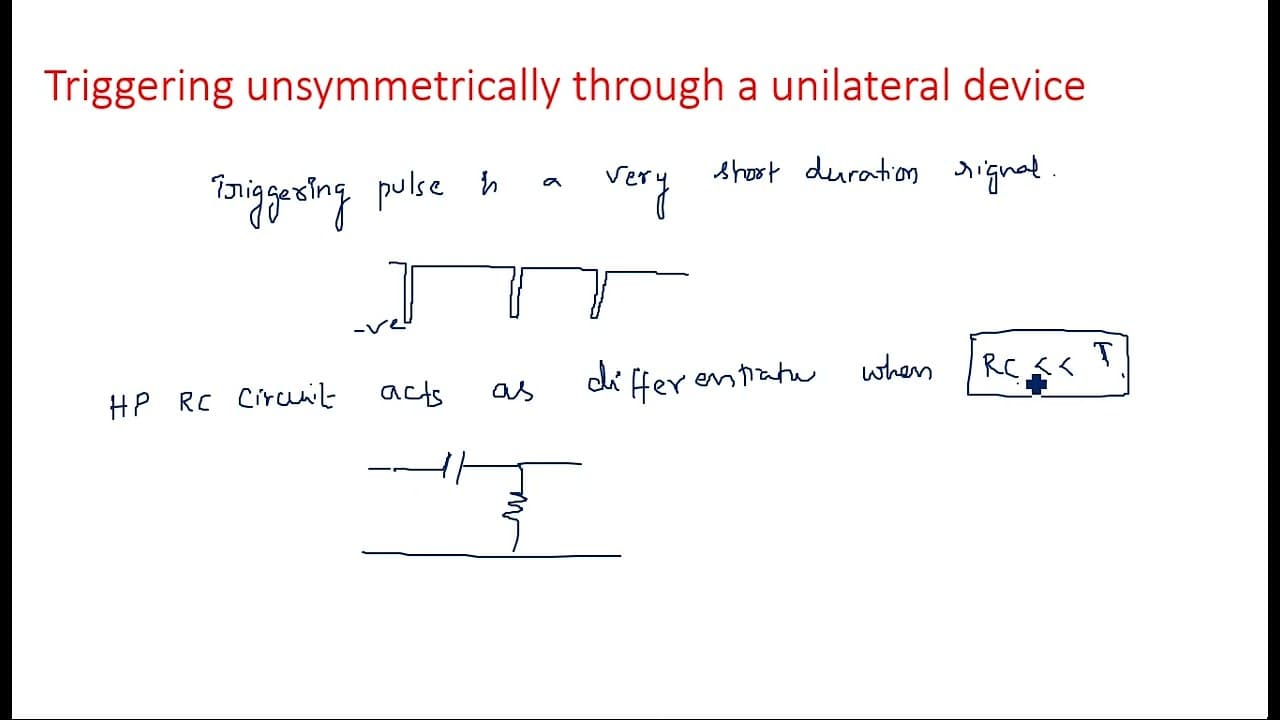
A high pass RC circuit acts as a differentiator when its time constant (RC) is significantly less than the input signal’s time period. The small capacitance and resistance allow for rapid charging and discharging, resulting in a quick response that produces the necessary short-duration triggering pulses from incoming square or rectangular waveforms.
Q: Why is the positive spike in the triggering pulse considered unnecessary?
The positive spike does not influence the operation of a transistor that is already in saturation, hence it is unnecessary for triggering purposes. To ensure only the negative spike is used for changing the transistor's state, the positive portion must be filtered out, which can effectively be achieved with a diode.
Q: What role do set and reset configurations play in flip-flops?
Set and reset pins directly control the output state of flip-flops, overriding the input conditions. Activating the set pin outputs a logic high (1), while activating the reset pin outputs a logic low (0). These operations enable the flip-flop to maintain specific states regardless of other input signals, facilitating reliable digital circuit behavior.
Summary & Key Takeaways
-
The video discusses unsymmetrical and symmetrical triggering techniques, emphasizing the difference in source usage for generating triggering pulses in circuits.
-
It explains how a high pass RC circuit functions as a differentiator to produce short-duration triggering pulses crucial for altering transistor states without continuous supply.
-
The video also covers the application of diodes to filter signals for essential negative spikes, demonstrating their role in the overall triggering process of bistable multivibrators.
Read in Other Languages (beta)
Share This Summary 📚
Summarize YouTube Videos and Get Video Transcripts with 1-Click
Try YouTube Summary with ChatGPT & Claude or YouTube Transcript Generator