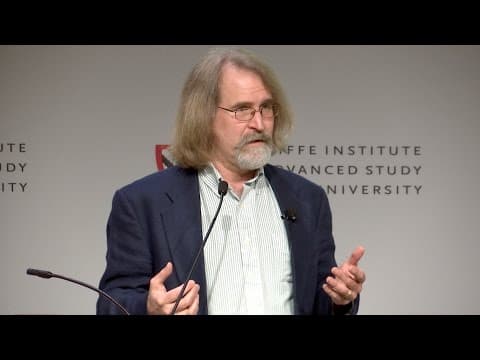
Linn Getz & Bruce McEwen | Precision, Personalized, and Social Medicine || Radcliffe Institute

TL;DR
The talk discusses the concept of allostatic load and its impact on individual health. It explores the relationship between adverse childhood experiences, genetics, environment, and disease. The talk also discusses the potential of personalized medicine and the need for a holistic approach to healthcare.
Transcript
-My name is Janet Rich-Edwards and I am one of co-directors of the science program here at the Radcliffe Institute for Advanced Studies. Thank you for coming out on a gray and drizzly day. I think you're going to get a treat. We have tonight coming from the Norwegian University of Science and Technology in Trondheim Dr. Linn Getz who is the profess... Read More
Key Insights
- 🥺 Allostatic load, a measure of chronic stress, can lead to poor health outcomes and the development of chronic diseases.
- 🧑⚕️ Adverse childhood experiences can have long-term effects on health and increase the risk of disease.
- 🪡 Personalized medicine has the potential to improve healthcare outcomes by tailoring treatment to individual needs and addressing underlying causes of disease.
- 🖐️ Social factors, such as income inequality and access to healthcare, play a significant role in health disparities and should be addressed in healthcare interventions.
Install to Summarize YouTube Videos and Get Transcripts
Explore YouTube Video Summarizer or Get YouTube Transcript Extractor
Questions & Answers
Q: What is allostatic load and how does it impact health?
Allostatic load refers to the wear and tear on the body and brain caused by chronic exposure to stress. It can lead to the development of various diseases and contribute to overall poorer health outcomes.
Q: How do adverse childhood experiences affect health later in life?
Adverse childhood experiences, such as abuse or neglect, have been shown to increase the risk of developing chronic diseases later in life. These experiences can impact the development of the brain and impair the body's ability to respond to stress, leading to long-term health consequences.
Q: What is personalized medicine and how does it relate to allostatic load?
Personalized medicine is an approach to healthcare that takes into account an individual's genetics, environment, and lifestyle to tailor treatment and prevention strategies. Allostatic load can be used as a measure to assess an individual's overall health and guide personalized interventions.
Q: How can healthcare professionals address the social factors that contribute to health disparities?
Healthcare professionals can play a role in addressing social factors by advocating for policies that promote equity and access to healthcare, providing resources and support to individuals facing social challenges, and promoting community-based interventions that address social determinants of health.
Summary & Key Takeaways
-
The talk explores the concept of allostatic load and its impact on health and disease.
-
It discusses the relationship between adverse childhood experiences and the development of chronic diseases.
-
The potential of personalized medicine is explored, including the use of biomarkers and big data to monitor health.
-
The importance of addressing social factors and inequalities in healthcare is emphasized.
Read in Other Languages (beta)
Share This Summary 📚
Summarize YouTube Videos and Get Video Transcripts with 1-Click
Try YouTube Summary with ChatGPT & Claude or YouTube Transcript Generator
Explore More Summaries from Harvard University 📚





Summarize YouTube Videos and Get Video Transcripts with 1-Click
Try YouTube Summary with ChatGPT & Claude or YouTube Transcript Generator