How Sound Travels and the X-59
TL;DR
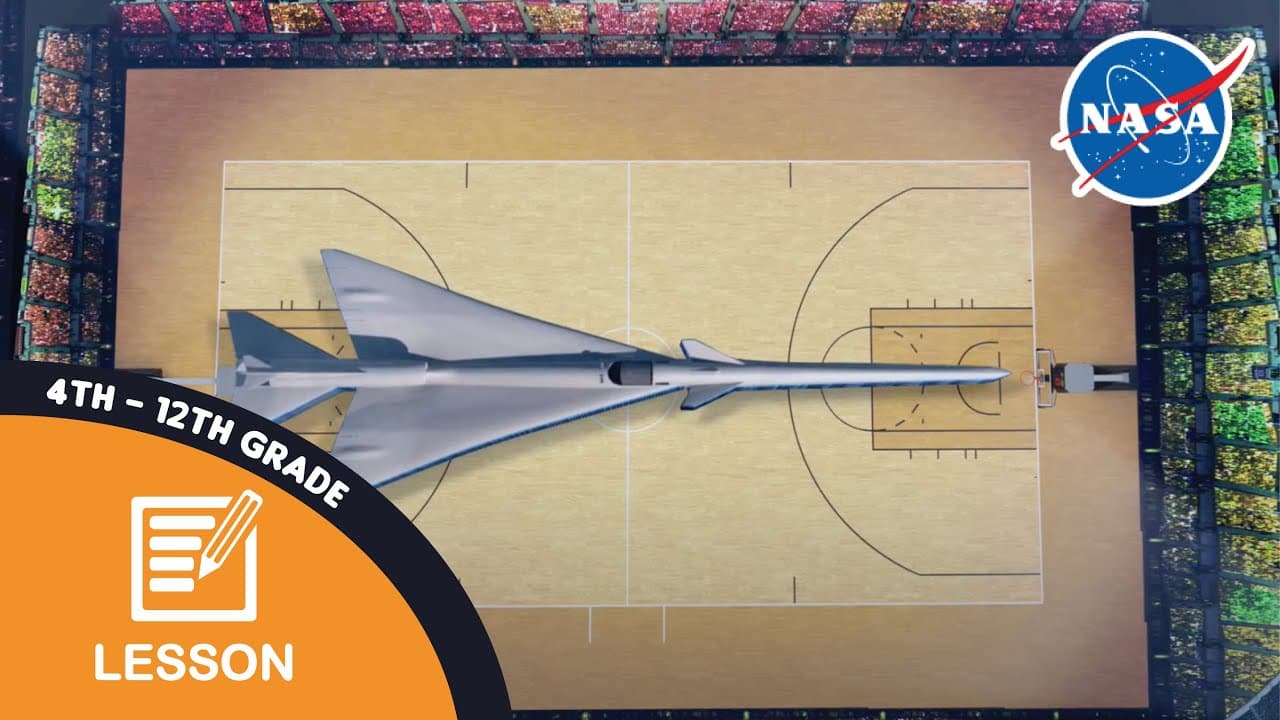
NASA's X-59 QueSST is an experimental airplane designed to revolutionize supersonic air travel by significantly reducing sonic booms.
Transcript
- NASA's newest experimental airplane, the X-59 QueSST, is designed with quiet supersonic technology, and is intended to help open a new era in faster-than-sound air travel over land. Now under construction by Lockheed Martin Aeronautics company, the X-59 is designed so that when flying supersonic, or faster than the speed of sound, people on the g... Read More
Key Insights
- 🇵🇳 The X-59 QueSST is being developed by NASA and Lockheed Martin Aeronautics to enable faster-than-sound air travel over land without disturbing noise pollution caused by sonic booms.
- 😘 The aircraft's unique design, including a long nose, highly swept wings, and carefully constructed fuselage, aims to minimize shock waves and produce a quieter sonic thump.
- ✈️ By conducting over-flight tests in select communities, NASA plans to gather valuable data on resident reactions to the X-59's noise, which will inform the establishment of noise-based regulations for commercial supersonic flights.
- 👂 Understanding how sound travels and its various characteristics is crucial for designing quieter supersonic aircraft.
- 🎚️ A typical supersonic aircraft can emit noise levels of 105 decibels or higher, comparable to a rock concert, while the X-59 aims for perceived noise levels around 75 decibels, similar to closing a car door.
- 🤢 The X-59 will operate at an altitude of approximately 55,000 feet above sea level, significantly higher than prominent landmarks like the Empire State Building and Mount Everest.
- 💢 The X-59's groundbreaking technology and reduced noise levels offer the potential for a new era of supersonic air travel, with improved comfort and minimized environmental impact.
Install to Summarize YouTube Videos and Get Transcripts
Explore YouTube Video Summarizer or Get YouTube Transcript Extractor
Questions & Answers
Q: How does the X-59 Quiets Sonic Booms?
The X-59's design focuses on minimizing the sonic boom by carefully shaping the aircraft's body, wings, and nose to produce shock waves that result in a low-intensity thump instead of a loud noise. It utilizes quiet supersonic technology to achieve this effect.
Q: How does sound travel, and what characteristics determine its properties?
Sound travels through vibrations that create sound waves which can move through solids, liquids, and gases. The wavelength, frequency, and amplitude of the wave determine properties such as pitch, loudness, and volume.
Q: How loud is a typical aircraft traveling at supersonic speeds?
A typical aircraft traveling at supersonic speeds can reach noise levels of around 105 decibels or higher, similar to the loudness of a rock concert. The X-59 aims to operate at perceived noise levels of around 75 decibels in supersonic flight, comparable to closing a car door.
Q: How high will the X-59 fly and how does it compare to prominent landmarks?
The X-59 will fly at approximately 55,000 feet above sea level, which is about 44 times higher than the Empire State Building and almost twice the height of Mount Everest. Flying at this altitude helps mitigate the effects of sonic booms on the ground.
Summary & Key Takeaways
-
The X-59 QueSST is an experimental airplane developed by Lockheed Martin Aeronautics for NASA, aiming to enable faster-than-sound air travel over land without causing disruptive sonic booms.
-
The aircraft's design incorporates quiet supersonic technology, including a long nose, swept wings, and careful fuselage construction, allowing the shock waves to produce a gentle thump rather than a loud noise.
-
Once fully tested and deemed safe, the X-59 will conduct supersonic flights over select communities to gather data on residents' reactions to the noise, which will help regulators establish new noise-based regulations for commercial supersonic flights over land.
Read in Other Languages (beta)
Share This Summary 📚
Summarize YouTube Videos and Get Video Transcripts with 1-Click
Try YouTube Summary with ChatGPT & Claude or YouTube Transcript Generator
Explore More Summaries from NASA STEM 📚




Summarize YouTube Videos and Get Video Transcripts with 1-Click
Try YouTube Summary with ChatGPT & Claude or YouTube Transcript Generator