What Is Shear Flow and How Is It Calculated?
TL;DR
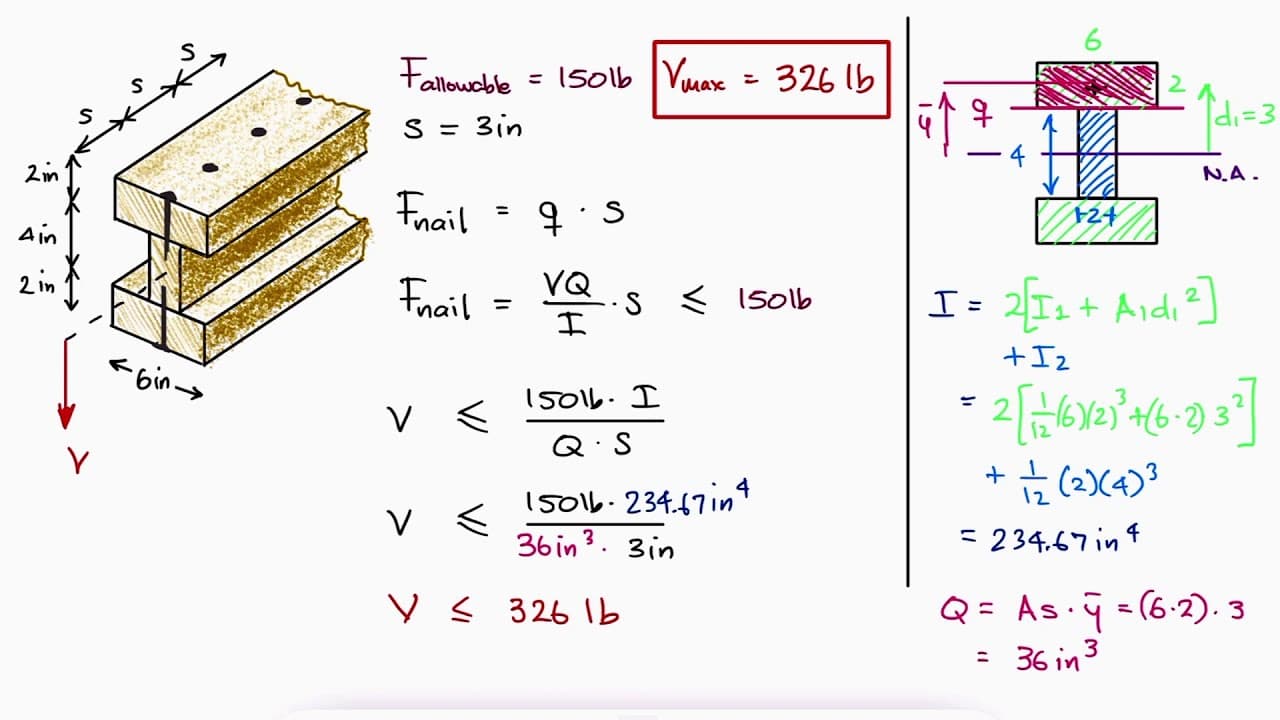
Shear flow is defined as the horizontal shear force per unit length along a beam, crucial for calculating stresses in thin-walled members like I-beams. It allows engineers to determine the force each connection, such as nails or bolts, must withstand. Use the formula q = VQ/I to compute shear flow, enabling accurate assessments of shearing force distribution.
Transcript
as part of the derivation of the transfer shear equation we developed in the previous main video linked below we came up with an expression for the shearing force delta h that is created at a specific planar location of a beam subjected to bending finding the shearing stress is helpful when we need to compare it to the maximum allowable shearing st... Read More
Key Insights
- 🚀 The shearing force delta h is the force created at a specific planar location of a beam subjected to bending.
- 💡 Calculating the shearing stress is helpful for comparing it to the maximum allowable shearing stress of the material or the glue holding the components of the beam together.
- ⚖️ The shearing force is effectively resisted by the nails or bolts holding the beam's geometries above and below the plane together.
- 🔍 By performing cuts and analyzing external forces, we can determine the shearing force distribution along the beam.
- ♻️ Shear flow, represented as lowercase q, is the horizontal shear force per unit length. It allows for more efficient calculations of forces between nails or bolts.
- 🔩 The shear flow concept is useful for calculating the forces each nail or bolt is subjected to and comparing it to maximum allowable values.
- 📏 Shear flow is also helpful for calculating stresses in thin-walled members, such as i-beams or box beams, by dividing delta h by the area it affects.
- 🔀 The shear flow vectors increase from zero to maximum through the thin walls of the beam, with the maximum shearing stress occurring at the neutral axis.
Install to Summarize YouTube Videos and Get Transcripts
Explore YouTube Video Summarizer or Get YouTube Transcript Extractor
Questions & Answers
Q: How can shear force be calculated in a beam?
Shear force in a beam can be calculated by multiplying the shear flow value with the distance that the force has been accumulated, such as the distance between nails or bolts.
Q: What is the significance of shear flow in calculating stresses in thin-walled members?
Shear flow can be used to determine the shearing stress in thin-walled members, such as I-beams or box beams, by dividing it by the area that the shearing force is affecting.
Q: How can shear flow be used to compare to the maximum allowable shearing force?
Shear flow can be multiplied by the distance between nails or bolts to find the force that each nail or bolt is subjected to, and then compared to the maximum allowable shearing force to ensure it does not exceed the limit.
Q: Why is it important to consider the neutral axis when calculating shear flow?
The neutral axis is the location in a beam where the shearing stress is maximum, and it is important to consider it when calculating shear flow to accurately determine the maximum shearing stress in the beam.
Summary & Key Takeaways
-
Shear force is the force that resists the shearing stress at a specific plane in a beam, and it is resisted by nails, bolts, or other forms of connection holding the beam together.
-
Shear flow is the horizontal shear force per unit length along the x-axis, and it can be used to calculate the force each nail or bolt is subjected to in a beam.
-
Shear flow is also helpful in calculating stresses in thin-walled members, such as I-beams or box beams.
Read in Other Languages (beta)
Share This Summary 📚
Summarize YouTube Videos and Get Video Transcripts with 1-Click
Try YouTube Summary with ChatGPT & Claude or YouTube Transcript Generator
Explore More Summaries from Less Boring Lectures 📚


Summarize YouTube Videos and Get Video Transcripts with 1-Click
Try YouTube Summary with ChatGPT & Claude or YouTube Transcript Generator