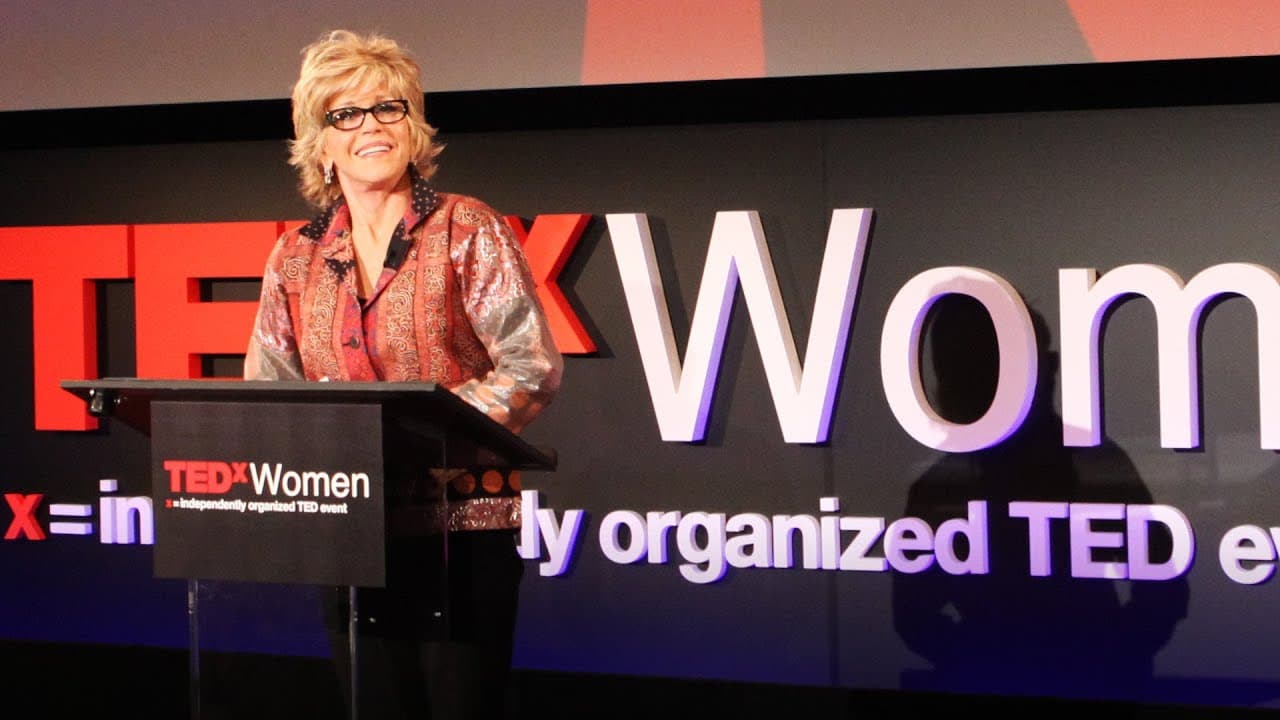
Jane Fonda: Life's third act
TL;DR
The longevity revolution and the significance of the last three decades of life are explored, urging a shift in the cultural paradigm of aging and emphasizing the potential for growth and fulfillment in the third act.
Transcript
There have been many revolutions over the last century, but perhaps none as significant as the longevity revolution. We are living on average today 34 years longer than our great-grandparents did -- think about that. That's an entire second adult lifetime that's been added to our lifespan. And yet, for the most part, our culture has not come to ter... Read More
Key Insights
- 🧬 The longevity revolution has added 34 years to our lifespan, creating a new stage of life called the third act, which is as different from midlife as adolescence is from childhood.
- 😊 Most people over 50 feel better and happier, less stressed, hostile, and anxious, challenging the old paradigm of age as decline.
- 🤔 The appropriate metaphor for aging is a staircase, representing the upward ascension of the human spirit into wisdom, wholeness, and authenticity.
- 🧠 Despite physical challenges like ALS, the human spirit can continue to evolve and grow, as seen in the case of Neil Selinger, who found his voice as his body deteriorated.
- 💔 The third act can be an opportunity to finish ourselves, to heal from past wounds and free ourselves from our past, creating new neural pathways in the brain.
- 🔁 Reflecting on past experiences and changing our relationship with them can lead to wisdom and authenticity, resetting the thermostat of our neural pathways.
- 🦳 Older women have the opportunity to reclaim their agency and become the subjects of their own lives once again, setting an example for younger generations to reconceive their own lifespan.
- 🌍 If older women can redefine themselves and become whole, it can create a cultural shift and inspire younger generations to embrace aging with positivity and purpose.
Install to Summarize YouTube Videos and Get Transcripts
Explore YouTube Video Summarizer or Get YouTube Transcript Extractor
Questions & Answers
Q: What is the significance of the longevity revolution?
The longevity revolution is significant because it has added an entire second adult lifetime to our lifespan. We now live on average 34 years longer than our great-grandparents did. It challenges the old paradigm of age as an arch and highlights the need to understand and embrace the last three decades of life as a developmental stage with its own significance.
Q: What is the appropriate new metaphor for aging?
The speaker suggests that a more appropriate metaphor for aging is a staircase. Aging should be seen as the upward ascension of the human spirit, bringing us into wisdom, wholeness, and authenticity. It emphasizes age as potential rather than a pathology, and this potential is not limited to a lucky few but can be experienced by most people over 50.
Q: How do most people over 50 feel compared to younger individuals?
Studies show that most people over 50 feel better, are less stressed, less hostile, and less anxious compared to their younger counterparts. They tend to see commonalities more than differences and, surprisingly, are even reported to be happier. This goes against the speaker's expectations and challenges the common perception of aging as a time of decline.
Q: How can we make the added years of life successful?
The speaker suggests that two-thirds of how well we do in the third act of life can be influenced by our actions. While genetics play a role in one-third of our well-being in the third act, we still have control over the majority of it. By reflecting on our past, changing our relationship to it, and re-visioning ourselves, we can create new neural pathways in our brain and experience a more positive and fulfilling third act.
Q: What might be the central purpose of the third act of life?
The central purpose of the third act is to go back and change our relationship to the past, if appropriate. By doing a life review and redefining our relationship to past events and people, we can alter neural pathways in our brain. This allows us to reset the norm and develop a more positive outlook, leading to wisdom, authenticity, and wholeness. In doing so, we not only benefit ourselves but also inspire younger generations to reconceive their own lifespan.
Summary & Key Takeaways
-
The longevity revolution, or the increase in average lifespan, is a significant development that our culture has not fully understood or adapted to.
-
The last three decades of life, known as the third act, is a stage of development that deserves attention and exploration.
-
Aging should be viewed as a staircase, representing the potential for growth, wisdom, and authenticity, rather than a decline or pathology.
Read in Other Languages (beta)
Share This Summary 📚
Summarize YouTube Videos and Get Video Transcripts with 1-Click
Try YouTube Summary with ChatGPT & Claude or YouTube Transcript Generator
Explore More Summaries from TED 📚

Summarize YouTube Videos and Get Video Transcripts with 1-Click
Try YouTube Summary with ChatGPT & Claude or YouTube Transcript Generator