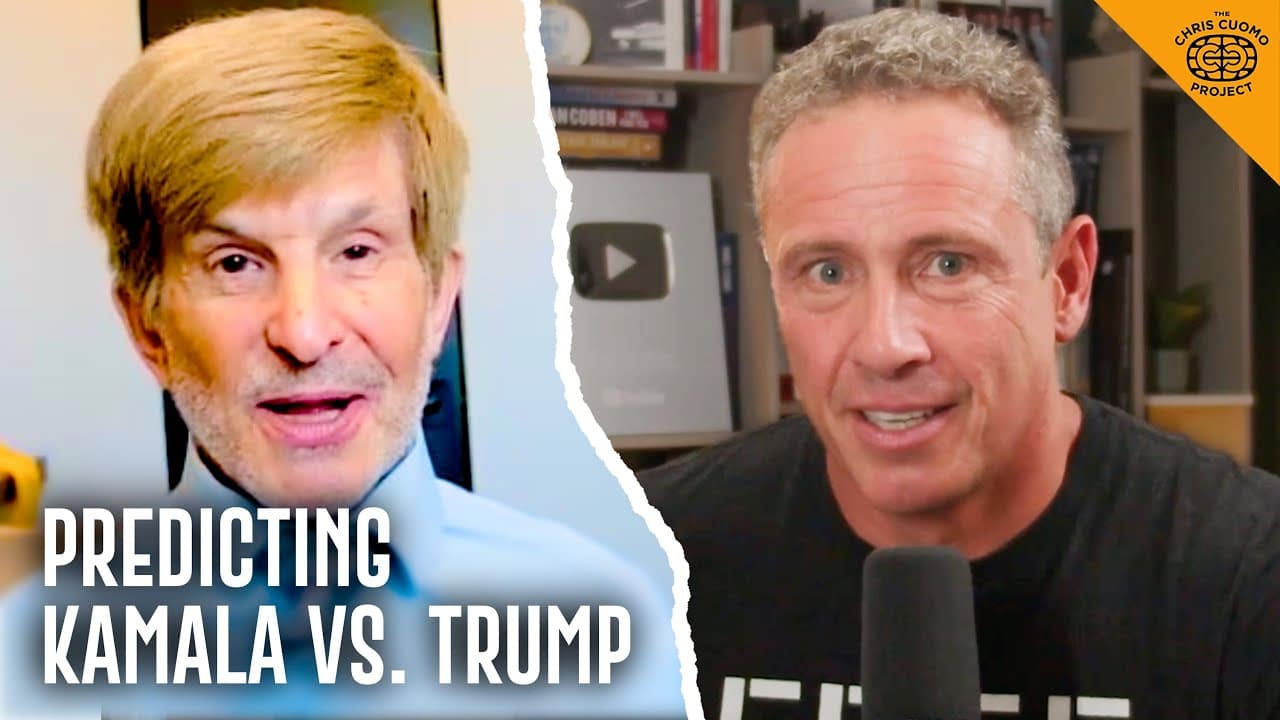
Who Will Win In 2024? Allan Lichtman’s 13 Keys For Predicting The Next President
TL;DR
Allan Lickman's 13 Keys predict U.S. presidential elections based on political stability factors.
Transcript
you want to know who's going to win the Trump Harris election well if I only knew I'd go to Vegas I know somebody who knows I'm Chris Cuomo welcome to the Chris Cuomo project Professor Allan lickman he is the developer of the famous 13 Keys 10 for 10 in the last 10 presidential Cycles he picked them all he picked Trump more importantly more impress... Read More
Key Insights
- ❓ The 13 Keys offer a systematic framework for predicting presidential elections, focusing on political stability while incorporating historical patterns.
- 🥺 Allan Lickman's collaboration with an earthquake prediction expert led to the novel application of scientific methods in political forecasting.
- 🤩 Since 1860, the keys have maintained a high accuracy rate, demonstrating their robustness as analytical tools amid political turmoil.
- 🤩 Key factors such as economic performance, political scandals, and foreign policy success are pivotal in influencing the electoral outcome as assessed by the keys.
- ❓ External perceptions and charisma are crucial, but Lickman's model asserts that fundamentals largely dictate election results regardless of individual candidate traits.
- 📈 The rejection of conventional polling as a primary predictor highlights the advantages of historical trend analysis in understanding voter behavior and intentions.
- 🛄 The 13 Keys do not adapt to favor individual candidates, reinforcing Lickman's claim of objectivity in political forecasting.
Install to Summarize YouTube Videos and Get Transcripts
Explore YouTube Video Summarizer or Get YouTube Transcript Extractor
Questions & Answers
Q: What prompted Allan Lickman to develop the 13 Keys?
Lickman created the 13 Keys in 1981 through a collaboration with earthquake prediction expert Valeriy Kyusborak. They reconceptualized presidential elections in geophysical terms, which led to formulating a set of keys based on historical patterns related to political stability.
Q: How accurate are the 13 Keys in predicting presidential elections?
Historically, the 13 Keys have been nearly 100% accurate in predicting outcomes from 1860 to 1980. Lickman claims only minimal errors, asserting that the keys effectively differentiate between stability and upheaval in political landscapes.
Q: What are some key factors the 13 Keys assess?
The keys evaluate various aspects such as political mandate, incumbent performance, party unity, social unrest, and significant economic changes. Each key plays a crucial role in determining the election outcome based on whether it's answered positively or negatively.
Q: Why does Lickman wait until after the conventions to make predictions?
Lickman holds off on predictions until after the conventions to observe the stability of key factors, like party unity and voter sentiment, which may settle more definitively post-convention. This cautious approach helps create a more accurate prediction environment.
Q: How do third-party candidates affect the political keys?
According to Lickman, a serious third-party candidate negatively impacts the chances of the White House party, as it reflects electoral dissatisfaction. He uses a 10% polling threshold to gauge the potential influence of these candidates for stability assessments.
Q: What makes Lickman's approach to prediction different from polling?
Lickman believes that conventional polling can be misleading due to its snapshot nature and the subjective interpretations behind voter responses. His 13 Keys framework provides a structured method that accounts for historical patterns and essential political factors.
Q: How does the 13 Keys model hold up against changing political demographics?
Lickman maintains that the keys transcend individual candidate characteristics, including race or gender, focusing instead on broader political dynamics that shape elections. This allows the 13 Keys to remain relevant despite the evolving nature of the electorate.
Q: What are Lickman's thoughts on the current political landscape?
Lickman suggests that the upcoming election landscape is complex, with factors like social unrest and economic conditions potentially shifting voter sentiments. He emphasizes that a lot would have to go wrong for Harris and the Democrats to lose, indicating a cautious confidence.
Summary & Key Takeaways
-
Allan Lickman developed the 13 Keys to predict presidential elections, using a model based on political stability that dates back to 1860. The keys offer a true-false format assessing various political factors.
-
Lickman's prediction model emphasizes the importance of the incumbent party's strength, mandating at least six false keys for a predicted loss, which has proven accurate for several election cycles.
-
The conversation explores how external factors, including candidate appeal and historical contexts, interplay with the 13 Keys, and Lickman discusses upcoming election predictions with a focus on current candidates.
Read in Other Languages (beta)
Share This Summary 📚
Summarize YouTube Videos and Get Video Transcripts with 1-Click
Try YouTube Summary with ChatGPT & Claude or YouTube Transcript Generator