L04.8 Each Person Gets An Ace
TL;DR
The video explains how to calculate the probability of each person receiving exactly one ace in a game where a standard 52-card deck is dealt to four players.
Transcript
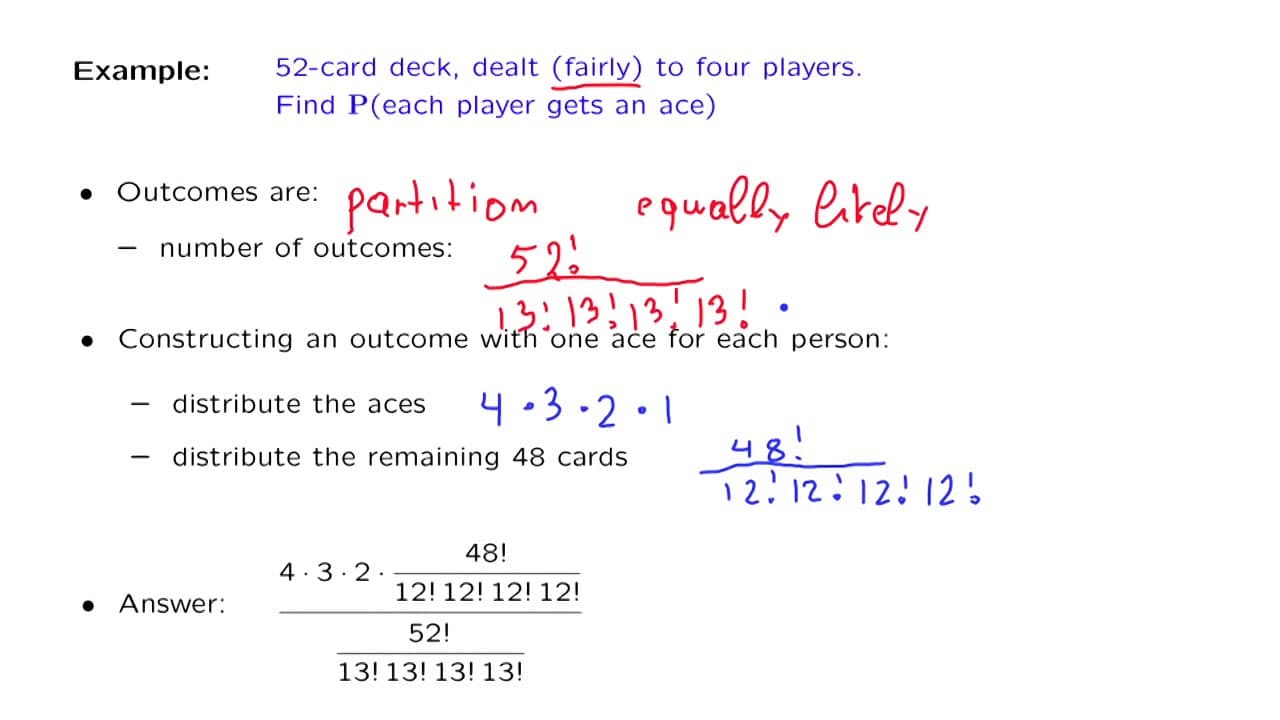
We will now apply our multinomial formula for counting the number of partitions to solve the following probability problem. We have a standard 52-card deck, which we deal to four persons. Each person gets 13 cards as, for example, in bridge. What is the probability that each person gets exactly one ace? Well, before we start, as always we will need... Read More
Key Insights
- 💨 The multinomial formula can be used to count the number of ways to partition items into subsets with different sizes.
- 🤝 Fairly dealing the cards implies that all possible partitions are equally likely.
- 💨 Different methods can be used to calculate the same probability, with some methods being faster than others.
Install to Summarize YouTube Videos and Get Transcripts
Explore YouTube Video Summarizer or Get YouTube Transcript Extractor
Questions & Answers
Q: What is the probability of each person receiving exactly one ace in a game with a standard 52-card deck dealt to four players?
The probability can be calculated by counting the number of ways to distribute the aces and the remaining cards. It turns out to be approximately 0.105 or 10.5%.
Q: What is the multinomial formula used for in probability?
The multinomial formula is used to count the number of ways to partition a set of items into subsets with a given number of items in each subset.
Q: How does the specific card dealing strategy affect the probability?
The specific card dealing strategy in which the aces are placed on top and randomly dealt to the players does not affect the probability. All partitions and outcomes are still equally likely.
Q: Can the probability be calculated using a different method than counting?
Yes, the video demonstrates a faster method by considering the specific card dealing strategy. The probability can be calculated by multiplying the probabilities of each ace being placed in a slot associated with a different player.
Summary & Key Takeaways
-
The video teaches how to use the multinomial formula for counting to solve a probability problem in card games.
-
The probability model assumes that all partitions (outcomes) of the cards being dealt to each player are equally likely.
-
The video demonstrates two different methods of calculating the probability, one involving counting and the other using a specific card dealing strategy.
Read in Other Languages (beta)
Share This Summary 📚
Summarize YouTube Videos and Get Video Transcripts with 1-Click
Try YouTube Summary with ChatGPT & Claude or YouTube Transcript Generator
Explore More Summaries from MIT OpenCourseWare 📚



Summarize YouTube Videos and Get Video Transcripts with 1-Click
Try YouTube Summary with ChatGPT & Claude or YouTube Transcript Generator