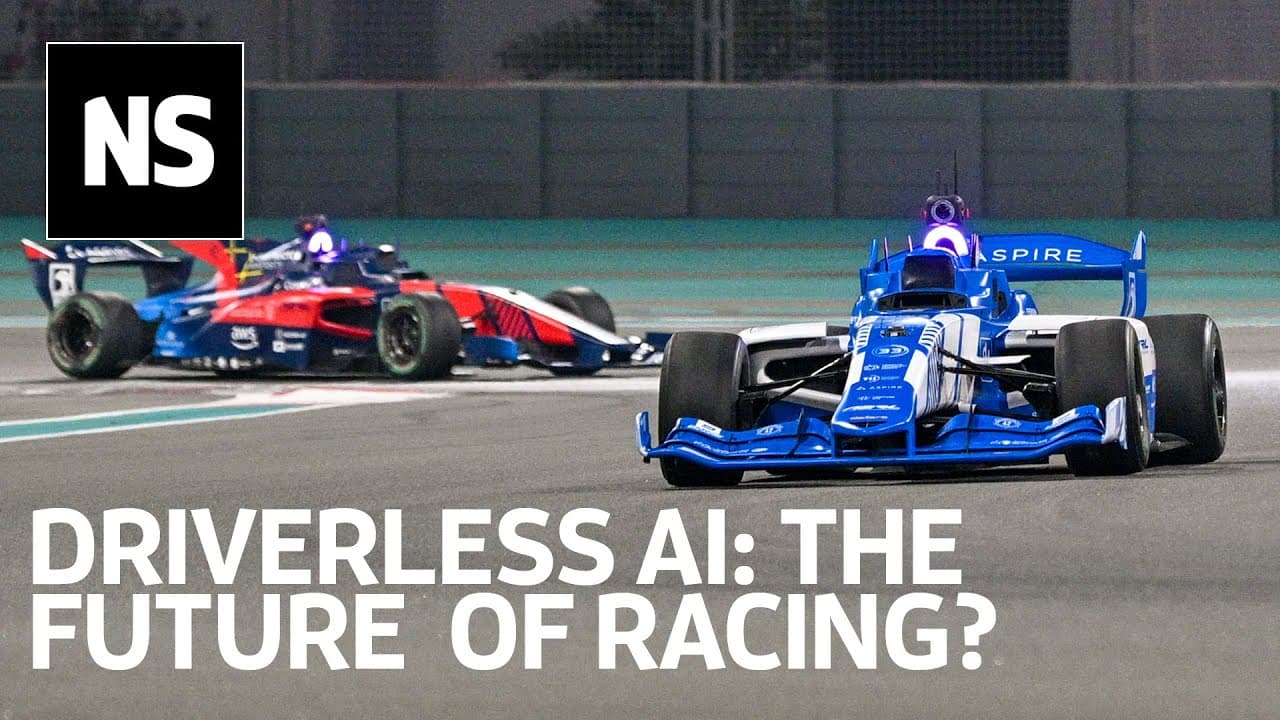
AI-driven race cars test limits of autonomous driverless technology
TL;DR
Cutting-edge AI technology enables fully autonomous racing cars to compete, pushing the boundaries of technology and safety.
Transcript
the Grand Challenge in AI right now is autonomous racing more than two autonomous race cars going head-to-head at full speed has never been done before green light on at the end the first J we've taken the fastest car that you can have taken out the position of the driver and developed a physical autonomy stack that allows the car to have perceptio... Read More
Key Insights
- 🏎️ Autonomous racing technology combines sensors, GPS, cameras, and AI algorithms to enable fully autonomous racing cars.
- 🫷 The development of autonomous racing technology aims to push the boundaries of AI research and improve road safety through technology transfer.
- 🏎️ Race engineers analyze data to enhance the performance of autonomous racing cars and refine algorithms for better decision-making.
- 🏇 Autonomous racing technology serves as a platform for testing cutting-edge AI algorithms and perception systems in a challenging environment.
- 🏇 By leveraging AI advancements in autonomous racing, developers aim to make significant strides in technology applications beyond motorsports.
- 🏇 Autonomous racing technology highlights the potential for AI to outperform human drivers and revolutionize various industries with autonomous solutions.
- 👻 The modular design of autonomous racing technology allows for its application to a wide range of challenges, pushing forward the field of autonomy research.
Install to Summarize YouTube Videos and Get Transcripts
Explore YouTube Video Summarizer or Get YouTube Transcript Extractor
Questions & Answers
Q: How do autonomous racing cars perceive their environment?
Autonomous racing cars use a combination of sensors, GPS, cameras, and AI algorithms to perceive their surroundings. This data enables the car to detect opponents, obstacles, and track boundaries, crucial for making split-second decisions while racing.
Q: What is the significance of autonomous racing technology in pushing the limits of AI research?
Autonomous racing technology serves as a testing ground for advanced AI algorithms and perception systems. By competing in challenging races, developers can push the boundaries of AI capabilities and refine autonomous driving technology for various industries.
Q: How does the analysis of data from autonomous racing cars contribute to their performance improvements?
Race engineers analyze gigabytes of data collected from autonomous racing cars to tweak parameters, refine algorithms, and enhance performance. This data-driven approach ensures that the cars continuously improve and adapt to race conditions.
Q: What is the ultimate goal of autonomous racing technology in terms of road safety?
The ultimate goal of autonomous racing technology is to apply the advancements in AI and robotics to improve road safety. By developing co-piloting capabilities for road cars, the technology aims to prevent accidents and reduce fatalities, leveraging the potential of autonomous technology for broader societal benefits.
Summary & Key Takeaways
-
Cutting-edge AI technology allows fully autonomous racing cars to compete at high speeds.
-
Sensors, GPS, cameras, and AI algorithms enable the car to perceive its environment and make decisions.
-
Autonomous racing technology aims to push the limits of AI research and improve road safety.
Read in Other Languages (beta)
Share This Summary 📚
Summarize YouTube Videos and Get Video Transcripts with 1-Click
Try YouTube Summary with ChatGPT & Claude or YouTube Transcript Generator
Explore More Summaries from New Scientist 📚


Summarize YouTube Videos and Get Video Transcripts with 1-Click
Try YouTube Summary with ChatGPT & Claude or YouTube Transcript Generator