Hazards | Static & Dynamic | STLD | Lec-101
TL;DR
Hazards are unwanted transients in digital circuits caused by varying propagation delays.
Transcript
hi everyone in this video I'm going to explain about hazards hazards are nothing but unwanted switching transients that occur in the output okay so Hazard it is nothing but it is nothing but an unwanted an unwanted switching transient switching transient that may appear that may appear at the output of your circuit because because see what do you m... Read More
Key Insights
- 🥺 Hazards result from multiple input paths having different propagation delays, leading to unwanted transient outputs in digital circuits.
- 0️⃣ Static hazards can be classified as static one (output expected to be one) or static zero (output expected to be zero), both experiencing spurious outputs for short durations.
- 🎚️ Dynamic hazards are characterized by multiple unwanted transitions between output states, mainly occurring in multi-level circuits.
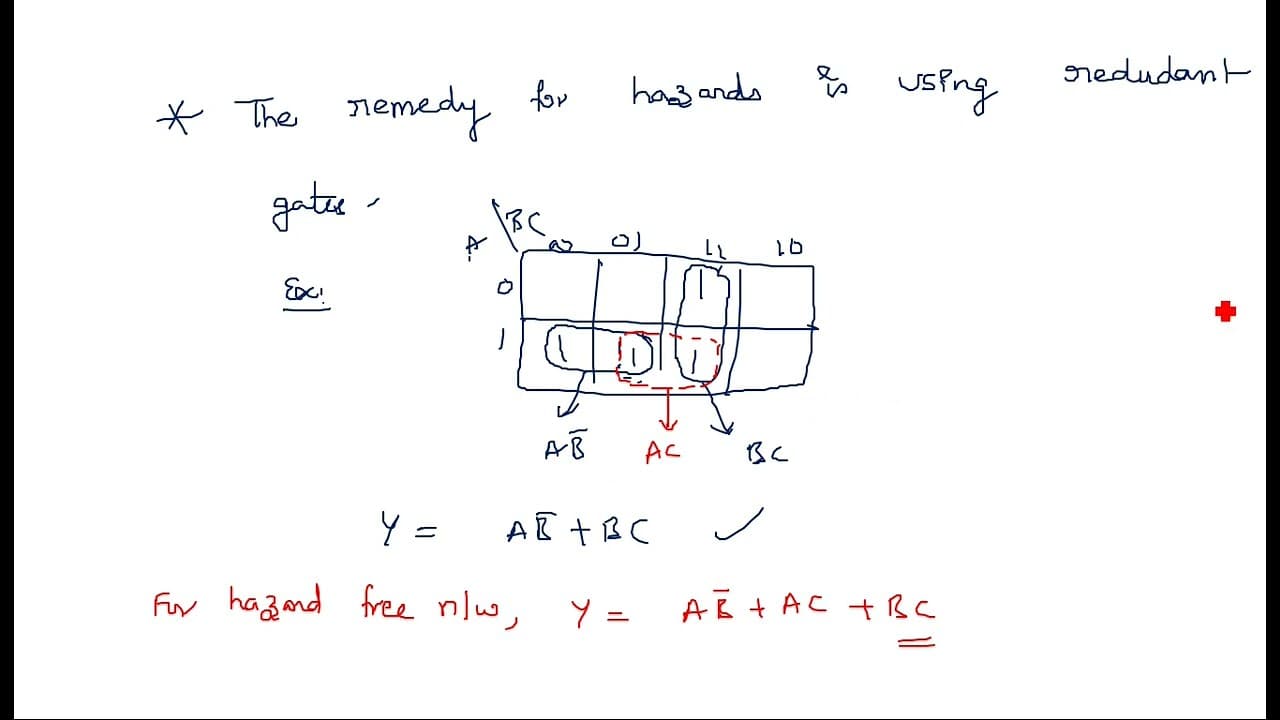
- 🔬 Remedies for static and dynamic hazards include using redundant gates to stabilize outputs and mitigate the transient behavior.
- 🎨 Redundant gates can create additional paths in circuit designs, thereby ensuring that even if one path is delayed, another may provide the correct output.
- 🍉 Unwanted transients, also termed glitches, can severely affect the reliability of digital circuits, making hazard management crucial in design.
- 🎨 Accurate circuit design must consider delay variations to prevent hazards from affecting circuit performance and reliability.
Install to Summarize YouTube Videos and Get Transcripts
Explore YouTube Video Summarizer or Get YouTube Transcript Extractor
Questions & Answers
Q: What are hazards in digital circuits?
Hazards are unwanted switching transients that occur at the output of a circuit, resulting from different propagation delays through various paths. These delays can cause outputs to deviate unpredictably from expected values, leading to inconsistencies in the circuit's function.
Q: What distinguishes static hazards from dynamic hazards?
Static hazards occur when the output remains consistently at one state but temporarily switches to another state due to transients, while dynamic hazards involve outputs changing between states, often multiple times, as inputs transition. Static hazards can further classify into static one and static zero, depending on their expected state.
Q: How do delays in signal propagation contribute to hazards?
Delays in signal propagation across different paths can lead to outputs reaching inputs at different times. If an input is ready but another output arrives late, it can cause the circuit to temporarily function incorrectly, resulting in hazards where the output may not represent the intended logical result.
Q: Can hazards appear in both combinational and sequential circuits?
Yes, hazards can occur in both combinational and sequential circuits. Combinational circuits (like adders and multiplexers) and sequential circuits (like flip-flops and counters) both exhibit paths with varying propagation delays, making them susceptible to unwanted transients and glitches.
Summary & Key Takeaways
-
Hazards in digital circuits refer to unwanted switching transients arising due to different propagation delays across various paths, disrupting expected output.
-
There are two primary types of hazards: static hazards, which maintain a constant state, and dynamic hazards, which exhibit changing states in outputs.
-
Remedies for hazards typically involve the use of redundant gates, which can ensure stable outputs even amid varying conditions in circuit paths.
Read in Other Languages (beta)
Share This Summary 📚
Summarize YouTube Videos and Get Video Transcripts with 1-Click
Try YouTube Summary with ChatGPT & Claude or YouTube Transcript Generator