The Science of Hyperloop
TL;DR
Elon Musk unveils his proposal for the Hyperloop, a magnet-driven transportation system that could transport people from Los Angeles to San Francisco in just 30 minutes.
Transcript
hello and welcome to scishow news I'm Michael Aranda infra Hank green who's currently faffing about in England ambitious billionaire and big dreamer Elon Musk has hatched a new model of Transportation that could soon transport us futuristically on Monday muskan veiled his plans for the Hyperloop a proposal to use the principles of fluid dynamics th... Read More
Key Insights
- 🚄 Elon Musk's Hyperloop proposal aims to revolutionize transportation with high speeds and efficiency.
- 🤩 Overcoming the Kantrowitz limit and reducing friction are key challenges addressed in Musk's design.
- ✊ Solar power is the chosen energy source for the Hyperloop.
- 😘 The estimated cost of the Hyperloop is relatively low compared to other transportation projects.
- 🧑🔬 The potential support from scientists and planners indicates the feasibility and desirability of the Hyperloop.
- ❓ The simplicity of Musk's proposal hides the complexity of the underlying physics.
- 🚄 The Hyperloop could provide a faster and more efficient alternative to the traditional high-speed rail.
Install to Summarize YouTube Videos and Get Transcripts
Explore YouTube Video Summarizer or Get YouTube Transcript Extractor
Questions & Answers
Q: How does the Hyperloop break through the Kantrowitz limit?
Musk plans to use compression fans mounted on the front of the passenger pod to push the air out of the way, overcoming the Kantrowitz limit.
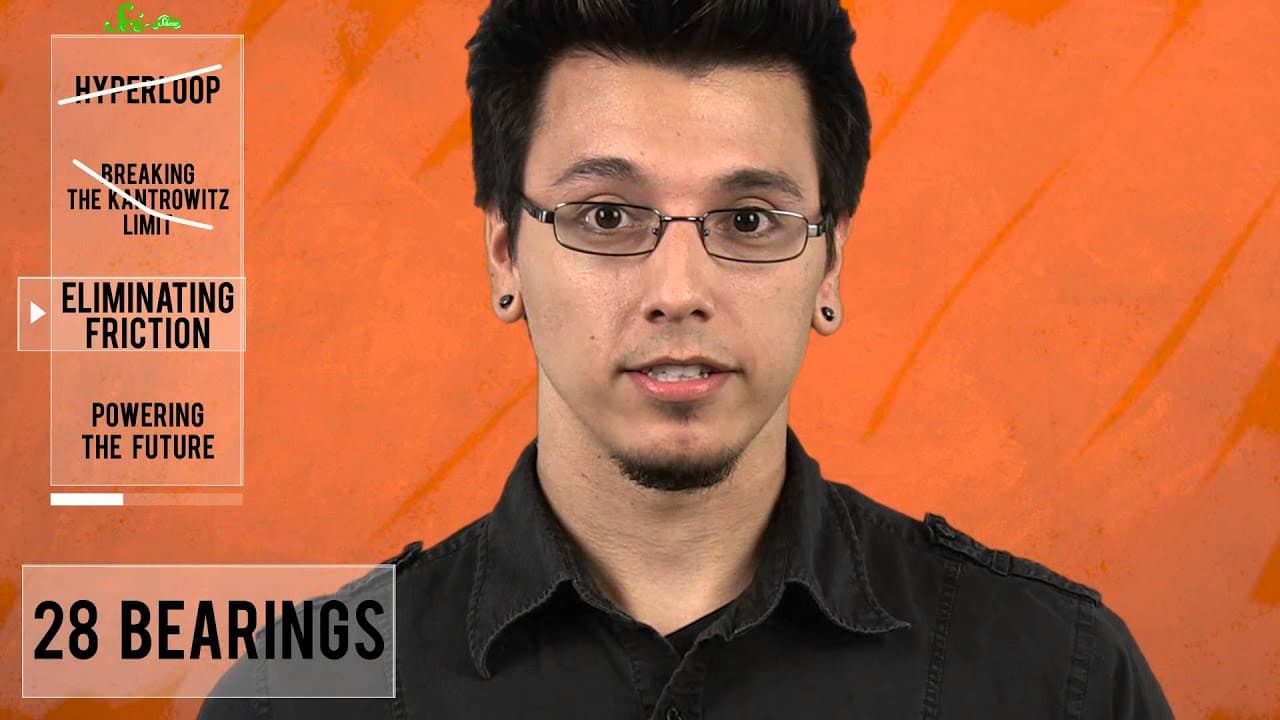
Q: How does the Hyperloop eliminate friction?
Friction is reduced by utilizing air bearings, which create pressurized cushions of air for the pod to ride on. Each passenger pod is equipped with 28 of these bearings.
Q: What powers the Hyperloop?
The Hyperloop is powered by solar panels mounted on the top of the tube, generating 120 watts per square meter. It is estimated to generate more energy than the system would use.
Q: How can the state of California be persuaded to support the Hyperloop?
Although facing challenges, the Hyperloop's estimated cost of $6 billion is significantly less than the state's high-speed rail project. Many scientists and planners have expressed support for the Hyperloop.
Summary & Key Takeaways
-
Elon Musk has revealed plans for the Hyperloop, a transportation system that utilizes fluid dynamics, thermodynamics, and electromagnetism.
-
The Hyperloop aims to transport people from Los Angeles to San Francisco in 30 minutes, covering a distance of 560 kilometers.
-
Musk's design includes compression fans to overcome speed limits, air bearings to reduce friction, and solar panels for powering the system.
Read in Other Languages (beta)
Share This Summary 📚
Summarize YouTube Videos and Get Video Transcripts with 1-Click
Try YouTube Summary with ChatGPT & Claude or YouTube Transcript Generator
Explore More Summaries from SciShow 📚


Summarize YouTube Videos and Get Video Transcripts with 1-Click
Try YouTube Summary with ChatGPT & Claude or YouTube Transcript Generator