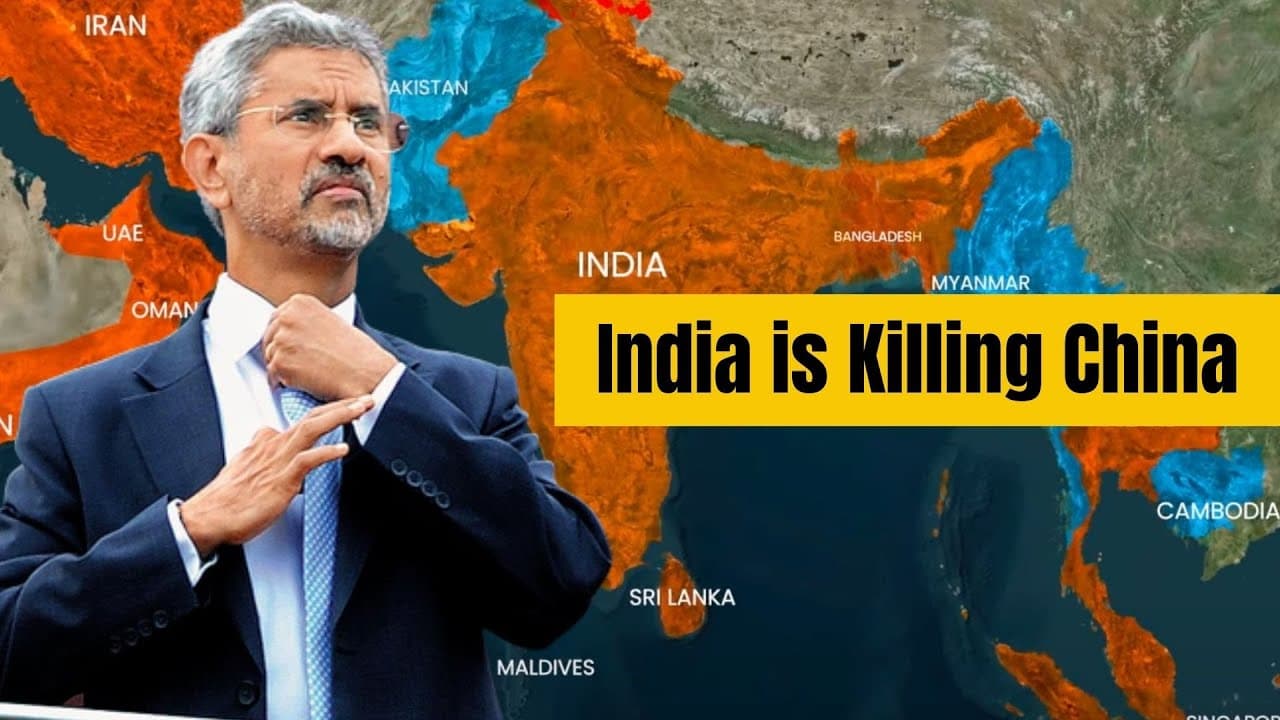
India - China series: Episode 1: - How India is TRAPPING China with its Military STRATEGY?
TL;DR
India is strategically countering China's Belt and Road Initiative by establishing key military bases and alliances in the Indian Ocean region.
Transcript
troubles began as early as 2013 when china expanded its belt and road initiative massive construction projects in pakistan sri lanka bangladesh and the maldives caused unease in delhi if you ask me is our relationship normal today my answer to you is no it is not china is clearly becoming a much stronger military power india has also stepped up its... Read More
Key Insights
- 🌏 China's Belt and Road Initiative has caused unease in India, as it strategically surrounds the country and establishes dominance over key trade routes. India has responded by stepping up its participation in the Quad, a group consisting of the US, Australia, and Japan.
- 🌊 The Indian Ocean region plays a crucial role in geopolitics, connecting major economies in the North Atlantic to the Asia-Pacific region. The region is home to 28 countries and covers 17.5% of the global land area, with over 35% of the world's population residing there.
- 🛣️ China's control over three choke points in the Indian Ocean (Strait of Hormuz, Strait of Malacca, and Strait of Bab el-Mandeb) allows it to dominate maritime trade. India, in response, has strategically established bases and partnerships in Oman, Seychelles, Singapore, Indonesia, Vietnam, Japan, Mongolia, and Iran to counter China's influence.
- ⚓ Control over these choke points gives a country the power to block trade routes. China's dominance over these choke points threatens global trade, particularly as 80% of the world's maritime oil trade flows through them. India seeks to prevent China from choking off its trade routes.
- 🤝 China has become a major trading partner for the Indian Ocean region, accounting for 16.1% of its total goods trade in 2017. China's infrastructure projects, known as the String of Pearls, in strategic locations such as Pakistan, Sri Lanka, Myanmar, and Djibouti, facilitate its trade routes and access to resources.
- 💪 India has adopted a stealth strategy, known as the Necklace of Diamonds, to counter China's String of Pearls. India has established strategic bases and partnerships in Oman, Seychelles, Singapore, Indonesia, Vietnam, Japan, Mongolia, and Iran, strategically encircling China.
- 📚 Study materials to understand India's geopolitical moves include documents on the importance of the Indian Ocean, China's Belt and Road Initiative, and the Quad summit fact sheet. These materials provide insights into India's international relations strategy to counter China and other threats.
- 💼 Wind Wealth, a platform that allows investment in bonds of NBFCs, supports this content. It offers higher returns than fixed deposits and lower volatility than stocks. Investing in Wind Wealth can help achieve short-term financial goals.
Install to Summarize YouTube Videos and Get Transcripts
Explore YouTube Video Summarizer or Get YouTube Transcript Extractor
Questions & Answers
Q: What is India's strategy to tackle the security implications of China's Belt and Road Initiative?
India's strategy involves establishing key military bases and alliances in strategic locations in the Indian Ocean region, forming a "necklace of diamond" to counter China's influence and secure its own geopolitical interests. India has set up bases in Oman and Seychelles, signed agreements with Singapore and Indonesia, strengthened relations with Vietnam and Japan, and developed the Chabahar port in Iran, among other initiatives. By strategically positioning itself, India aims to protect its trade routes and ensure national security against China's expanding influence.
Q: How does the Indian Ocean region play a crucial role in geopolitics and global trade?
The Indian Ocean region is strategically important as it connects the international economies of North Atlantic and Asia-Pacific regions. It houses critical sea routes that connect the Middle East, Africa, and East Asia with Europe and America. Furthermore, 80% of the world's maritime oil trade flows through three narrow passages in the Indian Ocean - the Strait of Hormuz, the Strait of Malacca, and the Strait of Bab-el-Mandeb. Control over these choke points can significantly impact global trade. Given its substantial population and fast-growing economies, the region holds immense geopolitical significance and attracts the attention of major powers like China and India.
Q: How is India countering China's dominance over strategic choke points in the Indian Ocean?
India has adopted a "necklace of diamond" strategy, strategically placing military bases and establishing alliances in countries surrounding critical choke points in the Indian Ocean. For instance, India has set up bases in Oman to counter China's presence in Pakistan's Gwadar port and Djibouti. It has secured military access to strategic locations like the Sabang port in Indonesia and the Changi naval base in Singapore, providing a strong presence near the Strait of Malacca. India has also strengthened ties with Vietnam, Japan, Mongolia, and Iran, positioning itself strategically to counter China's dominance and protect its trade routes in the region.
Q: What risks and challenges does India face in implementing its geopolitical strategy in the Indian Ocean region?
While India's "necklace of diamond" strategy offers a proactive approach to counter China's influence, it faces challenges and potential risks. Securing military access and maintaining favorable relations with partner countries is crucial, but not always guaranteed due to internal political changes and public protests, as seen in the case of the Assumption Island agreement in the Seychelles. Additionally, India's strategy may face resistance from China, which could employ diplomatic and economic tactics to undermine India's efforts. Effective implementation of the strategy requires consistent diplomatic efforts, strong partnerships, and the ability to navigate geopolitical complexities in the region.
Summary & Key Takeaways
-
China's Belt and Road Initiative has raised security concerns for India, leading to the development of its own geopolitical strategy.
-
The Indian Ocean region, home to 28 countries and critical trade routes, has become a focal point in the power struggle between India and China.
-
India has adopted a "necklace of diamond" strategy, establishing strategic military bases and alliances in countries such as Oman, the Seychelles, Singapore, Indonesia, Vietnam, Japan, Mongolia, and Iran, to counter China's influence in the region.
Read in Other Languages (beta)
Share This Summary 📚
Summarize YouTube Videos and Get Video Transcripts with 1-Click
Try YouTube Summary with ChatGPT & Claude or YouTube Transcript Generator
Explore More Summaries from Think School 📚

Summarize YouTube Videos and Get Video Transcripts with 1-Click
Try YouTube Summary with ChatGPT & Claude or YouTube Transcript Generator