L9.5 Nuclear Physics: Shell Model
TL;DR
The nuclear shell model explains the phenomenon of magic numbers in atomic nuclei through the concept of closed nuclear shells.
Transcript
MARKUS KLUTE: Welcome back to 8.701. So in this video, we'll talk about the nuclear shell model. We've already seen an interesting empirical model to describe nuclear binding energies-- the liquid drop model. But it comes short in the description of all aspects of the nucleus. So let's see what we can find here. First of all, you probably remember ... Read More
Key Insights
- 🧡 The nucleon mean field and harmonic oscillator model successfully describe the nucleus, despite its many-body nature and short-range forces.
- #️⃣ Magic numbers in atomic nuclei correspond to nuclei with specific proton or neutron numbers that exhibit higher binding energies, increased stability, and unique properties.
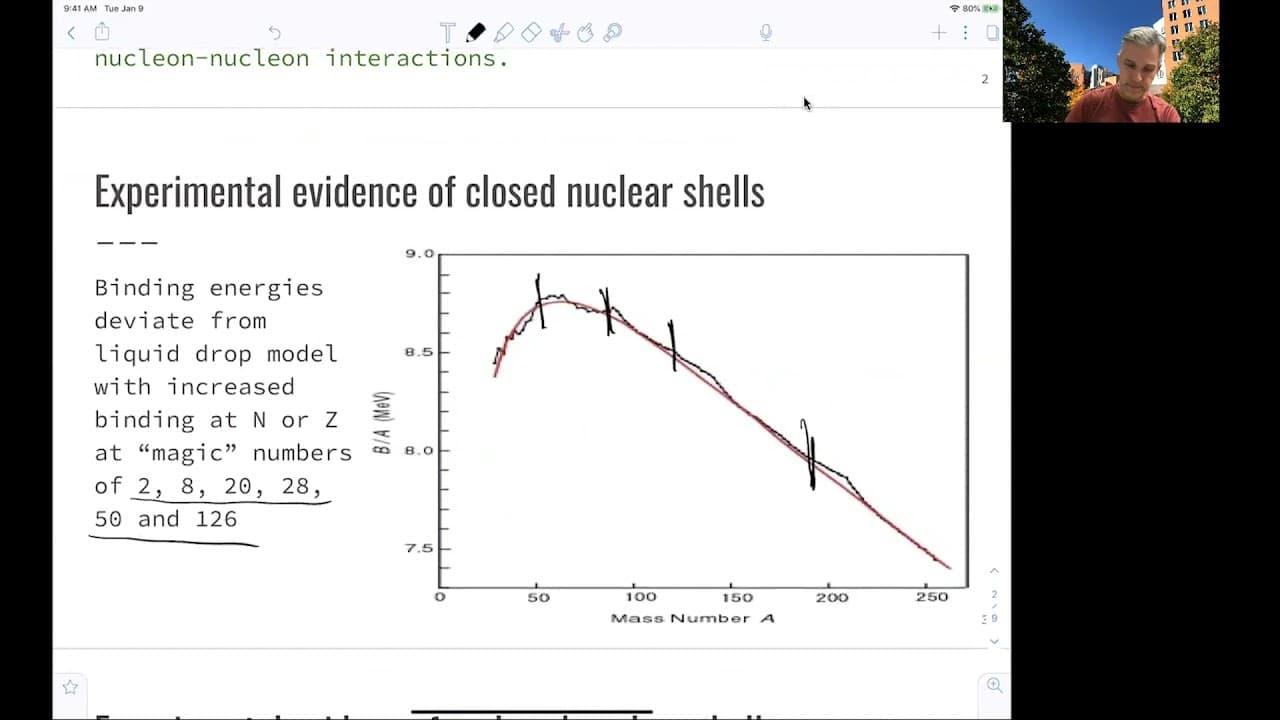
- 😚 The experimental evidence supports the concept of closed nuclear shells, influencing the number of stable isotopes, excitation probabilities, and shapes of nuclei.
- 🐚 Adding spin-orbit coupling to the nuclear shell model aligns the calculated magic numbers with experimental data.
- 🫀 Differences between the nuclear and atomic shell models lie in the energy gaps between shells, which are larger in atomic nuclei.
Install to Summarize YouTube Videos and Get Transcripts
Explore YouTube Video Summarizer or Get YouTube Transcript Extractor
Questions & Answers
Q: What is the nucleon mean field and how does it allow for the description of the nucleus?
The nucleon mean field refers to the average potential that protons and neutrons experience inside the nucleus. By using a harmonic oscillator model parameterized with this potential, the nucleus can be described.
Q: What is the significance of magic numbers in nuclear physics?
Magic numbers refer to specific proton or neutron numbers at which nuclei exhibit higher binding energies and unique characteristics. They indicate the presence of closed nuclear shells and are crucial for understanding nuclear structure and stability.
Q: How does experimental evidence support the existence of closed nuclear shells?
Experimental observations show that nuclei with a proton or neutron number equal to a magic number have a higher number of stable isotopes/isotones and a higher likelihood of capturing a proton or neutron. Additionally, the energy of excited states and the quadrupole moments of these nuclei differ significantly from others.
Q: How does the spin-orbit coupling affect the magic numbers in the nuclear shell model?
Including the spin-orbit coupling in the Hamiltonian of the three-dimensional harmonic oscillator model modifies the orbitals, aligning the calculated magic numbers with the experimental data. The spin-orbit coupling slightly alters the potential and resolves the disagreement between the shell model and experimental results at higher magic numbers.
Summary & Key Takeaways
-
The nucleon mean field describes the average potential that protons and neutrons experience inside the nucleus, allowing for the use of a harmonic oscillator model to describe the nucleus.
-
Experimental evidence shows that certain nuclei have higher binding energies at "magic numbers," which are specific proton or neutron numbers.
-
Nuclei with proton or neutron numbers equal to the magic numbers exhibit unique characteristics, such as increased stability, lower excitation probabilities, and spherical shape.
Read in Other Languages (beta)
Share This Summary 📚
Summarize YouTube Videos and Get Video Transcripts with 1-Click
Try YouTube Summary with ChatGPT & Claude or YouTube Transcript Generator
Explore More Summaries from MIT OpenCourseWare 📚



Summarize YouTube Videos and Get Video Transcripts with 1-Click
Try YouTube Summary with ChatGPT & Claude or YouTube Transcript Generator