Telecommunications with 5G
TL;DR
5G technology brings faster connectivity and a service-oriented architecture with network slicing, enabling the development of new applications and services.
Transcript
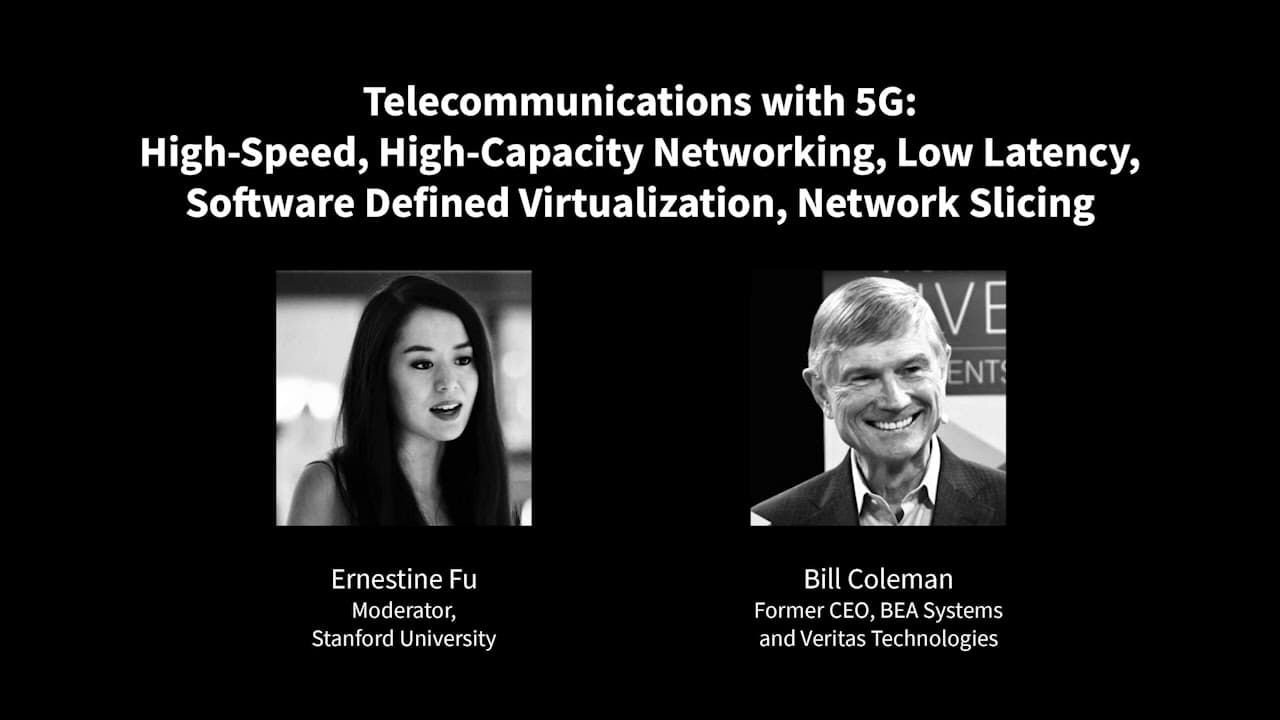
Stanford University so Bill's been CEO of multiple companies most recently he Oh CEO Veritas technologies when the Carlyle Group bought it out from Symantec and I believe it was 2015-2016 he also founded ba systems in 1995 he's the bee of ba and when he was chairman and CEO of the company in 2001 the company actually became the fastest software com... Read More
Key Insights
- 💨 5G is more than just faster connectivity; it enables a service-oriented architecture and network slicing, paving the way for innovative applications and services.
- 🏙️ The rollout of 5G will take several years and will initially focus on major cities before expanding to rural areas.
- 👊 Cybersecurity is a major concern with 5G, as the network is vulnerable to attacks. Efforts are being made to enhance security, but complete protection is still a challenge.
- 🤣 The cost and complexity of rolling out 5G infrastructure are significant, with mid-band spectrum and equipment being crucial for widespread adoption.
- 🥺 The integration of 5G and traditional broadband internet may lead to changes in competition and pricing among telecommunications and internet providers.
Install to Summarize YouTube Videos and Get Transcripts
Explore YouTube Video Summarizer or Get YouTube Transcript Extractor
Questions & Answers
Q: How does 5G differ from 4G?
5G is a logical extension of 4G, offering better network bandwidth management and increased performance. It allows for software to run on 4G networks, although some capabilities are limited compared to running on a 5G network.
Q: What are the benefits of 5G for consumers?
5G brings the service-oriented architecture and network slicing, enabling the development of new applications and services. Consumers may experience faster download and streaming speeds, but the real value lies in the ability to prioritize specific requirements for different applications and services.
Q: What are the risks associated with 5G, particularly in terms of cybersecurity?
5G networks are subject to the same vulnerabilities as the internet. Although the 3GPP organization has added security capabilities to the network, it does not guarantee complete security. Risks include vulnerabilities in devices connected to the network, the presence of hardware that can be exploited, and the need to compartmentalize network slices to prevent infections between slices.
Q: Will 5G lead to the consolidation of telecommunications and broadband internet providers?
There may be overlap between traditional internet services and 5G, but it is uncertain whether this will lead to mergers or buyouts. The integration of 5G and traditional broadband internet could result in more competition between providers and potentially affect pricing and quality of service.
Summary & Key Takeaways
-
5G is a logical extension of 4G, offering better bandwidth management and increased performance.
-
The revolutionary aspect of 5G is its software architecture, allowing for network slicing and service-oriented applications.
-
Network slicing enables the creation of individual slices that prioritize specific requirements, such as low latency for autonomous vehicles or ultra-reliability for telemedicine.
-
The rollout of 5G will occur over the next five to ten years, with initial focus on major cities and gradually expanding to rural areas.
Read in Other Languages (beta)
Share This Summary 📚
Summarize YouTube Videos and Get Video Transcripts with 1-Click
Try YouTube Summary with ChatGPT & Claude or YouTube Transcript Generator
Explore More Summaries from Stanford 📚





Summarize YouTube Videos and Get Video Transcripts with 1-Click
Try YouTube Summary with ChatGPT & Claude or YouTube Transcript Generator