Economic Tools of Foreign Policy
TL;DR
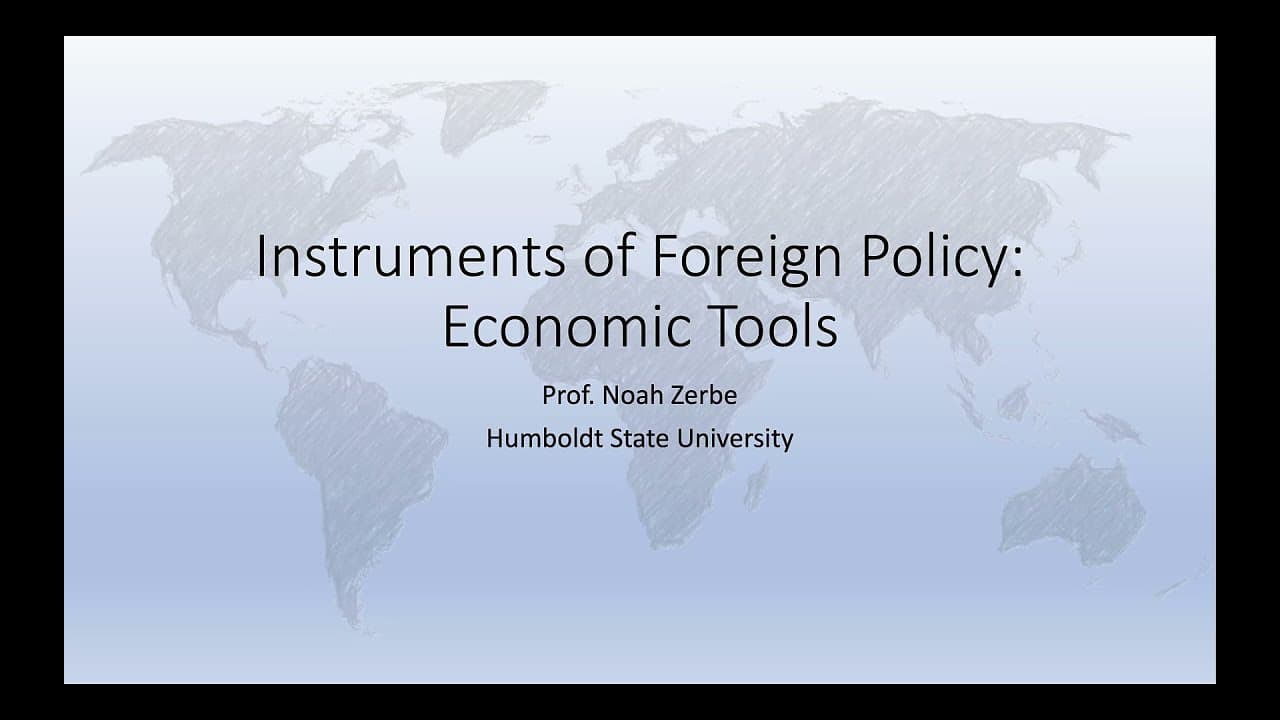
This video provides an overview of the economic tools available to states to achieve their foreign policy goals, including foreign aid, embargoes, sanctions, and boycotts.
Transcript
Hi everyone. Noah Zerbe here. This is one of a series of short videos looking at the instruments of foreign policy. That is, when a foreign policy goal is set by decision makers, how to they go about mobilizing the tools available to the state to achieve those goals? What options are available to pursue interests and achieve goals? In this video, w... Read More
Key Insights
- 🍂 Economic tools of foreign policy fall along the coercion spectrum, with some being non-coercive and others being more coercive.
- 🦻 Foreign aid is a commonly used economic instrument that serves various foreign policy objectives.
- ❓ Embargoes and sanctions are used to discourage specific behavior, while boycotts are symbolic protests.
- 🌍 The effectiveness of economic tools like sanctions depends on their objectives and level of international support.
- 🎯 Sanctions can have collateral damage and disproportionately impact the vulnerable in targeted countries.
Install to Summarize YouTube Videos and Get Transcripts
Explore YouTube Video Summarizer or Get YouTube Transcript Extractor
Questions & Answers
Q: What are some examples of non-coercive economic tools used in foreign policy?
Non-coercive economic tools include preferential trade status and humanitarian aid, which are used to encourage specific behavior or support.
Q: How is foreign aid classified based on its intended purpose?
Foreign aid can be classified as food aid, technical aid, project aid, emergency and humanitarian aid, or military aid, depending on its specific purpose in the recipient country.
Q: How do embargoes and sanctions differ from each other?
Embargoes are commercial or financial penalties, while sanctions encompass a range of trade restrictive measures. Embargoes are often more severe and can include military measures like no-fly zones.
Q: Do economic tools like embargoes and sanctions effectively achieve their goals?
The effectiveness of economic tools like sanctions is mixed. Sanctions with broad and far-reaching objectives are often unsuccessful, while those with more focused and internationally supported objectives may have more success.
Summary & Key Takeaways
-
Economic tools fall along the middle of the coercion spectrum, with some being non-coercive like preferential trade status and others being more coercive like military aid.
-
Foreign aid is one of the most frequently used economic instruments, serving various foreign policy objectives such as signaling approval, strengthening allies, and improving global image.
-
Embargoes and sanctions are used to discourage or disincentive specific behaviors, while boycotts are more limited and symbolic protests.
Read in Other Languages (beta)
Share This Summary 📚
Summarize YouTube Videos and Get Video Transcripts with 1-Click
Try YouTube Summary with ChatGPT & Claude or YouTube Transcript Generator
Explore More Summaries from Noah Zerbe 📚

Summarize YouTube Videos and Get Video Transcripts with 1-Click
Try YouTube Summary with ChatGPT & Claude or YouTube Transcript Generator