How to Derive Sine and Cosine Triple Angle Identities
TL;DR
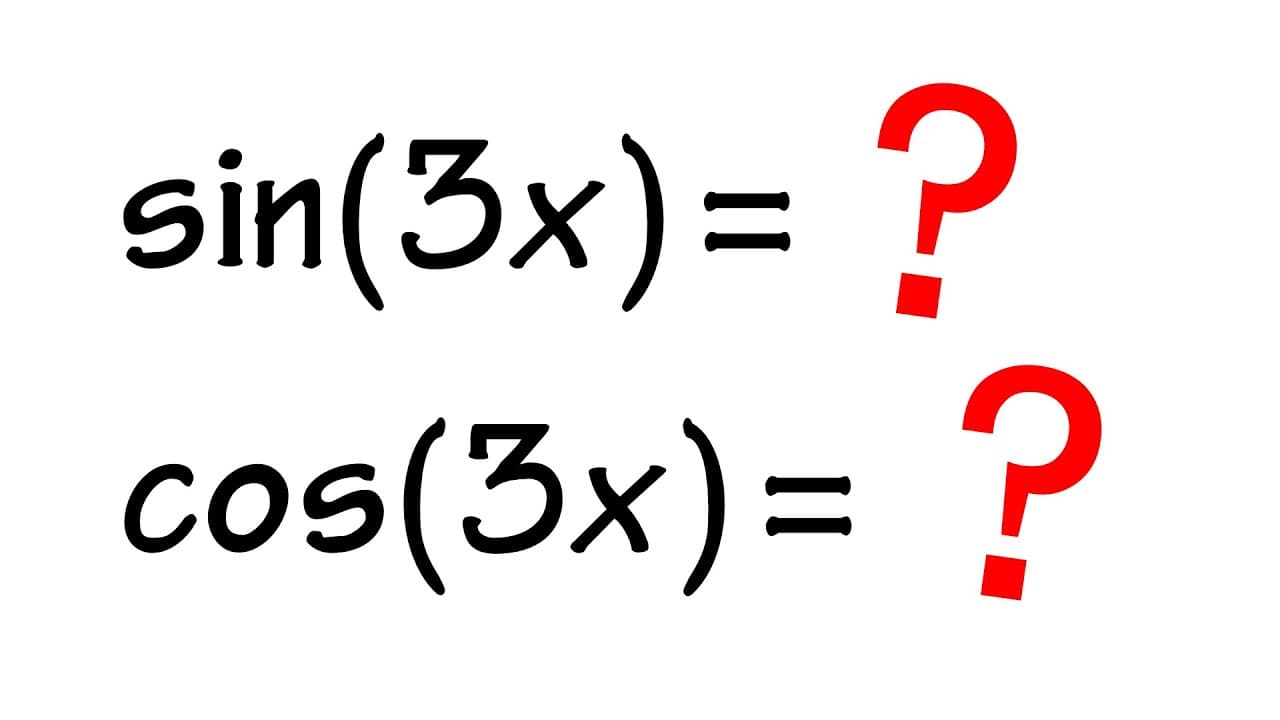
To derive triple angle identities for sine and cosine, treat them as the real and imaginary parts of a complex number and apply the binomial theorem. The identities are: cosine of 3 theta equals 4 cosine squared theta minus 3 cosine theta, and sine of 3 theta equals negative four sine cubed theta plus 3 sine theta.
Transcript
okay this video I'll show you guys have to figure out the triple angle identities for sine cosine and I'll also show you guys how to use one stone to kill two birds not the actual birds by not in math but anyway the deal is that I am trying to figure out an expression for cosine of 3 theta in terms of just cosine theta and likewise I want to have a... Read More
Key Insights
- 👨💼 Complex numbers can be used to derive triple angle identities for sine and cosine.
- 😑 By treating cosine and sine as real and imaginary parts, respectively, expressions can be obtained using the binomial theorem.
- 😑 The derived expression for cosine of 3 theta is 4 cosine squared theta minus 3 cosine theta.
- 👨💼 The derived expression for sine of 3 theta is minus four times sine to the third power theta plus three times sine theta.
- 🔺 It is possible to express triple angle identities in terms of original angle identities.
- 🎮 The video offers an alternative approach to deriving triple angle identities using complex numbers.
- 😑 The binomial theorem is a useful tool for expanding expressions involving powers and coefficients.
Install to Summarize YouTube Videos and Get Transcripts
Explore YouTube Video Summarizer or Get YouTube Transcript Extractor
Questions & Answers
Q: How can complex numbers be used to derive expressions for triple angle identities?
Complex numbers can be used by treating cosine as the real part and sine as the imaginary part. By raising this complex number to the third power and collecting the real and imaginary parts, expressions for cosine of 3 theta and sine of 3 theta can be obtained.
Q: Can you explain the steps involved in multiplying out the expression and collecting the real and imaginary parts?
To multiply out the expression, the binomial theorem is used. The first term is raised to the third power, followed by adding three times the first term squared multiplied by the second term, and finally adding the second term cubed. The resulting expression is then simplified by collecting the real and imaginary parts.
Q: How is the triple angle identity for cosine derived using the obtained expressions?
The derived expression for cosine of 3 theta consists of the real part, which is cosine to the third power theta, subtracted by three times cosine theta times sine square theta. This can be simplified to 4 cosine squared theta minus 3 cosine theta.
Q: What is the derived expression for sine of 3 theta?
The derived expression for sine of 3 theta consists of the imaginary part, which is minus four times sine to the third power theta plus three times sine theta.
Summary & Key Takeaways
-
The video explains how to derive expressions for cosine of 3 theta and sine of 3 theta using complex numbers.
-
By treating cosine and sine as the real and imaginary parts of a complex number, respectively, the expressions can be derived using the binomial theorem.
-
The video demonstrates the step-by-step process of multiplying out the expression and collecting the real and imaginary parts to obtain the desired identities.
Read in Other Languages (beta)
Share This Summary 📚
Summarize YouTube Videos and Get Video Transcripts with 1-Click
Try YouTube Summary with ChatGPT & Claude or YouTube Transcript Generator
Explore More Summaries from blackpenredpen 📚
Summarize YouTube Videos and Get Video Transcripts with 1-Click
Try YouTube Summary with ChatGPT & Claude or YouTube Transcript Generator