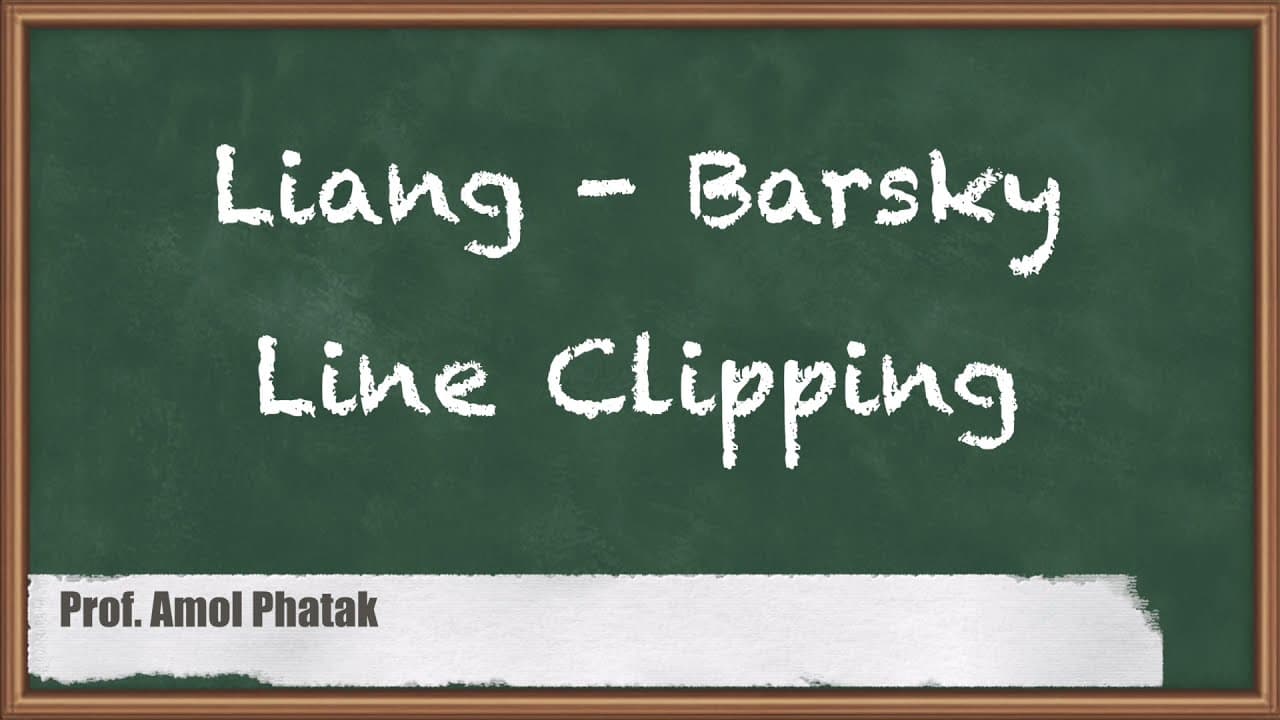
What Is the Liang and Barsky Line Clipping Algorithm?
TL;DR
The Liang and Barsky Line Clipping Algorithm is a faster method for line clipping that utilizes parametric equations, significantly reducing intersection point calculations. It determines if a line intersects with the clipping window by checking the line's coefficients against the window boundaries, improving efficiency and performance compared to older algorithms like Cohen-Sutherland.
Transcript
i welcome all the students we have started learning the unit number four and we have convert the point to ohin sudhar land line sleeping algorithm okay in the last session we have learned when suddenly clipping algorithm in detail so today's session we are going to learn and concentrate on the one more algorithm which is used for the line sleeping ... Read More
Key Insights
- 🫥 The Liang and Barsky Line Clipping Algorithm is designed to make line clipping faster and more efficient.
- 🫥 Parametric equations and clip test functions are used to determine if a line is inside or outside the window.
- 😥 The algorithm reduces intersection point calculations and requires only one division for parameter updates.
Install to Summarize YouTube Videos and Get Transcripts
Explore YouTube Video Summarizer or Get YouTube Transcript Extractor
Questions & Answers
Q: How does the Liang and Barsky Line Clipping Algorithm differ from the Cohen-Sutherland Line Clipping Algorithm?
The Liang and Barsky algorithm is faster and more efficient due to the use of parametric equations, which reduce intersection point calculations and require only one division. It also computes the window intersections of the line only once.
Q: What are the advantages of the Liang and Barsky Line Clipping Algorithm?
The algorithm is more efficient than the Cohen-Sutherland algorithm, requires only one division for parameter updates, and computes window intersections only once, reducing computation time and improving speed.
Q: How does the algorithm determine if the line is inside or outside the window?
The algorithm tests the line against each clipping boundary using clip test functions. If the line is parallel to and outside a boundary, it can be discarded. If the line is not rejected after testing all four boundaries, the endpoints of the clipped line are determined.
Q: Why is finding the intersection point important in line clipping?
The intersection point determines the portion of the line that is inside the window. Without finding the intersection point, it is impossible to determine which part of the line should be preserved and which part should be discarded. The intersection point calculations help identify the visible portion of the line.
Summary & Key Takeaways
-
The Liang and Barsky Line Clipping Algorithm is designed to perform line clipping faster by using parametric equations.
-
Parametric equations, such as x = x1 + u * delta x, are used to calculate the coordinates of the line segment.
-
The algorithm checks if the line is parallel to a clipping boundary and if the line is inside or outside the window.
Read in Other Languages (beta)
Share This Summary 📚
Summarize YouTube Videos and Get Video Transcripts with 1-Click
Try YouTube Summary with ChatGPT & Claude or YouTube Transcript Generator
Explore More Summaries from Ekeeda 📚

Summarize YouTube Videos and Get Video Transcripts with 1-Click
Try YouTube Summary with ChatGPT & Claude or YouTube Transcript Generator