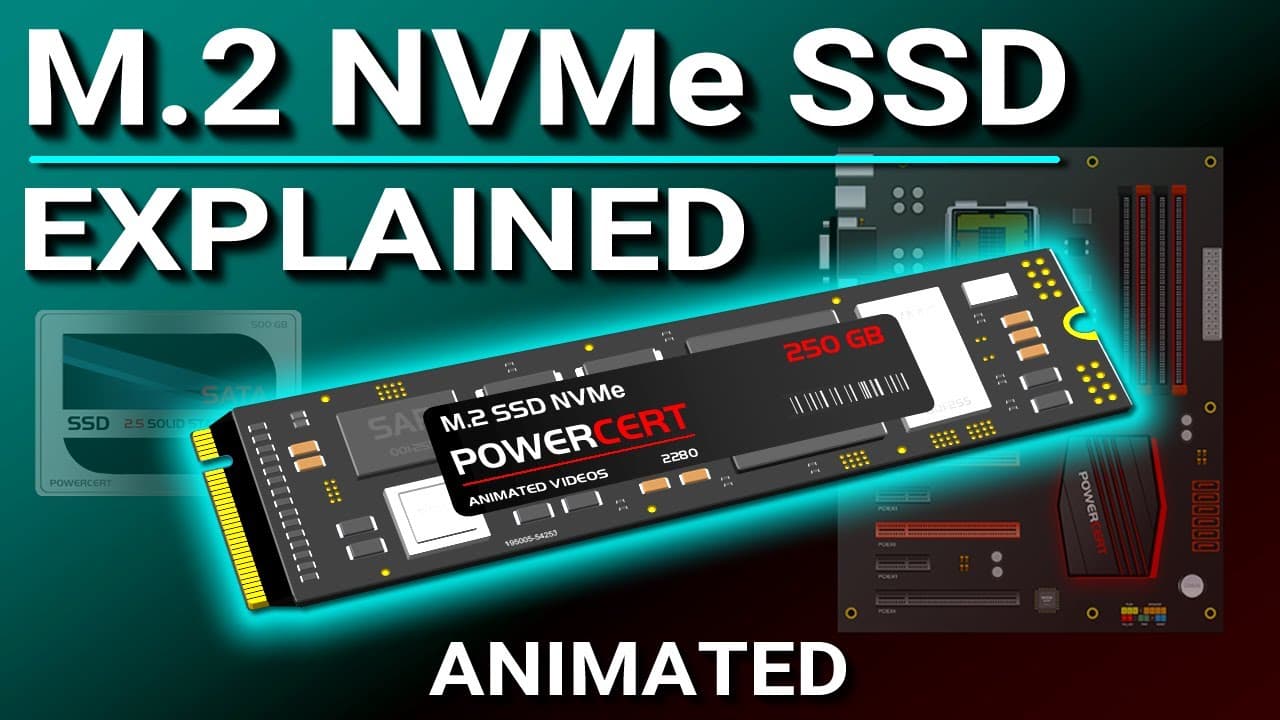
M.2 NVMe SSD Explained - M.2 vs SSD
TL;DR
M.2 NVMe SSDs are faster and more efficient than traditional SSDs.
Transcript
Hello everyone. In this video, we're going to talk about M.2 Non-Volatile Memory Express Solid-State Drives or SSDs. Now these drives are relatively new and have only been around for a few years now and just like regular 2.5 inch SSDs that we're more familiar with M.2 SSDs also use flash memory for data storage and they are very fas... Read More
Key Insights
- M.2 SSDs are a newer form factor for solid-state drives, connecting via a different slot and offering faster data transfer than traditional 2.5-inch SSDs.
- Unlike regular SSDs, M.2 SSDs utilize the PCI Express bus, allowing for significantly faster data transfer rates up to 3 GB/s.
- NVMe, or Non-Volatile Memory Express, is a protocol designed to optimize SSD performance by reducing CPU overhead and increasing I/O operations per second.
- The NVMe protocol supports parallel processing, similar to multi-core CPUs, enhancing the efficiency of data processing tasks.
- NVMe's command queue capability vastly surpasses AHCI, supporting up to 64,000 queues with 64,000 commands each, enabling billions of commands to be processed.
- Not all M.2 SSDs are created equal; some use the slower SATA bus, offering no speed advantage over standard SSDs.
- Compatibility is crucial when upgrading to an M.2 NVMe SSD; ensure your motherboard has an M.2 slot and supports the NVMe protocol.
- M.2 NVMe SSDs are easy to install, requiring no additional cables, but not all motherboards support this newer technology.
Install to Summarize YouTube Videos and Get Transcripts
Explore YouTube Video Summarizer or Get YouTube Transcript Extractor
Questions & Answers
Q: What makes M.2 NVMe SSDs faster than traditional SSDs?
M.2 NVMe SSDs are faster because they use the PCI Express bus instead of the SATA bus, allowing for data transfer rates up to 3 GB/s. Additionally, the NVMe protocol reduces CPU overhead and increases I/O operations per second, further enhancing speed and efficiency compared to traditional SSDs.
Q: How does the NVMe protocol improve SSD performance?
The NVMe protocol improves SSD performance by reducing CPU overhead and allowing for multiple input/output operations to occur simultaneously. It supports a high number of command queues and commands per queue, enabling parallel processing similar to multi-core CPUs, which significantly boosts data processing efficiency.
Q: What should you consider before upgrading to an M.2 NVMe SSD?
Before upgrading to an M.2 NVMe SSD, ensure your motherboard supports the M.2 slot and NVMe protocol. Not all motherboards are compatible with this newer technology. Additionally, verify that the M.2 SSD you choose uses the PCI Express bus for optimal speed, as some use the slower SATA bus.
Q: Are all M.2 SSDs faster than 2.5-inch SSDs?
Not all M.2 SSDs are faster than 2.5-inch SSDs. Only M.2 SSDs using the PCI Express bus and NVMe protocol offer significant speed advantages. Some M.2 SSDs use the SATA bus, providing no speed benefit over traditional 2.5-inch SSDs, so it's important to check specifications before purchasing.
Q: What installation advantages do M.2 NVMe SSDs offer?
M.2 NVMe SSDs offer a straightforward installation process, as they connect directly to the motherboard via an M.2 slot. This eliminates the need for additional cables, such as data or power cables, simplifying the setup and reducing clutter within the computer case.
Q: Why was the NVMe protocol developed?
The NVMe protocol was developed to optimize SSD performance by addressing the limitations of the older AHCI protocol, which was designed for mechanical hard drives. NVMe reduces CPU overhead, supports parallel processing, and allows for a large number of command queues, maximizing the potential of modern SSDs.
Q: How does the command queue capability of NVMe compare to AHCI?
NVMe's command queue capability vastly exceeds AHCI's. While AHCI supports one queue with up to 32 commands, NVMe allows for 64,000 queues with 64,000 commands each. This enormous capacity enables NVMe to handle billions of commands, significantly improving data processing efficiency and speed.
Q: What are the benefits of using the PCI Express bus for M.2 SSDs?
Using the PCI Express bus for M.2 SSDs offers substantial benefits, including significantly faster data transfer rates compared to the SATA bus. PCI Express allows for up to 3 GB/s transfer speeds, enabling faster boot times, quicker file transfers, and overall improved system responsiveness, particularly for demanding applications.
Summary & Key Takeaways
-
M.2 NVMe SSDs represent a significant advancement in storage technology, offering faster data transfer rates and efficiency compared to traditional SSDs. They connect via the PCI Express bus and utilize the NVMe protocol, which reduces CPU overhead and enhances input/output operations.
-
The NVMe protocol allows for parallel task processing, similar to multi-core CPUs, and supports a vast number of command queues, greatly enhancing data processing capabilities. However, compatibility with your motherboard is essential, as not all support M.2 NVMe technology.
-
While some M.2 SSDs use the slower SATA bus, true M.2 NVMe SSDs offer a notable speed advantage. Installation is straightforward, involving a single screw, but ensure your system supports the necessary slot and protocol for optimal performance.
Read in Other Languages (beta)
Share This Summary 📚
Summarize YouTube Videos and Get Video Transcripts with 1-Click
Try YouTube Summary with ChatGPT & Claude or YouTube Transcript Generator
Explore More Summaries from PowerCert Animated Videos 📚






Summarize YouTube Videos and Get Video Transcripts with 1-Click
Try YouTube Summary with ChatGPT & Claude or YouTube Transcript Generator