Torque | Advantages & Dis Advantages | Synchronous Machines | Lec-36
TL;DR
Synchronous motors have specific applications, advantages, and disadvantages affecting speed and efficiency.
Transcript
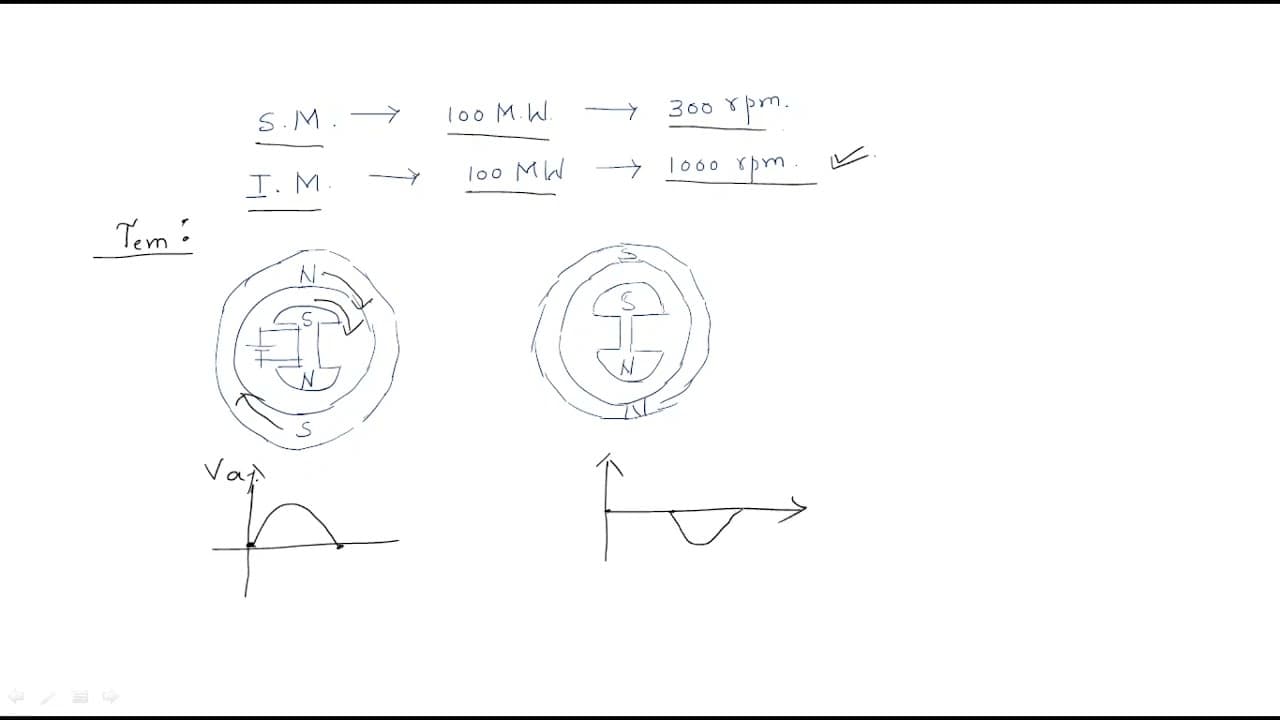
hello everyone in the last session we will discuss about the introduction of the synchronous meeting synchronous motor and speed regulation so how the Tarkan power will be acting depends on the speed now we will discuss what are the applications of the synchronous monitor the first application is for large power and low head applications that means... Read More
Key Insights
- 🚄 Synchronous motors are effective in high-power, low-speed applications, especially suitable for industrial machinery.
- 🤳 They require separate field excitation and are not self-starting, highlighting their operational dependencies.
- ✊ The ability to control power factor makes synchronous motors advantageous for optimizing energy consumption in industrial applications.
- 🧑🦼 Despite their efficiencies, synchronous motors may involve complex starting mechanisms due to the zero starting torque.
- 🧑🦼 Comparison with induction motors shows that synchronous motors tend to be smaller and cheaper for equivalent power ratings.
- 🐎 The operation principle of electromagnetic torque necessitates a careful balance between rotor and stator speeds.
- 🚄 Synchronous motors' high efficiency makes them ideal for processes requiring consistent operational speeds.
Install to Summarize YouTube Videos and Get Transcripts
Explore YouTube Video Summarizer or Get YouTube Transcript Extractor
Questions & Answers
Q: What are the main applications of synchronous motors?
Synchronous motors are utilized in various applications such as large power supplies with low head, compressors, reciprocating pumps, and industrial processes like steel rolling. Their ability to function effectively under specific conditions makes them valuable in sectors demanding robust performance.
Q: What are the advantages of using a synchronous motor over an induction motor?
Synchronous motors offer benefits such as operating at constant speed, being cheaper and smaller in size, and possessing a controllable power factor, enhancing efficiency. They achieve high efficiency levels, making them preferable in scenarios with large power requirements, particularly at low speeds.
Q: Why is the synchronous motor not self-starting?
Synchronous motors are not self-starting due to their design that requires an external starting force. The initial torque generated by the motor is zero, necessitating additional energy to initiate rotation and align the rotor with the stator's magnetic field before reaching synchronous speed.
Q: How does starting torque affect the operation of synchronous motors?
Starting torque in synchronous motors is zero, meaning they cannot initiate movement independently. This characteristic implies that auxiliary systems or external forces are required to begin operation, ensuring the motor can reach the necessary rotational speed before generating effective torque.
Q: What is the role of field excitation in synchronous motors?
Field excitation plays a crucial role in synchronous motors as it enables the generation of an electromagnetic field essential for operation. Without adequate excitation, the motor cannot produce enough torque to sustain movement, making it a critical aspect of synchronous motor functionality.
Q: Can synchronous motors be used in variable speed applications?
Synchronous motors are typically not well-suited for variable speed applications due to their design that focuses on maintaining a constant speed synchronously with the electrical supply frequency. Their efficiency and functionality are optimized around stable operational parameters typically found in fixed-speed environments.
Summary & Key Takeaways
-
Synchronous motors are widely used in applications requiring large power and low head, including compressors and pumps, particularly in industrial settings.
-
Key advantages of synchronous motors include their ability to maintain constant speed, control power factor, and achieve high efficiency compared to induction motors, though they are not self-starting.
-
The operation of synchronous motors involves managing torque and excitation, presenting challenges such as the need for external force to overcome initial inertia before reaching synchronous speed.
Read in Other Languages (beta)
Share This Summary 📚
Summarize YouTube Videos and Get Video Transcripts with 1-Click
Try YouTube Summary with ChatGPT & Claude or YouTube Transcript Generator