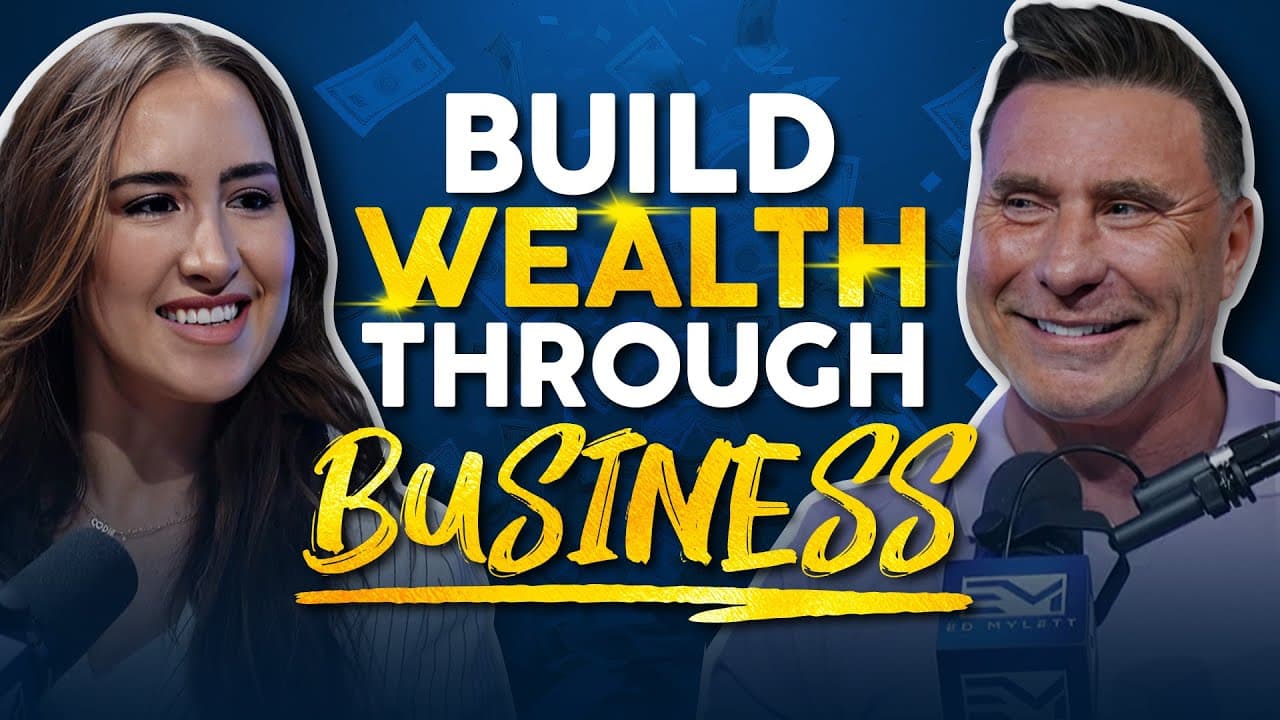
What Is the Fastest, Lower-Risk Path to Escape Your 9-to-5? Buying Businesses With @CodieSanchezCT
TL;DR
Buying an existing small business can be a faster, less risky path out of a 9-to-5 because it offers proven demand, operating history and immediate cash flow. Codie Sanchez contrasts this with startups, noting that more than 70% die from lack of product-market fit, and explains how work, referrals and operational value can earn ownership. Read on for her acquisition, equity and leadership principles.
Transcript
almost nobody talks about buying businesses other than you as a way to get into business the fact is most businesses stay for sale for a long time and aren't acquired at all and I think sometimes people might be surprised how easy the barrier of Entry is to getting into buying or acquiring somebody's business if you just look at the math most start... Read More
Key Insights
- Existing businesses reduce uncertainty: An operating company can provide customers, revenue and evidence that people will pay. A startup begins with an idea that may never achieve product-market fit. Sanchez therefore frames acquisition as a way to avoid rebuilding proof that an existing owner has already established.
- Unbought companies create openings: Most businesses stay for sale for a long time, and many are never acquired at all. That weak acquisition interest can make entry easier than aspiring owners expect. The opportunity begins with examining the actual deal math instead of assuming every purchase requires an unreachable amount of capital.
- Startup motivation should be exceptional: Sanchez does not reject startups completely. She says they should be pursued when someone cannot sleep because the desired thing must exist in the world. If the objective is simply money, she believes existing small businesses already contain cash-flow opportunities without requiring a new market to be invented.
- Product-market fit is decisive: More than 70% of startups die from a lack of product-market fit, according to the discussion. Friends may praise an idea without ever paying for it. Their encouragement is therefore not equivalent to customer validation, while an existing company’s paying customers offer more concrete evidence.
- Employment can become diligence: Working for a target business allows a prospective owner to understand operations before assuming control. For a “brand new Young Gun,” this can be a safer opening move than purchasing on day one. Strong performance can also build the credibility required to earn a later takeover opportunity.
- Owner fatigue can reveal deals: The existing fields describe the “Bathwater Method” as identifying owners who are tired, dissatisfied or ready to leave. Their desire to exit may support a purchase with less capital or more favorable terms. The opportunity comes from solving the seller’s transition problem, not merely negotiating a price.
- Operational gaps create leverage: Strikefire Productions did not primarily need operational improvement. Its operator had capacity but hated sales, selling and repeated follow-up. Sanchez identified that exact constraint and proposed supplying referrals, showing how a buyer or partner can gain leverage by solving the bottleneck the current owner least wants to handle.
- Equity can replace cash payment: Sanchez asked to earn into 49% of Strikefire Productions rather than charging only for referral work. The ownership depended on bringing enough referrals to double existing revenue. This linked the size of her stake to a concrete outcome that increased the original owner’s earnings.
- Recurring revenue supports cash flow: After helping double Strikefire Productions, Sanchez says she cash flowed from the company because its revenue was recurring. The example shows why revenue structure matters in an ownership deal. A continuing stream can produce ongoing returns after the value-creation work establishes the expanded customer base.
- Leadership requires willing followers: Sanchez’s entrepreneurial test is not limited to credentials, intelligence or interview performance. She asks whether people will follow the candidate. Former colleagues who willingly join again provide stronger evidence of leadership than a candidate merely claiming an ability to recruit and inspire a team.
- Balanced operators offer versatility: For the BizScout CEO role, Sanchez liked candidates who had led technical teams and also performed sales and marketing. That combination suggested an ability to manage both sides of the business. Early-stage leadership may require crossing functional boundaries rather than remaining effective in only one specialty.
- Small decisions expose awareness: Taking excessive time to order while a line waits can indicate uncertainty and poor awareness of other people. Sanchez values candidates who know what they want and avoid wasting others’ time. The coffee-shop test turns an ordinary choice into a practical observation of decisiveness and urgency.
Install to Summarize YouTube Videos and Get Transcripts
Explore YouTube Video Summarizer or Get YouTube Transcript Extractor
Questions & Answers
Q: What is the fastest, lower-risk path to escape a 9-to-5 job according to Codie Sanchez?
Sanchez presents buying an existing small business as a faster, less risky route than creating a startup from scratch. The business may already have customers, revenue, operations and evidence of product-market fit. A newcomer can reduce risk further by working inside the company before attempting to take it over. This path works because it builds on value and cash flow that already exist.
Q: Why can buying a business be less risky than starting one?
An existing business has already tested whether customers will exchange money for its offering. By contrast, more than 70% of startups die from lack of product-market fit, according to the transcript. Positive comments from friends do not provide the same validation as actual purchases. Buying therefore removes part of the uncertainty around demand, although the buyer still needs to understand the operation.
Q: How can someone buy or acquire a business without starting with a large amount of capital?
The discussion identifies work, trust and measurable value as alternatives to simply paying the full price immediately. A prospective owner can join a business, learn its operations and earn the right to take it over. The “Bathwater Method” also looks for fatigued owners who are ready to exit and may accept favorable terms. Another route is earning equity by solving a constraint such as sales or referrals.
Q: What is the “Bathwater Method” for acquiring businesses?
The “Bathwater Method” means looking for owners who are fatigued, dissatisfied or ready to leave their businesses. Their motivation to exit can create an opportunity to acquire the company with minimal capital or favorable terms. The method works by recognizing that the owner’s desire for relief may matter as much as the purchase price. It focuses attention on businesses where a transition solves a real problem for the seller.
Q: How did Codie Sanchez earn equity in Strikefire Productions?
Strikefire Productions had an operationally capable owner who disliked sales and follow-up but still had capacity for more customers. Sanchez proposed bringing referrals and earning into 49% of the company if her contribution doubled its revenue. The company doubled, and she received cash flow because the revenue was recurring. The deal worked by connecting ownership directly to a measurable increase in value.
Q: Why does Codie Sanchez emphasize equity instead of payment for services?
Payment for a service compensates someone for a specific contribution, while equity provides ownership in the value that contribution helps create. Sanchez urges people to think like owners and seek more ownership for the value they bring. Her Strikefire arrangement illustrates this by exchanging successful referral growth for a stake rather than a simple sales fee. The structure aligned her benefit with the company’s continuing performance.
Q: How does Codie Sanchez judge whether someone can become a successful entrepreneur?
Her central question is whether other people will follow that person. During the BizScout CEO search, one candidate named essential former colleagues and offered to accept a lower salary so they could join. Their willingness to work with him again demonstrated real leadership and loyalty. Sanchez viewed that evidence as a stronger entrepreneurial signal than polished interview answers alone.
Q: What does ordering at a coffee shop reveal about business ability?
Sanchez uses a busy coffee shop with many choices as an informal test of “speed to urgency.” She watches whether a person knows what they want, decides efficiently and recognizes that other people are waiting. The behavior can expose decisiveness and situational awareness in an ordinary setting. She values these traits because business leaders must make choices without unnecessarily consuming everyone else’s time.
Summary & Key Takeaways
-
Choosing acquisition over invention: Codie Sanchez presents buying existing businesses as an overlooked route into entrepreneurship. Many businesses remain for sale for long periods and are never acquired, so the barrier to entry can be easier than people assume. Unlike an unproven startup, an operating business may already have customers, revenue and product-market fit. She argues that startups make sense when an idea feels indispensable, but existing small businesses may be the better path when the primary objective is making money.
-
Learning before taking ownership: A new or young entrepreneur does not necessarily need to buy a company immediately. Sanchez suggests first working inside a business, learning how it operates and earning the right to take it over. This creates a practical bridge from employment to ownership while reducing the risk of entering an unfamiliar operation. Her broader point is that acquisition is not limited to buyers with large amounts of money. Capability, trust and demonstrated contribution can also create a path into a deal.
-
Earning equity through referrals: Sanchez illustrates value-based ownership with Strikefire Productions, a small podcast production company whose operator was strong operationally but disliked sales and follow-up. She proposed earning up to 49% by bringing referrals, provided those referrals helped double the company’s revenue. The arrangement gave the owner more business while allowing her to cash flow from recurring revenue. Her lesson is to negotiate for ownership based on measurable value instead of viewing every contribution as a service that deserves only a fee.
-
Testing whether people will follow: When deciding who may succeed as an entrepreneur, Sanchez looks for evidence that others will follow that person. While hiring a CEO for BizScout, she favored a candidate with experience leading technical teams and handling sales and marketing. The decisive signal came when he identified essential former colleagues and offered to reduce his own salary to bring them. Existing loyalty demonstrated that he could recruit people around a mission, which Sanchez considers central to high-level entrepreneurship.
-
Watching decisions under pressure: Sanchez calls her approach to evaluating decisiveness “speed to urgency.” Instead of asking whether a candidate would be enjoyable company over a beer at an airport, she watches how people handle ordinary choices, such as ordering breakfast or coffee when many options and a waiting line are present. Knowing what one wants and respecting other people’s time reveal useful operating instincts. She treats everyday situational awareness as evidence of whether someone can decide and act effectively in business.
Read in Other Languages (beta)
Share This Summary 📚
Summarize YouTube Videos and Get Video Transcripts with 1-Click
Try YouTube Summary with ChatGPT & Claude or YouTube Transcript Generator
Explore More Summaries from Ed Mylett 📚




Summarize YouTube Videos and Get Video Transcripts with 1-Click
Try YouTube Summary with ChatGPT & Claude or YouTube Transcript Generator