How Does Hydroiodic Acid Convert Secondary Alcohols?
TL;DR
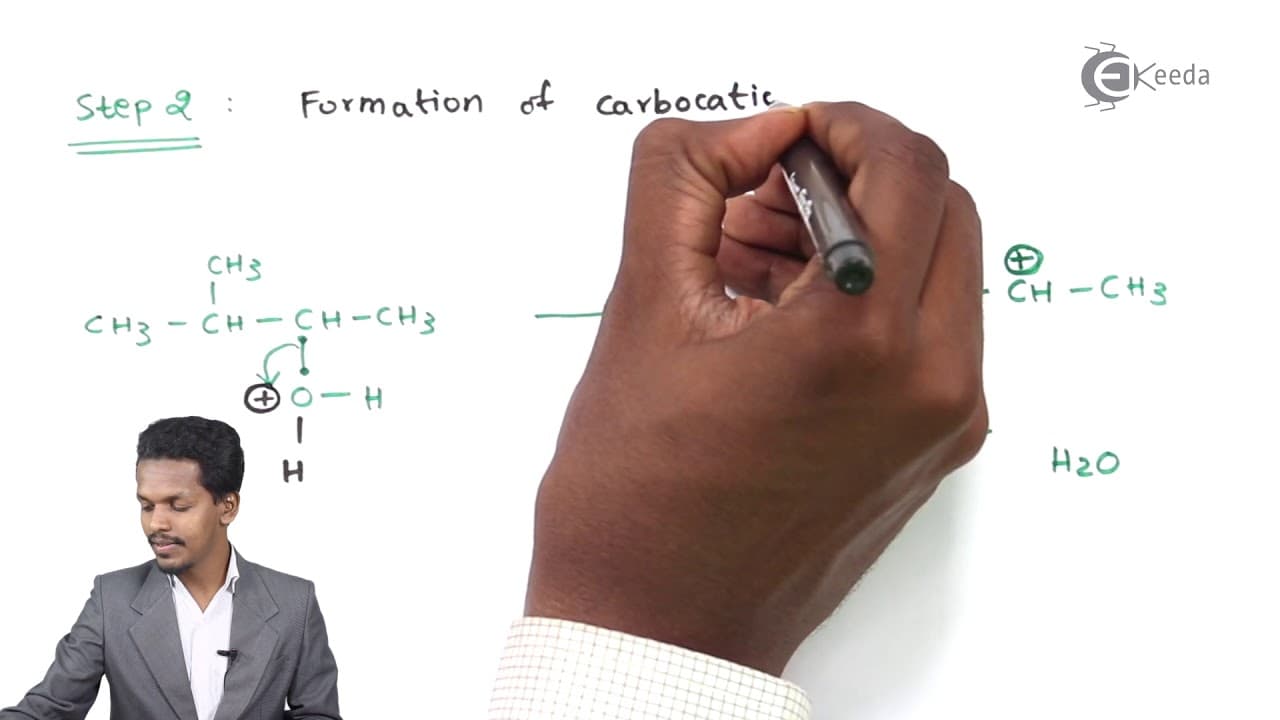
Hydroiodic acid converts secondary alcohols into tertiary alcohols through a three-step mechanism: first, it protonates the alcohol, creating a positively charged intermediate; next, it removes a water molecule to form a carbocation; finally, the iodide ion attacks the carbocation to yield the tertiary alcohol.
Transcript
click the bell icon to get latest videos from equator they should be a concern of the reaction of alcoholics hydroiodic acid in that case we have did a particular example so based on that only we are going to do the mechanism of the detection and the question is suppressing this lobbying you are going to talk about the mechanism of action of there ... Read More
Key Insights
- 💁 Hydroiodic acid reacts with secondary alcohol to form a tertiary alcohol.
- 😑 The mechanism involves protonation of the alcohol, removal of a water molecule, and nucleophilic attack by iodide ion.
- 🫀 Protonation converts the secondary alcohol into a positively charged oxygen atom.
- 💦 Removal of a water molecule forms a carbocation.
- 💁 Nucleophilic attack by iodide ion leads to the formation of a tertiary alcohol.
- 😑 Hydroiodic acid is a strong acid that provides a hydrogen ion for the protonation step.
- 👊 The mechanism proceeds in three steps: protonation, carbocation formation, and nucleophilic attack.
Install to Summarize YouTube Videos and Get Transcripts
Explore YouTube Video Summarizer or Get YouTube Transcript Extractor
Questions & Answers
Q: What is the main reaction discussed in this content?
The main reaction discussed is the reaction between hydroiodic acid and a secondary alcohol to form a tertiary alcohol.
Q: How does hydroiodic acid protonate the alcohol in the mechanism?
Hydroiodic acid protonates the alcohol by donating a hydrogen ion (H+) to the oxygen atom of the alcohol, resulting in the formation of a positively charged oxygen atom.
Q: What happens in step two of the mechanism?
In step two, a water molecule is removed from the positively charged oxygen atom, leading to the formation of a carbocation.
Q: How does the nucleophilic attack by iodide ion occur in step three?
In step three, the iodide ion (I-) attacks the positively charged carbon atom of the carbocation, resulting in the formation of a tertiary alcohol.
Summary & Key Takeaways
-
Hydroiodic acid, a strong acid, reacts with secondary alcohol to produce a tertiary alcohol.
-
The mechanism involves protonating the alcohol, removal of a water molecule, and nucleophilic attack by iodide ion.
-
The reaction proceeds in three steps: protonation of the alcohol, formation of a carbocation, and nucleophilic attack.
Read in Other Languages (beta)
Share This Summary 📚
Summarize YouTube Videos and Get Video Transcripts with 1-Click
Try YouTube Summary with ChatGPT & Claude or YouTube Transcript Generator
Explore More Summaries from Ekeeda 📚




Summarize YouTube Videos and Get Video Transcripts with 1-Click
Try YouTube Summary with ChatGPT & Claude or YouTube Transcript Generator