Radar equation | Derivation | Radar Systems | Lec-05
TL;DR
This video explains how to derive the radar range equation including transmitter and antenna parameters.
Transcript
hi everyone in this video I am going to explain and derive the equation of radar range in the previous video I have explained how to determine the range to the Target using the standard notation like distance is equal to Velocity into time so using this standard notation like a distance is equal to velocity into time using this standard notation we... Read More
Key Insights
- 🧡 The radar range equation, R = CT/2, forms the basis for calculating target distance using speed and time metrics.
- 🧡 Introducing the roles of transmitter power and gain helps in deriving a more accurate radar range equation, enhancing system reliability.
- 📡 Isotropic antennas are ideal for theoretical discussions, while practical applications often require more focused designs like parabolic antennas.
- ✊ The scattering of signals from spherical objects is an essential concept, ensuring power is reflected back to the radar system effectively.
- 😵 The effective area (AE) and cross-sectional area (σ) of the target are critical in determining the power received by radar systems.
- 📡 Understanding the environment and specific antenna adjustments can drastically improve radar detection capabilities.
- 📡 The minimum detectable signal concept helps gauge the effectiveness of radar systems within varied real conditions.
Install to Summarize YouTube Videos and Get Transcripts
Explore YouTube Video Summarizer or Get YouTube Transcript Extractor
Questions & Answers
Q: What is the significance of the equation R = CT/2 in radar systems?
The equation R = CT/2 is central to understanding how the range to a target is calculated in radar systems. It states that the distance is equal to the speed of the electromagnetic signal (C) multiplied by the time taken to travel to the target and back, giving a practical method to estimate how far away a detected object is.
Q: Why is an isotropic antenna mentioned as a reference in the video?
An isotropic antenna is discussed because it radiates power uniformly in all directions, making it a baseline for understanding power density in radar systems. This uniformity helps to simplify calculations of how radar signals behave at various distances, although real-world applications often necessitate more directive antennas.
Q: How do the parameters affect the radar range equation?
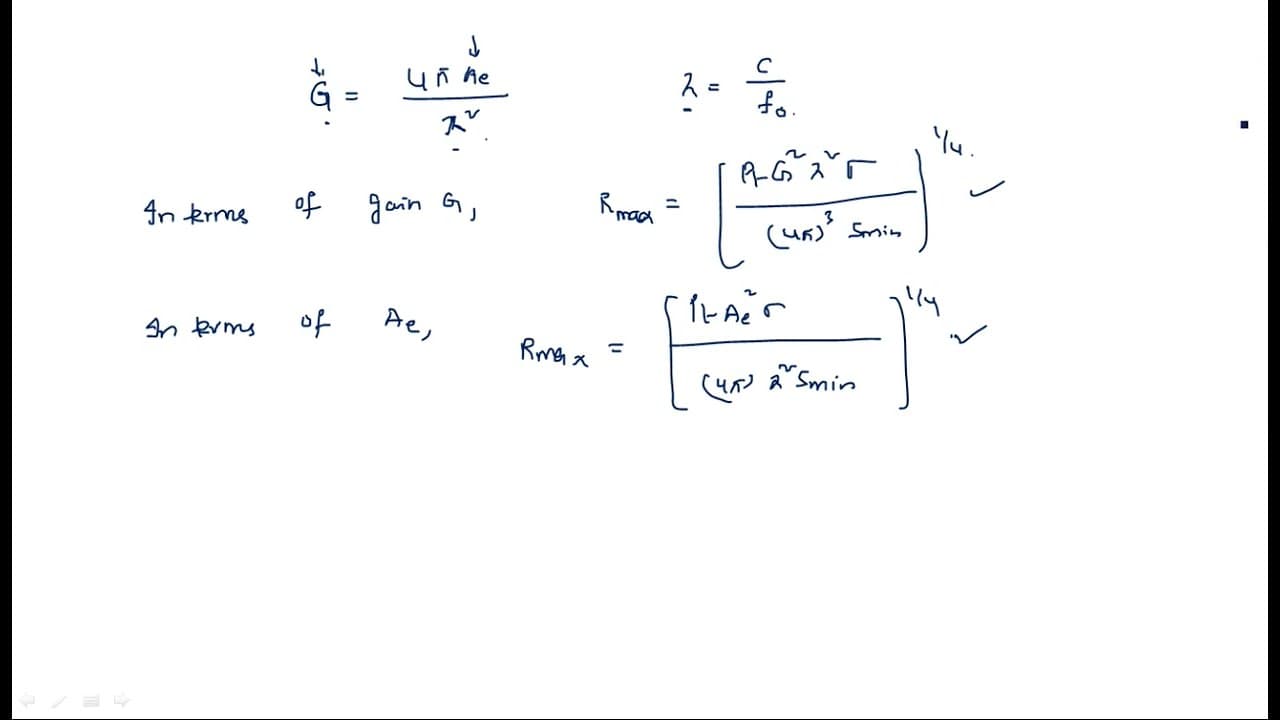
The radar range equation is influenced by several parameters such as transmitter power (PT), gain of the antenna (G), cross-sectional area of the target (σ), and effective aperture area (AE). These factors collectively determine the maximum detectable range of a radar system, affecting its performance in real-time object detection.
Q: What role do parabolic antennas play in radar functionality?
Parabolic antennas are vital for radar systems targeting specific directions because they focus signals into a narrow beam, improving power density in that direction. This targeted approach enhances the radar’s ability to detect and track objects located within that focused range, making it a preferred choice over isotropic antennas in many situations.
Q: How does the concept of minimum detectable signal (S_min) relate to radar range?
The minimum detectable signal (S_min) is crucial for establishing the radar's maximum operational range (R_max). If the received power falls below this threshold, the radar system cannot reliably identify targets. The equation R_max directly incorporates S_min, ensuring that the radar remains effective within its operational limits.
Q: What is the relation between gain (G) and effective aperture (AE) in radar systems?
The relationship between gain (G) and effective aperture (AE) in radar systems is given by the formula G = 4πAE/λ². This relation indicates that both factors contribute to the overall efficiency of signal transmission and reception, where optimizing one can enhance the overall performance of the radar system.
Q: How does the radar range equation change with varying conditions?
The radar range equation adapts according to the operational conditions, such as the distance from the target, transmission power, and environmental factors. Under various scenarios like increasing distance or obstacles in the path, the received power diminishes, which in turn affects the reliability of the detected range, demonstrating the importance of tailored calculations.
Summary & Key Takeaways
-
The video discusses the fundamental concept of radar range determination using the equation R = CT/2, focusing on the significance of including various radar system parameters.
-
It elaborates on the role of antennas, specifically isotropic and parabolic antennas, in broadcasting and receiving power density for radar systems.
-
The final radar range equation is presented, detailing how parameters such as transmitter power and gain relate to the effective range detection of radar systems.
Read in Other Languages (beta)
Share This Summary 📚
Summarize YouTube Videos and Get Video Transcripts with 1-Click
Try YouTube Summary with ChatGPT & Claude or YouTube Transcript Generator