Geog136 Lecture 11.1 Remote sensing basics
TL;DR
This lecture provides a brief overview of remote sensing, including the electromagnetic spectrum and the classification process using remote sensing data.
Transcript
welcome to lecture 11 for geography 136 in this lecture I'm going to be talking about the basics of remote sensing as well as one of these analysis processes that you can conduct just using remote sensing data which is called classification or image classification so this is going to be a pretty brief introduction to both of these things I'm actual... Read More
Key Insights
- 🌍 Overview of Remote Sensing and Classification:
- Remote sensing is the process of obtaining images of Earth's surface using sensors, which can be on satellites or airplanes.
- Classification is a method in remote sensing that groups pixels or areas on the ground into specific categories based on features such as land cover.
- 🔍 Understanding the Electromagnetic Spectrum:
- The electromagnetic spectrum is the range of energy emitted by the Sun and includes wavelengths from radio waves to gamma rays.
- Remote sensing focuses on the visible and infrared parts of the spectrum, as these are the areas that can be sensed by sensors.
- ♻️ Different Interactions of Energy with Matter:
- Energy from the Sun can be transmitted, absorbed, reflected, scattered, or emitted by objects on Earth's surface.
- Remote sensing primarily focuses on measuring reflectance, which is the energy that is reflected back from an object in a specific part of the spectrum.
- 📷 Sensors and Bands in Remote Sensing:
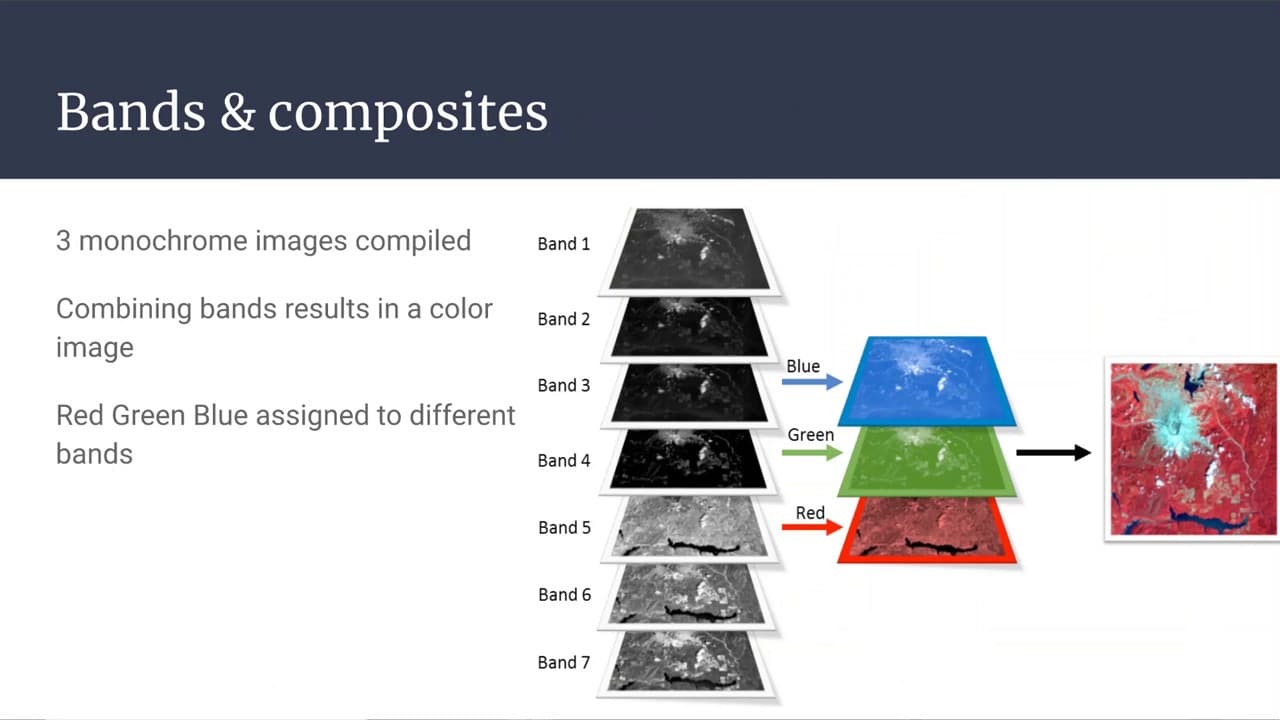
- Sensors in remote sensing detect radiation in specific wavelength ranges, known as bands.
- Multi-spectral sensors, like those on the Landsat satellites, detect reflectance in multiple bands, which can then be combined to create images.
- 🎨 Color composites in Remote Sensing:
- Remote sensing images can be visualized as true color composites, where red, green, and blue bands are assigned to corresponding RGB slots.
- False color composites can also be created by assigning different bands to the RGB slots, allowing for different interpretations of the data.
- 📊 Indices in Remote Sensing:
- Indices are created by combining bands in different ways to highlight specific features of interest.
- The Normalized Difference Vegetation Index (NDVI) is a common index used to detect vegetation, highlighting areas of high photosynthetic activity.
- NDVI provides better separation of highly photosynthetic vegetation from less vegetated areas compared to other band combinations.
- It is a valuable tool for analyzing vegetation health and distribution in remote sensing applications.
- 🌐 Limitations of Hyperspectral Sensors:
- Hyperspectral sensors, which detect continuous zones within the spectrum, are not commonly used in remote sensing due to their experimental nature and limited practicality for large-scale applications.
Install to Summarize YouTube Videos and Get Transcripts
Explore YouTube Video Summarizer or Get YouTube Transcript Extractor
Questions & Answers
Q: What is remote sensing and how does it contribute to geographic analysis?
Remote sensing is the process of capturing images of Earth's surface using sensors on satellites or airplanes, which helps in geographic analysis by providing valuable data on land cover, vegetation, urban areas, and more. By analyzing these images, researchers can gain insights into various environmental factors and make informed decisions.
Q: How does the electromagnetic spectrum play a role in remote sensing?
The electromagnetic spectrum is the range of energy that moves at the speed of light and is emitted by the Sun. Remote sensing focuses on specific parts of the spectrum, such as the visible and infrared regions, to capture information about Earth's surface. Different objects interact with this energy in unique ways, allowing us to gather valuable data.
Q: How is classification done using remote sensing data?
Classification in remote sensing involves grouping pixels or areas on the ground into specific categories based on their spectral properties. This is typically done using GIS software, where different methods can be employed to classify land cover or specific objects like trees or houses. Classification helps in understanding and analyzing patterns on Earth's surface.
Q: What are band combinations and how are they used in remote sensing?
Band combinations involve combining different bands of information gathered by remote sensing sensors to create color composite images. By assigning different bands to the red, green, and blue channels, we can visually distinguish different features on Earth's surface. These combinations help in enhancing specific characteristics and drawing out differences between objects or phenomena.
Q: How do indices like NDVI contribute to remote sensing analysis?
Indices like the Normalized Difference Vegetation Index (NDVI) are derived from specific band combinations and provide a numerical value for analyzing vegetation density and health. NDVI highlights the differences between near-infrared and red reflectance, allowing us to assess areas of high vegetation activity. This index is widely used in agriculture, forestry, and environmental studies.
Summary & Key Takeaways
-
Remote sensing is the process of using sensors to capture images of Earth's surface from satellites or airplanes, and these sensors measure radiation in specific wavelength ranges called bands.
-
Classification is an analysis process that groups pixels or areas on the ground into specific categories, such as land cover or specific objects, based on the information obtained from remote sensing data.
-
The lecture explains the basics of remote sensing, the electromagnetic spectrum, band combinations, and the use of indices like NDVI for analyzing and visualizing data.
Read in Other Languages (beta)
Share This Summary 📚
Summarize YouTube Videos and Get Video Transcripts with 1-Click
Try YouTube Summary with ChatGPT & Claude or YouTube Transcript Generator