What Is International Trade and How Does It Affect Us?
TL;DR
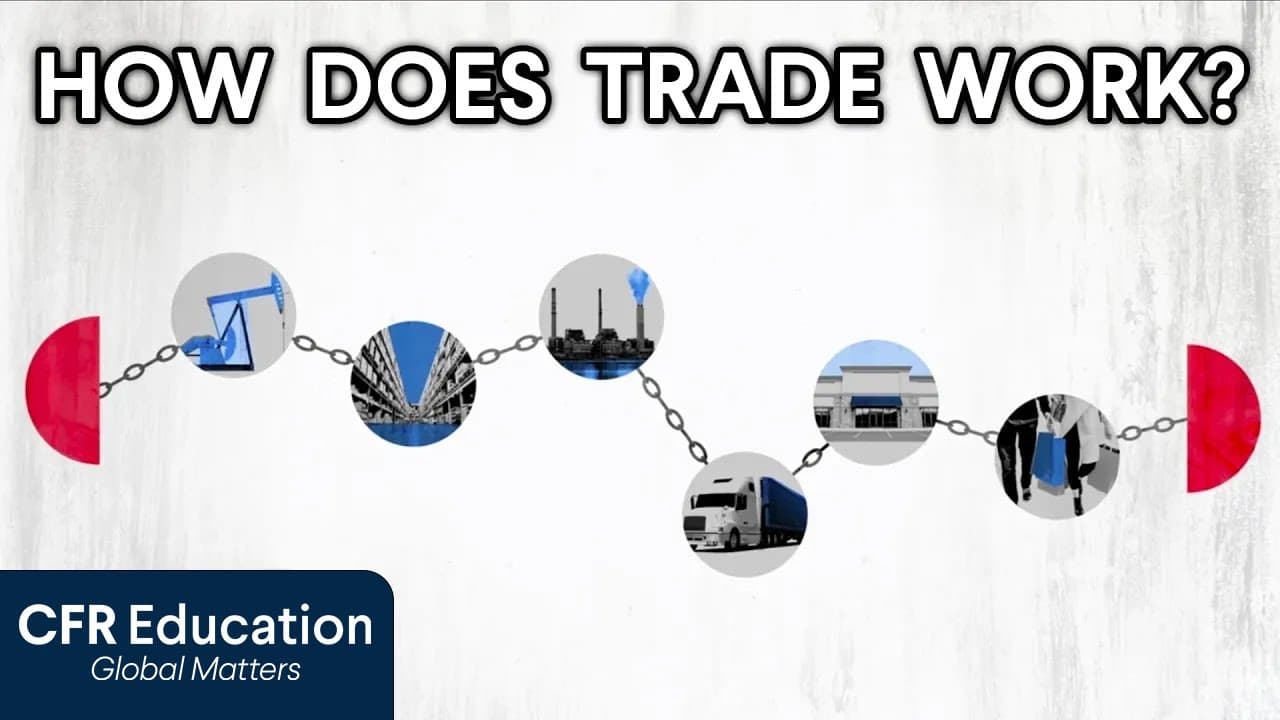
International trade refers to the exchange of goods and services across borders, allowing countries to specialize in their most efficient production. This system, evolving from mercantilism to today's focus on comparative advantage, has led to global economic growth and job creation, while also posing challenges for local industries competing with imports. Policymakers must support those disadvantaged by trade to ensure equitable benefits.
Transcript
Every day, a network of ships, trucks and planes move massive quantities of goods around the world. Your car might come from South Korea, and your T-shirt from Bangladesh. All countries export, sell products and services abroad and import buy goods and services from foreign trading partners. These goods are manufactured items or agricultural commod... Read More
Key Insights
- International trade involves a complex network of goods and services moving globally, supported by intricate supply chains that span multiple countries.
- Historically, mercantilism dominated trade policies, focusing on self-sufficiency and gold accumulation, but modern trade emphasizes comparative advantage and specialization.
- Classical economists argued that countries benefit more by specializing in what they produce best and trading for other goods and services.
- The rise of international trade was facilitated by technological advancements and the establishment of global trade agreements like GATT, which evolved into the WTO.
- The WTO plays a crucial role in regulating international trade, but faces criticism for not adequately addressing issues like unfair trade practices and agricultural subsidies.
- Trade agreements, such as NAFTA, aim to facilitate regional trade and have inspired similar agreements worldwide, significantly increasing global trade volume.
- While international trade has created economic growth and job opportunities, it also poses challenges for local industries unable to compete with cheaper imports.
- Policymakers face the challenge of supporting those negatively impacted by trade, ensuring that everyone benefits from the global trade system.
Install to Summarize YouTube Videos and Get Transcripts
Explore YouTube Video Summarizer or Get YouTube Transcript Extractor
Questions & Answers
Q: What is the role of the WTO in international trade?
The World Trade Organization (WTO) is pivotal in regulating international trade by establishing rules and guidelines that member countries must follow. It aims to reduce trade barriers, resolve disputes, and promote free trade globally. However, the WTO faces criticism for not adequately addressing issues like unfair trade practices and for the difficulty in achieving consensus among its 164 member countries.
Q: How did classical economists influence modern trade practices?
Classical economists challenged mercantilist policies by advocating for trade based on comparative advantage. They argued that countries benefit more by specializing in products they produce efficiently and trading for other goods. This specialization leads to innovation and economic growth, shifting the focus from gold accumulation to productivity and GDP as measures of economic success.
Q: What impact did technological advancements have on international trade?
Technological advancements, such as the development of massive container ships, cargo planes, and instantaneous communication, have significantly impacted international trade by making remote markets more accessible. These innovations have facilitated the rapid movement of goods globally, connecting producers with millions of new customers and contributing to the exponential growth of global trade volumes.
Q: What challenges do local industries face due to international trade?
Local industries often struggle to compete with imported goods that are either cheaper or of higher quality due to international trade. This competition can lead to the closure of local businesses and job losses in affected sectors. Policymakers are challenged to provide support and retraining for displaced workers to help them transition to new roles in the evolving global economy.
Q: How did the transition from mercantilism to modern trade systems occur?
The transition from mercantilism to modern trade systems occurred as classical economists refuted the idea of self-sufficiency and gold accumulation. They introduced the concept of comparative advantage, encouraging countries to specialize in what they produce best and trade for other goods. This shift was supported by technological advancements and the establishment of global trade agreements, facilitating the growth of international trade.
Q: What are the benefits of trade agreements like NAFTA?
Trade agreements like NAFTA are designed to facilitate trade among member countries by reducing tariffs and other trade barriers. They provide a framework for increased economic cooperation and have significantly boosted trade volumes, leading to economic growth and job creation. These agreements also serve as models for similar trade pacts worldwide, further integrating the global economy.
Q: What criticisms does the WTO face in regulating international trade?
The WTO faces criticism for its inability to adequately address unfair trade practices and agricultural subsidies that disadvantage developing countries. Additionally, changes to WTO rules require consensus among all member countries, making it challenging to implement necessary reforms. Critics argue that the WTO needs to evolve to better address the complexities of modern global trade.
Q: How does international trade contribute to global stability?
International trade contributes to global stability by creating economic interdependence among countries, reducing the likelihood of conflict. It provides access to a wider range of goods and services, enhances economic growth, and creates job opportunities. However, trade can also create disparities, requiring policymakers to balance the benefits of trade with support for those negatively impacted.
Summary & Key Takeaways
-
International trade is a vast network involving the movement of goods and services across borders, supported by complex supply chains. It has evolved from mercantilism to a system emphasizing comparative advantage, where countries specialize in what they produce best, enhancing global economic productivity.
-
The shift from gold accumulation to GDP measurement, along with technological advancements, has propelled international trade. Organizations like the WTO regulate trade, but face challenges in addressing unfair practices and ensuring equitable benefits for all countries, especially developing nations.
-
Trade agreements like NAFTA have boosted global trade volumes, creating economic growth and job opportunities. However, they also present challenges for local industries that struggle to compete with imports. Policymakers must address these disparities to ensure a balanced global trade system.
Read in Other Languages (beta)
Share This Summary 📚
Summarize YouTube Videos and Get Video Transcripts with 1-Click
Try YouTube Summary with ChatGPT & Claude or YouTube Transcript Generator
Explore More Summaries from CFR Education 📚
Summarize YouTube Videos and Get Video Transcripts with 1-Click
Try YouTube Summary with ChatGPT & Claude or YouTube Transcript Generator