Root Locus | System stability | Example | Control Systems | Lec-68
TL;DR
Analyzing system stability using root locus focuses on pole placements and their implications.
Transcript
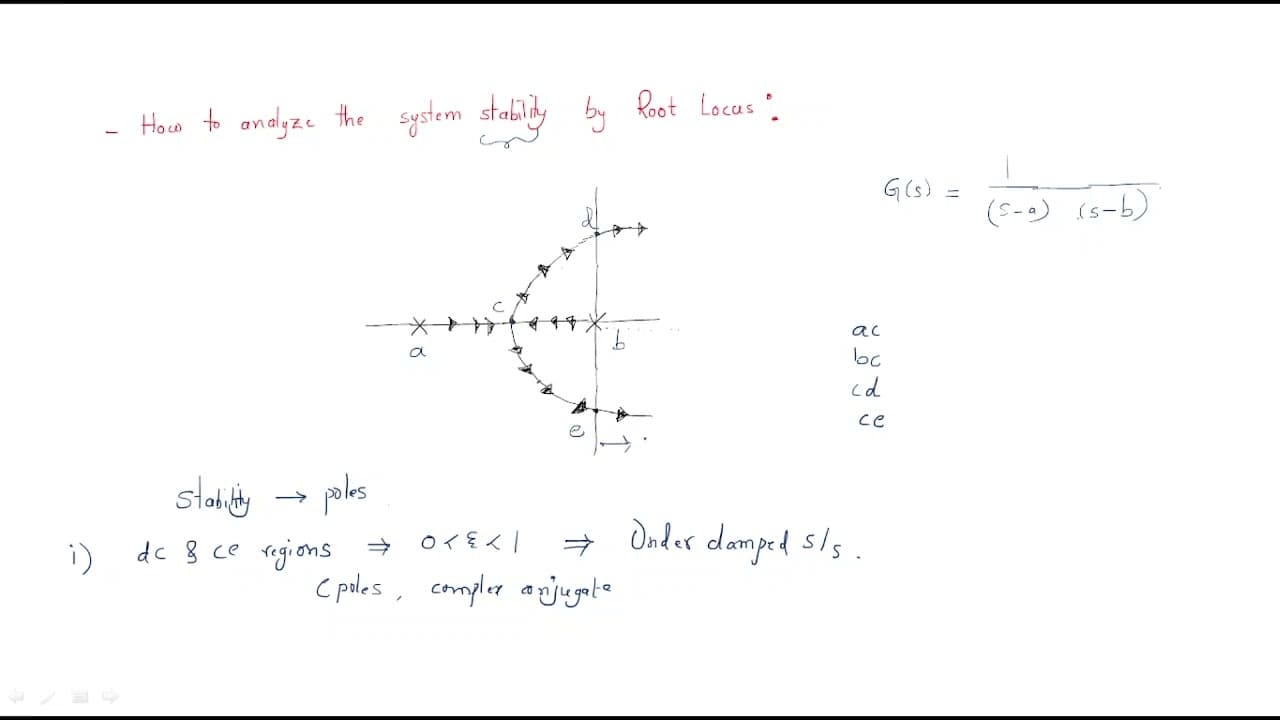
hello everyone up to now we discussed about root locus root locus problems so how we are solving the root locus but here the most important thing is how to analyze the system stability by the root locus our intention is to system stability yeah how to analyze the system stability what is stability what is the meaning of stability generally when bou... Read More
Key Insights
- 💈 System stability is predominantly determined by the location of poles within the complex plane, impacting response behavior.
- 🥳 An appropriate understanding of damping ratios helps differentiate between underdamped, overdamped, and critically damped systems.
- 🤩 The interaction of poles with the imaginary axis is key in assessing if a system is marginally stable.
- 💁 Regions formed by pole placements enable engineers to visualize and analyze stability more effectively.
- 💈 Left half-plane poles guarantee system stability, while right half-plane poles indicate instability.
- 🦻 Understanding these dynamics aids in controlled system design, ensuring desirable performance characteristics.
- 💈 Poles need to be analyzed within specific regions to ensure proper damping and stability.
Install to Summarize YouTube Videos and Get Transcripts
Explore YouTube Video Summarizer or Get YouTube Transcript Extractor
Questions & Answers
Q: What is the basic principle of analyzing system stability using root locus?
The basic principle of analyzing system stability using root locus hinges on the placement of poles within specific regions of the complex plane. The poles indicate how the system responds to input; if they lie within the left half-plane, the system is stable. Conversely, poles in the right half-plane signal instability.
Q: How do you determine if a system is marginally stable?
A system is considered marginally stable when poles lie exactly on the imaginary axis of the complex plane. This condition indicates that while the system doesn’t diverge, it doesn’t settle to a stable state over time, showcasing oscillatory behavior indefinitely.
Q: What characterizes an underdamped system?
An underdamped system is characterized by having complex conjugate poles located in the left half-plane but close to the imaginary axis. This arrangement leads to oscillations that gradually decrease in amplitude, indicating the system responds to inputs but does not settle quickly.
Q: What does it mean when poles are in the right half-plane?
When poles are located in the right half-plane, the system is classified as unstable. This signifies that inputs cause the output to diverge rather than converge, leading to potential runaway behavior in the system response.
Q: Can you explain the concepts of critically damped and overdamped systems?
A critically damped system has poles situated exactly at the edge of oscillation (real, repeated roots) reflecting the quickest response without overshooting. An overdamped system, by contrast, has real roots but they are distinct and located in the left half-plane, leading to a slower return to equilibrium without oscillation.
Q: How does the damping ratio affect the stability and response of a system?
The damping ratio (zeta) significantly influences how a system responds to perturbations. A zeta less than one indicates an underdamped system with oscillations, a zeta equal to one signifies critically damped behavior with no overshoot, and a zeta greater than one indicates an overdamped system that returns to stability without oscillatory motion.
Q: What is the importance of regions defined between poles in root locus?
The regions defined between poles on the root locus are crucial as they dictate the nature of the system’s response and stability. For example, the stability can change based on whether poles fall between specific points like ac, bc, or along the imaginary axis, guiding engineers in the design and analysis of control systems.
Q: How does pole placement influence the overall system design?
Pole placement is vital in system design as it directly affects stability, response time, and the behavior of the system under various inputs. By strategically positioning poles within ideal regions, engineers can ensure desired performance metrics are met, optimizing the response and stability criteria for specific applications.
Summary & Key Takeaways
-
The discussion revolves around analyzing system stability through root locus, emphasizing the role of pole locations and damping ratios.
-
Stability is defined by bounded outputs in response to boundary inputs, and different regions related to poles influence whether a system is stable or unstable.
-
Key findings include characterizing underdamped, critically damped, and overdamped systems based on pole placements relative to the imaginary axis and other critical points on the root locus.
Read in Other Languages (beta)
Share This Summary 📚
Summarize YouTube Videos and Get Video Transcripts with 1-Click
Try YouTube Summary with ChatGPT & Claude or YouTube Transcript Generator