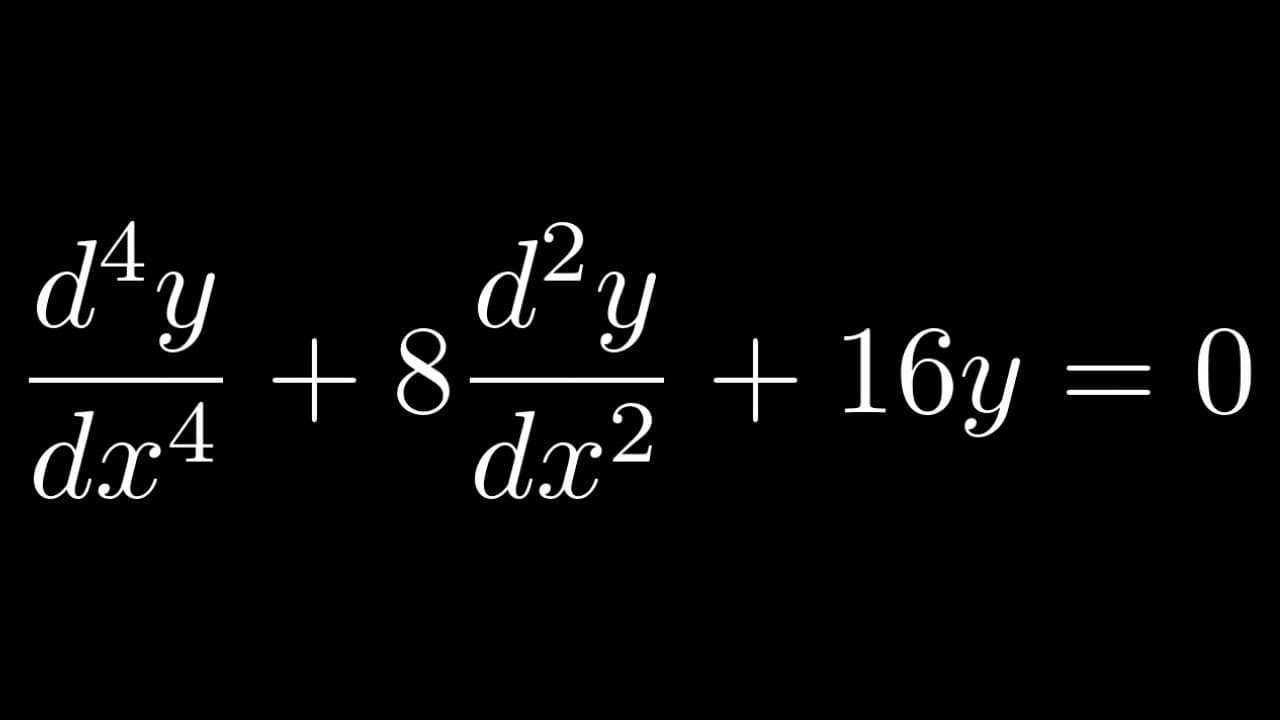
Solve the Fourth Order Differential Equation d^4y/dx^4 - 8d^2y/dx^2 + 16y = 0
TL;DR
Solving fourth-order homogeneous differential equations with complex conjugate solutions through auxiliary equations and multiplicity concepts.
Transcript
in this problem we have a fourth order linear differential equation that's equal to zero that means it's homogeneous so the first thing you want to do in a problem like this is write down the auxiliary equation so you look at the order of the derivative so in this case this is the fourth derivative so you write down m to the fourth and then plus ei... Read More
Key Insights
- 🦮 The auxiliary equation is crucial in solving fourth-order linear differential equations, guiding the derivation of complex conjugate solutions.
- 🫚 Factorization aids in determining the roots of the auxiliary equation, especially when dealing with repeated complex roots.
- 🖐️ Multiplicity plays a significant role in adjusting the final solution for differential equations with repeated complex roots.
- 🫚 Recognizing the presence of multiplicity 2 indicates a repeated complex root in the differential equation solution process.
- 🖐️ Trigonometric functions come into play when solving differential equations with complex conjugate solutions.
- ☺️ Incorporating x terms into the solution is necessary when addressing multiplicity in repeated complex roots for accurate results.
- 🫚 Understanding the significance of repeated complex roots helps in handling more challenging differential equation problems effectively.
Install to Summarize YouTube Videos and Get Transcripts
Explore YouTube Video Summarizer or Get YouTube Transcript Extractor
Questions & Answers
Q: How do you determine the auxiliary equation in solving fourth-order linear homogeneous differential equations?
To find the auxiliary equation, identify the order of derivatives in the equation and write down the corresponding terms, which involve m raised to the power of the derivative order.
Q: Why does a fourth-order homogeneous differential equation with complex conjugate solutions result in multiplicity 2?
In this case, the auxiliary equation has a squared term, indicating a repeated complex root, which leads to a multiplicity of 2 in the final solution involving trigonometric functions.
Q: How is the solution modified when dealing with a repeated complex root in a fourth-order differential equation?
When encountering a repeated complex root, the solution includes additional terms multiplied by x to account for the multiplicity, altering the form of the final answer.
Q: What key concept is essential in solving fourth-order linear homogeneous differential equations with complex conjugate solutions?
Understanding the concept of multiplicity and recognizing repeated complex roots is crucial in accurately determining the final solution for such differential equations.
Summary & Key Takeaways
-
Identify the auxiliary equation by considering the derivatives involved in the fourth-order linear differential equation.
-
Utilize factorization to determine complex conjugate solutions for m in the auxiliary equation.
-
Apply the multiplicity concept to derive the final solution involving trigonometric functions and x due to a repeated complex root.
Read in Other Languages (beta)
Share This Summary 📚
Summarize YouTube Videos and Get Video Transcripts with 1-Click
Try YouTube Summary with ChatGPT & Claude or YouTube Transcript Generator
Explore More Summaries from The Math Sorcerer 📚





Summarize YouTube Videos and Get Video Transcripts with 1-Click
Try YouTube Summary with ChatGPT & Claude or YouTube Transcript Generator