IGCSE Physics Revision: Unit 4 Electricity & Magnetism | for Cambridge IGCSE 2023 Syllabus
TL;DR
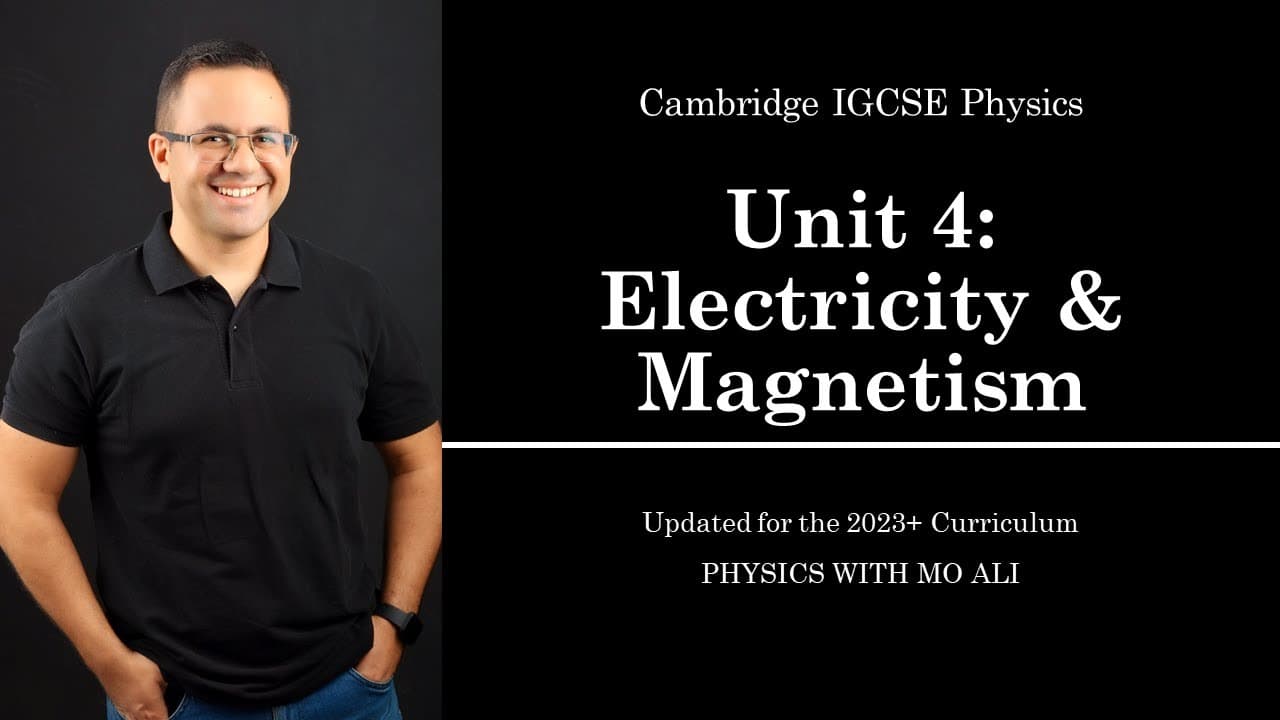
Comprehensive guide to electricity and magnetism for IGCSE Physics 2023.
Transcript
okay okay so in this session we're going to be talking about everybody's favorite unit electricity and magnetism so remember this is split into two parts both electricity and magnetism all right so it's technically two units but it's not as long as full two separate units before we continue remember the syllabus has ... Read More
Key Insights
- The IGCSE Physics 2023 syllabus has removed digital electronics, including logic gates, and added the kilowatt hour as a new unit of energy.
- Static electricity involves charges that do not move in a circuit, with positive and negative charges attracting or repelling each other.
- Current electricity focuses on circuits, explaining concepts like voltage, current, resistance, and the importance of a closed loop for energy transfer.
- Magnetism is explored through the basics of magnets, magnetic fields, and electromagnetic applications like motors, generators, and transformers.
- The right-hand grip rule helps determine the direction of a magnetic field produced by a current-carrying wire, which is circular around the wire.
- Electromagnetic induction generates electricity when a conductor cuts through a magnetic field, with the induced current opposing the change causing it.
- Transformers adjust voltage levels using primary and secondary coils, with step-up transformers increasing voltage and step-down transformers decreasing it.
- Safety features in electrical systems include fuses, circuit breakers, and earth wires to prevent overloads and electrical shocks.
Install to Summarize YouTube Videos and Get Transcripts
Explore YouTube Video Summarizer or Get YouTube Transcript Extractor
Questions & Answers
Q: What changes were made to the IGCSE Physics 2023 syllabus regarding electricity?
The IGCSE Physics 2023 syllabus removed digital electronics, including topics like digital and analog circuits and logic gates. These topics have been shifted to focus more on waves and communication. Additionally, a new unit of energy called the kilowatt hour was added, which is used to measure electrical energy consumed at home.
Q: How is static electricity different from current electricity?
Static electricity involves charges that do not move in a circuit. It deals with the attraction and repulsion of positive and negative charges without the flow of current. In contrast, current electricity involves the flow of charges through a circuit, where energy is transferred from a power source to a device. Current electricity focuses on concepts like voltage, current, and resistance in circuits.
Q: What are the key concepts covered under magnetism in the video?
The video covers the basics of magnetism, including the nature of magnets and magnetic fields. It explains how magnetic fields are regions where magnets experience force, represented by lines from the North to South poles. The video also discusses electromagnetic applications like motors, generators, and transformers, which utilize magnetic fields to perform various functions.
Q: How does the right-hand grip rule help in understanding magnetic fields?
The right-hand grip rule is used to determine the direction of the magnetic field produced by a current-carrying wire. By using the right hand, the thumb represents the direction of the current, while the curvature of the fingers indicates the direction of the magnetic field. This rule helps visualize the circular magnetic field around a wire, which is crucial for understanding electromagnetism.
Q: What is electromagnetic induction and how is it achieved?
Electromagnetic induction is the process of generating electricity when a conductor cuts through a magnetic field. It is achieved by moving a wire or magnet so that the magnetic field lines are cut, inducing a current in the conductor. The direction of the induced current is such that it opposes the change causing it, according to Lenz's law. This principle is fundamental in the operation of generators and transformers.
Q: How do transformers adjust voltage levels in electrical systems?
Transformers consist of primary and secondary coils and an iron core. They adjust voltage levels by using the ratio of turns in the coils. A step-up transformer increases voltage by having more turns in the secondary coil compared to the primary coil, while a step-down transformer decreases voltage by having fewer turns in the secondary coil. This adjustment is crucial for efficient electricity transmission and safe household voltage levels.
Q: What safety features are highlighted for electrical systems in the video?
The video highlights several safety features for electrical systems, including fuses, circuit breakers, and earth wires. Fuses protect circuits from overload by melting when the current is too high, stopping the flow of electricity. Circuit breakers use electromagnets to open a switch and stop the current when it exceeds safe levels. Earth wires redirect current away from metal cases to prevent electrical shocks, enhancing safety in household electrical systems.
Q: Why is high voltage transmission advantageous in power systems?
High voltage transmission is advantageous because it reduces the current in transmission cables, which in turn decreases the heat produced by the cables due to their high resistance. This reduction in heat minimizes energy loss during transmission, making the process more efficient and cost-effective. Step-up transformers increase voltage for long-distance transmission, while step-down transformers decrease voltage to safe levels for household use.
Summary & Key Takeaways
-
The video covers the updated IGCSE Physics 2023 syllabus, focusing on electricity and magnetism, including changes like the removal of digital electronics and the addition of the kilowatt hour. It explains static electricity, where charges attract or repel without moving in a circuit, and current electricity, which involves circuits and concepts like voltage, current, and resistance.
-
Magnetism is discussed, including the basics of magnets and magnetic fields, and applications like motors and transformers. The right-hand grip rule is used to determine magnetic field direction around a current-carrying wire. Electromagnetic induction is explained as generating electricity when a conductor cuts through a magnetic field, with the induced current opposing the change causing it.
-
Transformers are introduced as devices that adjust voltage levels, with step-up transformers increasing voltage and step-down transformers decreasing it. Safety features like fuses, circuit breakers, and earth wires are highlighted as crucial for preventing overloads and electrical shocks in household electrical systems.
Read in Other Languages (beta)
Share This Summary 📚
Summarize YouTube Videos and Get Video Transcripts with 1-Click
Try YouTube Summary with ChatGPT & Claude or YouTube Transcript Generator
Explore More Summaries from Physics with Mo Ali 📚
Summarize YouTube Videos and Get Video Transcripts with 1-Click
Try YouTube Summary with ChatGPT & Claude or YouTube Transcript Generator