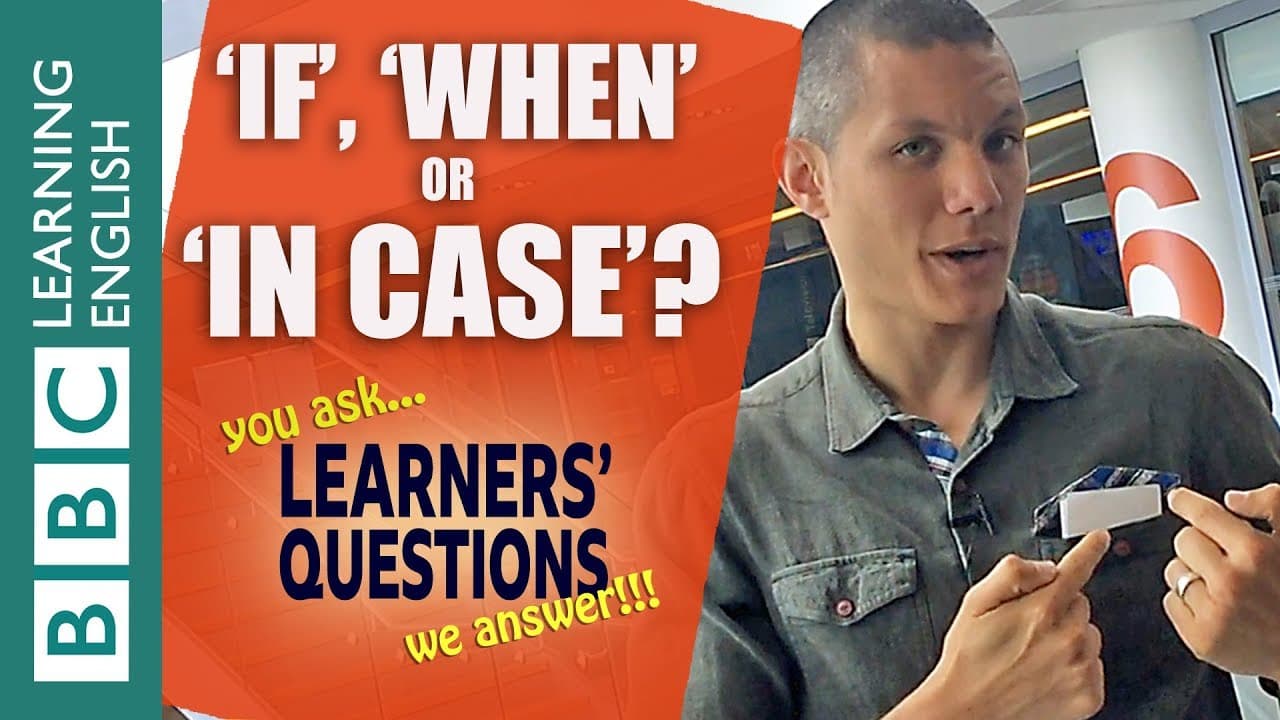
❓'When', 'if' and 'in case' - Improve your English with Learners' Questions
TL;DR
Learn the differences between 'when', 'if', and 'in case' in conditionals.
Transcript
Hi guys! Dan for BBC Learning English here with this week's Learner Question. Find out what it is after this. OK! This week's Learner Question comes from Honza from the Czech Republic, who writes: what is the difference between the use of when and if in all types of conditional sentences? And Trung from Vietnam, who writes: would you please explain... Read More
Key Insights
- The word 'when' is used for events that are certain to happen in the future, even though the present tense is used in the clause.
- The word 'if' is employed for events that may or may not happen, indicating uncertainty about future occurrences.
- 'When' and 'if' can be interchangeable when discussing general situations, where 'if' can mean 'whenever'.
- 'In case' is used to discuss precautions, implying actions taken because another event might occur.
- Using 'in case' describes possible future situations, while 'if' refers to conditions that might apply.
- Example: 'I’ll fill up the car with petrol in case you need to go to Brighton' implies a precautionary action.
- The sentence 'I’ll fill up the car with petrol if you need to go to Brighton' requires confirmation before action.
- The video encourages viewers to send their questions to BBC Learning English for further assistance.
Install to Summarize YouTube Videos and Get Transcripts
Explore YouTube Video Summarizer or Get YouTube Transcript Extractor
Questions & Answers
Q: What is the main difference between 'when' and 'if'?
The main difference between 'when' and 'if' lies in the certainty of the event. 'When' is used for events that are certain to happen in the future, while 'if' is used for events that may or may not occur, indicating uncertainty. The choice between them depends on the speaker's perception of the event's likelihood.
Q: How can 'if' and 'when' be interchangeable?
'If' and 'when' can be interchangeable when discussing general situations where the meaning of 'if' is similar to 'whenever'. In such contexts, both words can imply the same general condition or repeated action. For instance, 'I keep the air-conditioning on at night if/when the temperature goes above 30 degrees' illustrates this interchangeability.
Q: What does 'in case' signify in conditional sentences?
'In case' is used in conditional sentences to discuss taking precautions or actions because another event might happen. It implies preparation for a possible future situation. For example, 'I’ve brought some candles in case there’s a power cut' indicates readiness for an event that may or may not occur.
Q: Can you give an example of using 'in case' and 'if' differently?
Yes, consider the sentences: 'I’ll fill up the car with petrol in case you need to go to Brighton' and 'I’ll fill up the car with petrol if you need to go to Brighton'. The first implies filling the car as a precautionary measure, while the second suggests waiting for confirmation before taking action.
Q: Why is the present tense used in 'when' clauses for future events?
The present tense is used in 'when' clauses for future events to emphasize certainty and immediacy. Although the event is in the future, using the present tense highlights that the occurrence is definite. For example, 'I’ll give you a ring when I get home' uses the present tense to convey certainty about the future action.
Q: What should learners do if they have more questions?
Learners with additional questions are encouraged to contact BBC Learning English via email. They should include 'Learners’ Questions' in the subject line and provide their name and location. While not all questions can be answered due to volume, the team reads every submission and provides resources for further learning on their website.
Q: How does this video help improve English grammar skills?
This video helps improve English grammar skills by clarifying the usage of 'when', 'if', and 'in case' in conditional sentences. By providing clear explanations, examples, and distinctions between these terms, it enhances learners' understanding and application of grammar rules, contributing to more accurate and confident English communication.
Q: What additional resources are available for learners?
In addition to the video, learners can access a wealth of resources on BBC Learning English's website, including courses, activities, and more videos. The platform also offers content on social media channels like YouTube, Instagram, Twitter, and TikTok, providing diverse opportunities for learners to engage with English language materials and improve their skills.
Summary & Key Takeaways
-
The video explains the differences between 'when', 'if', and 'in case' in conditional sentences. 'When' indicates certainty about future events, while 'if' suggests uncertainty. 'In case' is used for precautionary actions. Examples illustrate these differences, enhancing understanding of their proper usage in English grammar.
-
Dan from BBC Learning English addresses questions from learners about using 'when', 'if', and 'in case'. He provides insights into their distinct uses in conditional sentences, emphasizing the importance of context in determining the correct choice. The video serves as a resource for improving English grammar skills.
-
Viewers are encouraged to submit questions to BBC Learning English for personalized assistance. The video highlights the platform's commitment to helping learners enhance their English proficiency by addressing common grammatical queries. It also promotes additional resources available on their website and social media channels.
Read in Other Languages (beta)
Share This Summary 📚
Summarize YouTube Videos and Get Video Transcripts with 1-Click
Try YouTube Summary with ChatGPT & Claude or YouTube Transcript Generator
Explore More Summaries from BBC Learning English 📚

Summarize YouTube Videos and Get Video Transcripts with 1-Click
Try YouTube Summary with ChatGPT & Claude or YouTube Transcript Generator