Permutations and Combinations | People & Questions | Aptitude | Part- 24 | Bharath Kumar
TL;DR
The session covers permutations, combinations, and solving seating arrangements and questions selection.
Transcript
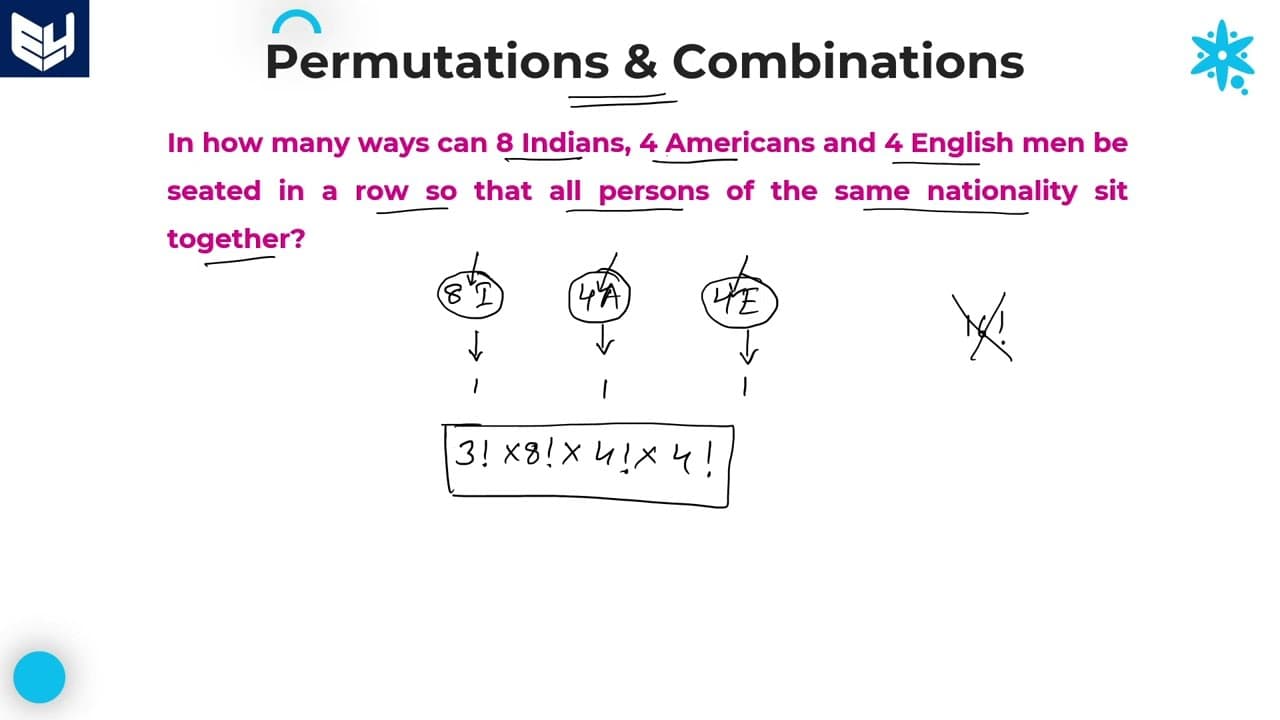
hi everyone welcome to the session in this session i am continuing the problems related to foundations and combinations in the last sessions we already discussed the problems on permutations and combinations let's continue the problems related to pnc see the first question in this session in how many ways in how many ways eight indians four america... Read More
Key Insights
- 👥 Treating groups as single entities simplifies complex arrangement problems in permutations and combinations.
- ❓ The factorial concept is foundational for calculating arrangements when conditions are imposed.
- 💨 The shortcut formula 2^n - 1 is an efficient way to determine combinations of questions without exhaustive calculation.
- 🧘 Arrangement problems often require unique considerations, such as grouping or positioning requirements based on the item's nature.
- 👻 Understanding symmetry in combinations allows for reusing calculated values and simplifies the process.
- ❓ The content emphasizes the importance of adhering to problem conditions for accurate outcomes in combinatorial mathematics.
- 🧑🎓 Exploring diverse combinatorial problems enhances problem-solving strategies for students and practitioners.
Install to Summarize YouTube Videos and Get Transcripts
Explore YouTube Video Summarizer or Get YouTube Transcript Extractor
Questions & Answers
Q: How do you determine the arrangement of people from different nationalities?
To arrange people of different nationalities so that all individuals of the same nationality sit together, you treat each nationality as a single entity. For instance, if you have eight Indians, four Americans, and four Englishmen, you would calculate the arrangements as the factorial of the number of entities multiplied by the factorials of the arrangements within each group.
Q: What is the significance of calculating factorials in permutations and combinations?
Factorials are crucial in permutations and combinations as they represent the number of ways to arrange a set of items. When positioning groups or selecting items, understanding factorial calculations helps in determining the total arrangements possible under specified conditions.
Q: How can a student figure out how many questions they can attempt from an exam?
A student can use combinations to determine the number of ways they can select questions to attempt. By calculating the sum of the combinations from selecting 1 to all available questions, or alternatively applying the shortcut formula 2^n - 1, where n is the total number of questions.
Q: Why is it important to maintain the nationality grouping in the seating problem?
Maintaining nationality grouping is essential for accurate calculations in the seating arrangement problem. It ensures that the arrangement respects the condition that individuals of the same nationality must sit together, affecting how entities are counted and arranged.
Summary & Key Takeaways
-
The session continues from previous discussions on permutations and combinations, focusing on practical problems related to seating arrangements and question selection in exams.
-
A specific problem involves seating eight Indians, four Americans, and four Englishmen with nationality constraints, leading to a calculation using factorials of each group.
-
Another problem discusses the methods for determining how many questions a student can answer from an exam, utilizing both combinatorial selection and a shortcut formula.
Read in Other Languages (beta)
Share This Summary 📚
Summarize YouTube Videos and Get Video Transcripts with 1-Click
Try YouTube Summary with ChatGPT & Claude or YouTube Transcript Generator