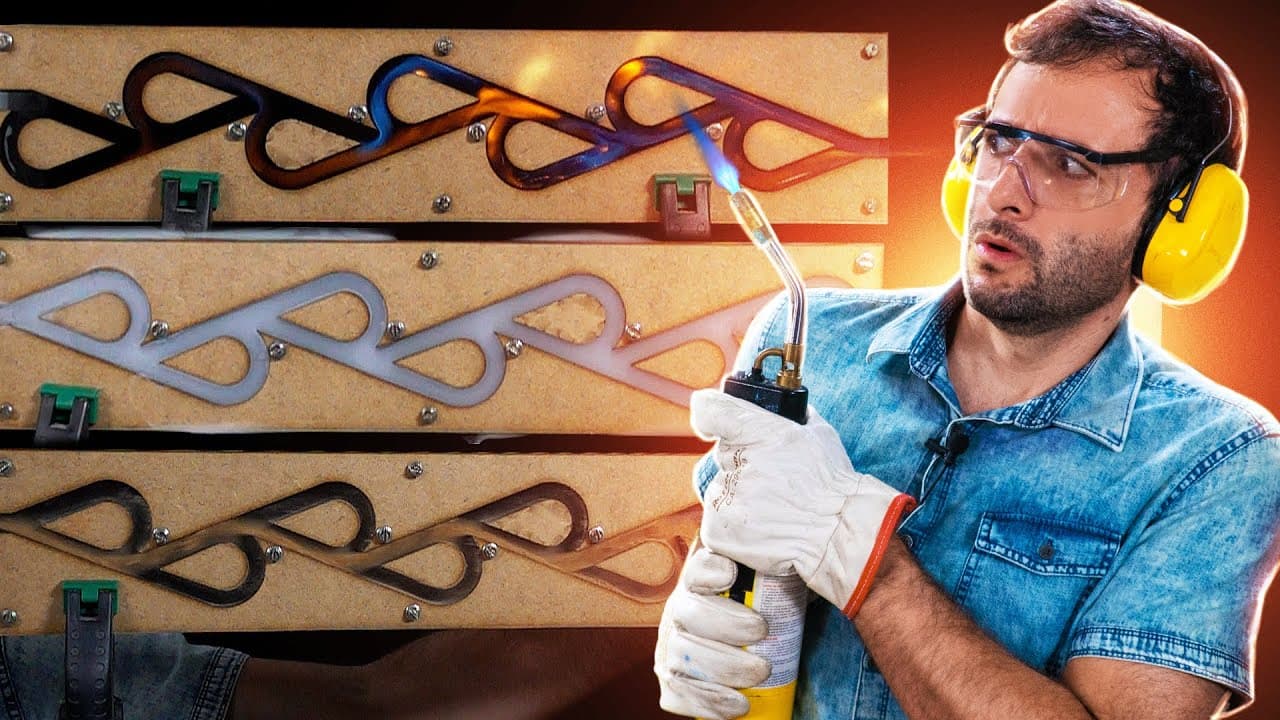
Testamos a VÁLVULA DE TESLA até o LIMITE!
TL;DR
Exploring Tesla valve's unique fluid control without moving parts.
Transcript
Water, Earth, fire, air.. . heart! I mean, heart in this case we won't use today, no. By the union of these powers, today, we are going to test the Tesla valve to the limit. Before anyone thinks that in this video I'm going to talk about Space X and Elon Musk, the name Tesla that we're going to use here has nothing to do with it. Tesla, both in the... Read More
Key Insights
- The Tesla valve, invented by Nikola Tesla, controls fluid flow direction without moving parts, unlike traditional valves.
- Tesla valves create internal turbulence, allowing easy flow in one direction and hindering it in the opposite direction.
- The video demonstrates various tests using air, water, earth (sawdust), and fire to showcase the Tesla valve's functionality.
- 3D printing was used to create models of the Tesla valve for experimental purposes, highlighting its design intricacies.
- Despite its innovative design, Tesla valves are not widely used in practical applications due to their specific operational requirements.
- The video includes a promotional segment for Alura, an educational platform offering courses in technology and design.
- Visual experiments with smoke and fire illustrate how the Tesla valve affects fluid dynamics by creating chaotic flow patterns.
- The Tesla valve's potential applications include high-pressure fluid systems and jet engine designs, where pulsing fluids are involved.
Install to Summarize YouTube Videos and Get Transcripts
Explore YouTube Video Summarizer or Get YouTube Transcript Extractor
Questions & Answers
Q: What is a Tesla valve and how does it differ from traditional valves?
A Tesla valve, invented by Nikola Tesla, is a type of check valve that controls fluid flow direction without moving parts. Unlike traditional valves with mechanical components, the Tesla valve uses the fluid's own motion to create turbulence and resistance, allowing flow in one direction while blocking it in the opposite direction.
Q: How does the Tesla valve create resistance without moving parts?
The Tesla valve creates resistance by using the fluid's own dynamics. Its internal design causes the fluid to form chaotic patterns and turbulence, which hinders flow in one direction. This unique feature eliminates the need for mechanical components like springs or pistons, relying solely on the fluid's behavior to control the flow.
Q: What experiments were conducted to demonstrate the Tesla valve's function?
The video conducted experiments using air, water, sawdust (representing earth), and fire to demonstrate the Tesla valve's function. These tests showcased how the valve allows fluid to flow easily in one direction while creating resistance in the opposite direction, highlighting its unique ability to control flow without moving parts.
Q: What challenges were encountered during the Tesla valve experiments?
Challenges included ensuring the valve's design effectively demonstrated its function, as initial models allowed fluid to bypass the intended path. The experiments required precise construction and testing with different materials to visualize fluid dynamics. Additionally, maintaining structural integrity during tests, especially with water, was a concern due to potential damage to the valve.
Q: Why is the Tesla valve not widely used in practical applications?
The Tesla valve is not widely used because its unique design is suited for specific scenarios involving high-pressure or pulsing fluids. Its complexity and reliance on fluid dynamics make it less practical for everyday applications compared to traditional valves with simple mechanical components. Its niche applications limit its widespread adoption.
Q: What educational content is promoted in the video?
The video promotes Alura, an educational platform offering courses in technology, design, and digital business. It highlights the benefits of becoming a T-shaped professional with expertise in a specific area while having knowledge in various fields. A discount link for Alura is provided under the video for viewers interested in expanding their skills.
Q: How did the video visually demonstrate the Tesla valve's effects?
The video used smoke, sawdust, and colored water to visually demonstrate the Tesla valve's effects. These materials highlighted how the valve's design creates turbulence and resistance, allowing viewers to see the chaotic flow patterns and understand how the valve controls fluid direction without moving parts. Slow-motion footage further emphasized these effects.
Q: What potential applications exist for the Tesla valve?
Potential applications for the Tesla valve include high-pressure fluid systems and jet engine designs, where its ability to handle pulsing fluids is advantageous. Its unique flow control mechanism could be beneficial in specialized industrial settings, although its complexity and niche functionality limit its use in broader applications.
Summary & Key Takeaways
-
The Tesla valve, named after inventor Nikola Tesla, uniquely controls fluid flow without moving parts, relying on the fluid itself to create resistance.
-
Experiments with air, water, earth, and fire demonstrate the valve's ability to allow flow in one direction while obstructing it in the other.
-
Despite its innovative design, the Tesla valve is not commonly used in everyday applications, but it offers insights into fluid dynamics.
Read in Other Languages (beta)
Share This Summary 📚
Summarize YouTube Videos and Get Video Transcripts with 1-Click
Try YouTube Summary with ChatGPT & Claude or YouTube Transcript Generator
Explore More Summaries from Manual do Mundo 📚
Summarize YouTube Videos and Get Video Transcripts with 1-Click
Try YouTube Summary with ChatGPT & Claude or YouTube Transcript Generator