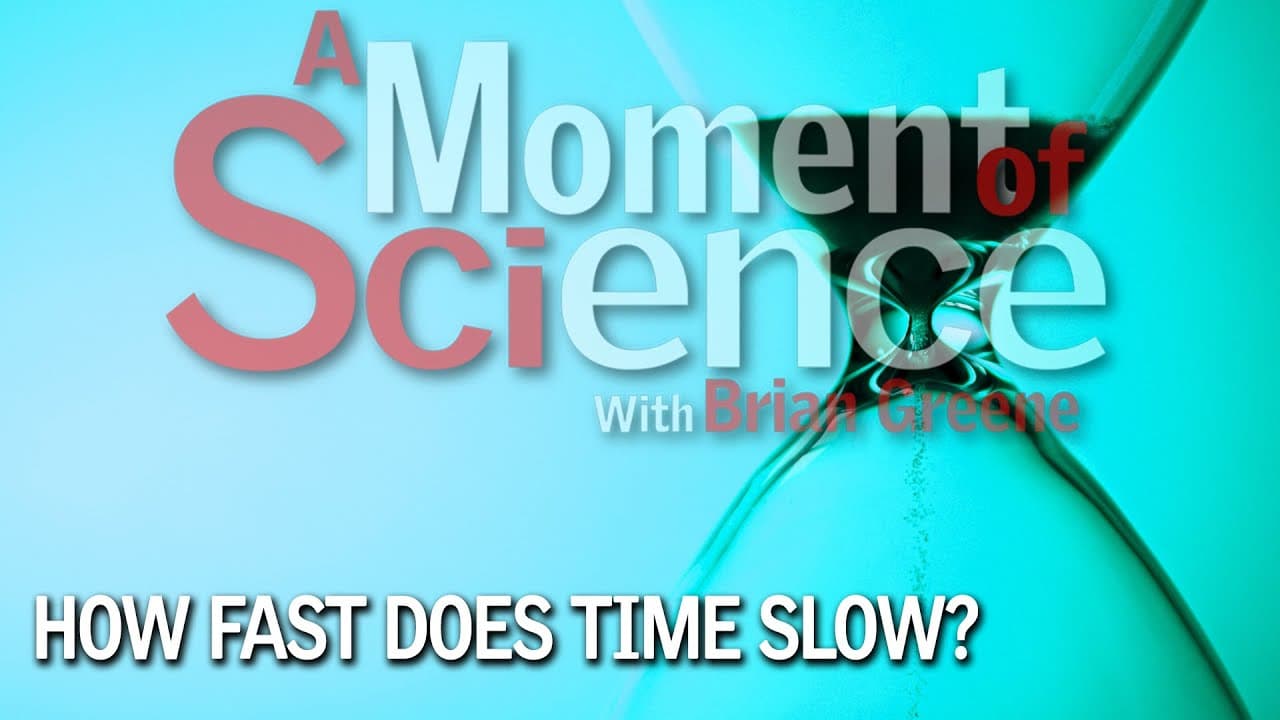
How fast does time slow?
TL;DR
Time slows down for objects in motion compared to stationary ones, explained through visual illustrations.
Transcript
when Einstein realized that time elapses more slowly for an object in motion compared to the rate which of the lapses for us here on a stationary clock he didn't just make a qualitative statement he made a quantitative statement he wrote down a formula that tells us how much more slowly time will elapse on that moving object and if you like equatio... Read More
Key Insights
- ⌛ Einstein's formula precisely quantifies the slowdown of time for objects in motion.
- 🐎 Time dilation is not noticeable at everyday speeds but becomes apparent as the velocity approaches the speed of light.
- ⏲️ Visual illustrations of clocks on a spaceship moving at different velocities demonstrate the concept of time dilation effectively.
- 🐎 Time dilation would be intuitive and apparent if we routinely traveled at speeds near the speed of light.
- 🚄 Our lack of experience with high speeds contributes to the unfamiliarity of time dilation.
- ⌛ Time dilation is a fundamental aspect of Einstein's theory of relativity.
- ⌛ The formula for time dilation allows for precise calculations of the extent of time slowdown.
Install to Summarize YouTube Videos and Get Transcripts
Explore YouTube Video Summarizer or Get YouTube Transcript Extractor
Questions & Answers
Q: How did Einstein quantify the slowdown of time for objects in motion?
Einstein developed a formula, 1/sqrt(1-V^2/C^2), where V is the object's speed and C is the speed of light, to calculate the extent of time dilation.
Q: Why is the slowdown of time not noticeable at everyday speeds?
At slower speeds, such as a thousand miles per hour, the time dilation is too minuscule for us to perceive, which is why we don't notice it in our daily lives.
Q: What happens to time dilation as the velocity of the object increases?
As the velocity approaches the speed of light, the slowdown of time becomes increasingly significant, as demonstrated by the progressively noticeable difference in time elapsed on the spaceship clock compared to the stationary clock.
Q: Why is time dilation not intuitive to us if we don't experience it in our everyday lives?
We never reach speeds anywhere near the speed of light in our normal activities, which is why the concept of time dilation is not intuitive. If we routinely traveled at such speeds, the dramatic slowing of time near the speed of light would be obvious to us.
Summary & Key Takeaways
-
Einstein's formula quantitatively explains how time elapses more slowly for objects in motion compared to stationary ones.
-
At everyday speeds, the slowdown is too small to notice, but at speeds approaching the speed of light, time dilation becomes apparent.
-
Visual illustrations of clocks on a spaceship moving at different velocities demonstrate the progressively noticeable slowdown in time.
Read in Other Languages (beta)
Share This Summary 📚
Summarize YouTube Videos and Get Video Transcripts with 1-Click
Try YouTube Summary with ChatGPT & Claude or YouTube Transcript Generator
Explore More Summaries from World Science Festival 📚



Summarize YouTube Videos and Get Video Transcripts with 1-Click
Try YouTube Summary with ChatGPT & Claude or YouTube Transcript Generator