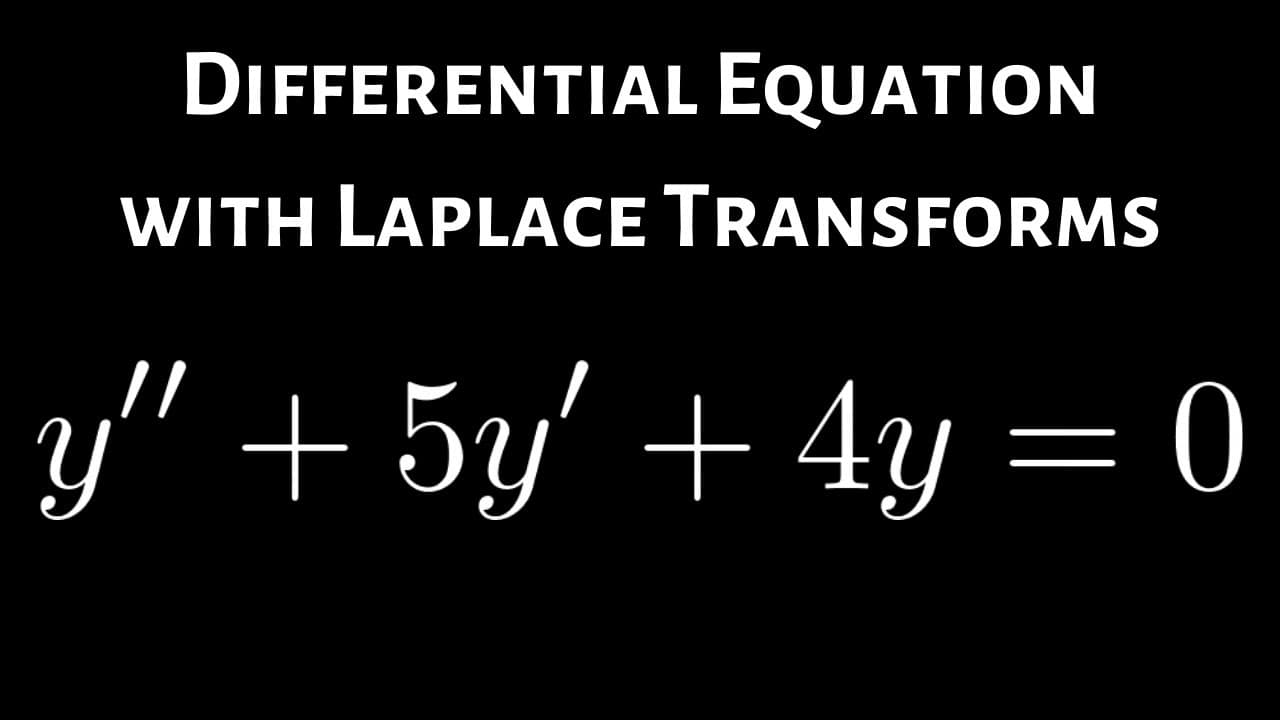
How to Solve a Differential Equation Using Laplace Transforms y'' + 5y' + 4y = 0
TL;DR
Learn to solve differential equations using Laplace transforms step by step.
Transcript
in this video I'm going to show you how to solve a differential equation using Laplace transforms so let's just jump into it and go through it and as we go through it I'll show you the formulas that you need so the very first step you need to do is take the Laplace transform of both sides so we'll start by taking the Laplace of Y double prime plus ... Read More
Key Insights
- ❓ Laplace transforms convert differential equations into algebraic equations.
- 👻 Linearity property allows for parsing out Laplace transforms of individual terms.
- ❓ Initial conditions are essential for solving differential equations with Laplace transforms.
- 📔 The cover-up method simplifies finding coefficients in partial fractions.
- 🍉 Inverse Laplace transform is crucial for obtaining the final solution in terms of the original function.
- 🈸 Application of Laplace transforms in differential equations enhances problem-solving efficiency.
- 🦻 Memorizing Laplace transform formulas can aid in quick problem-solving.
Install to Summarize YouTube Videos and Get Transcripts
Explore YouTube Video Summarizer or Get YouTube Transcript Extractor
Questions & Answers
Q: What is the first step in solving the differential equation using Laplace transforms?
The initial step involves taking the Laplace transform of both sides of the differential equation to convert the problem into an algebraic form.
Q: How does the linearity property of Laplace transforms aid in solving differential equations?
The linearity property allows for the individual Laplace transforms of terms in the equation, simplifying the process by breaking it down into manageable components.
Q: What role do initial conditions play in solving the differential equation with Laplace transforms?
Initial conditions, such as Y(0) and Y'(0), are incorporated into the equations to impose constraints and help determine the constants in the solutions obtained through Laplace transforms.
Q: How does the cover-up method assist in finding the coefficients of partial fractions in Laplace transforms?
The cover-up method simplifies the process of finding the coefficients A and B by directly evaluating expressions at the roots of the linear factors in the denominator instead of the full partial fraction decomposition.
Summary & Key Takeaways
-
Utilizing Laplace transforms, solve differential equations by applying formulas and initial conditions.
-
Use the linear transformation property to simplify the process and solve for the Laplace transform of the function.
-
Employ the cover-up method for partial fractions to find the solution in terms of inverse Laplace transform.
Read in Other Languages (beta)
Share This Summary 📚
Summarize YouTube Videos and Get Video Transcripts with 1-Click
Try YouTube Summary with ChatGPT & Claude or YouTube Transcript Generator
Explore More Summaries from The Math Sorcerer 📚


Summarize YouTube Videos and Get Video Transcripts with 1-Click
Try YouTube Summary with ChatGPT & Claude or YouTube Transcript Generator