How North America Almost Separated Into Two Pieces
TL;DR
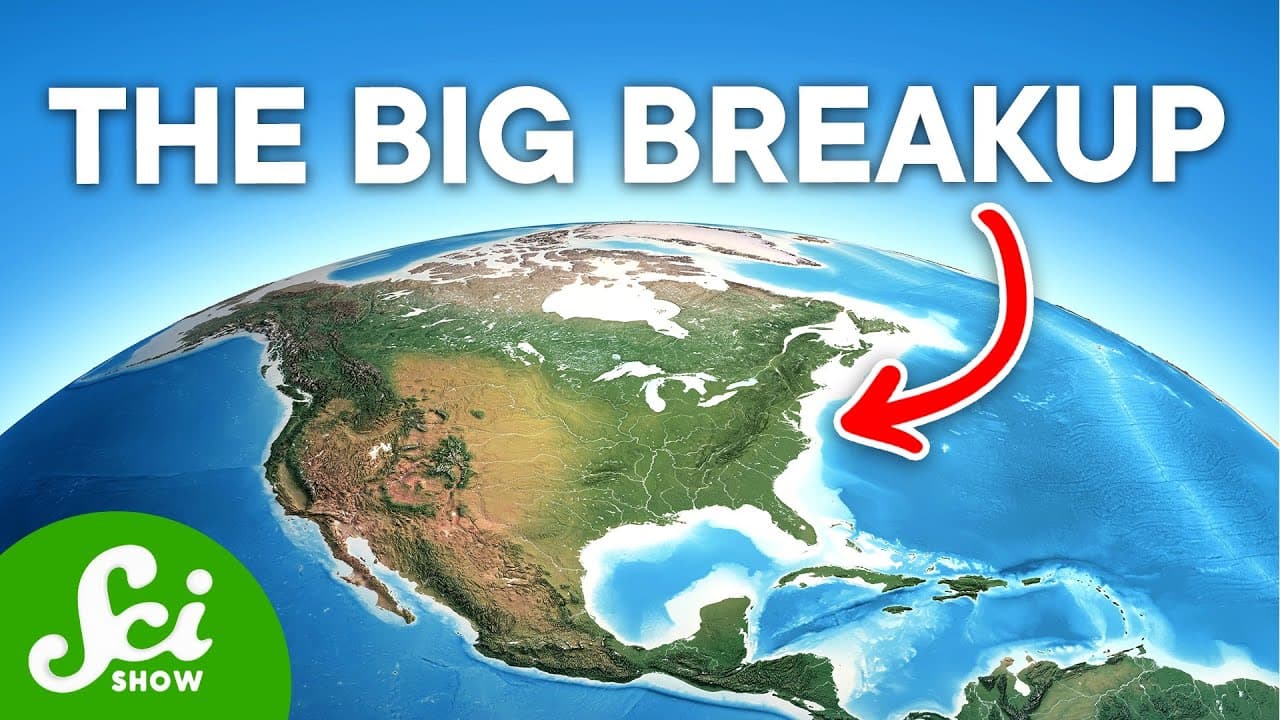
1.1 billion years ago, the Midcontinent Rift attempted to split North America in half, leaving a scar on the land. It is a rare snapshot of continental rift and demonstrates how Earth changes.
Transcript
Thanks to Brilliant for supporting this episode of SciShow. Go to Brilliant.org/SciShow to check out their new course, Knowledge and Uncertainty. [♪ INTRO] 1.1 billion years ago, long before the dinosaurs, there wasn’t much going on in the world. Many geologists even call this “The Boring Billion”, because when it comes to the evolution of life and... Read More
Key Insights
- 🫤 The Midcontinent Rift attempted to split North America in half 1.1 billion years ago, during a time called "The Boring Billion".
- 💨 Passive rifting occurred as the continent of Amazonia broke away from Laurentia, causing the stretching and thinning of the crust.
- 🍘 The Midcontinent Rift is filled with extensive flood basalts, indicating an active rift with magma filling the cracks.
- 😌 The rift stopped when stress on Laurentia was relieved as an ocean started forming between it and Amazonia.
- 💁 The Midcontinent Rift is a rare example of a continental rift that didn't form an ocean.
- 💱 It provides insights into the Wilson Cycle and the changes that occur during the evolution of continents.
- 💠 The landscape shaped by the Midcontinent Rift includes the Eastern U.S., Southern Ontario, and Lake Superior.
Install to Summarize YouTube Videos and Get Transcripts
Explore YouTube Video Summarizer or Get YouTube Transcript Extractor
Questions & Answers
Q: How did scientists discover the Midcontinent Rift?
Scientists discovered the Midcontinent Rift in the 1940s while mapping the strength of gravity across the U.S. They noticed a region of stronger gravity called the Midcontinent Gravity High, which was connected to dense volcanic rocks around Lake Superior.
Q: Why is the Midcontinent Rift different from other rifts?
The Midcontinent Rift is different from other rifts because it is filled with thick layers of volcanic rock, known as flood basalts. Most other rifts do not have such extensive volcanic activity.
Q: What caused the Midcontinent Rift to stop and not form a new ocean?
The Midcontinent Rift likely stopped when Amazonia broke away from Laurentia and an ocean started forming between them. The stress on Laurentia was relieved, leading to the end of the rifting process.
Q: What has happened to the Midcontinent Rift since its formation?
After the volcanic activity ceased, rivers eroded the rock into sedimentary layers, glaciers carved out Lake Superior, and the entire area was compressed and pushed upwards.
Summary & Key Takeaways
-
1.1 billion years ago, the Midcontinent Rift in Laurentia (North America) attempted to split the continent in half, creating a scar known as the Midcontinent Rift.
-
The rift was caused by passive rifting as the continent of Amazonia broke away from Laurentia, pulling and stretching it from the side.
-
The rift resulted in the formation of extensive volcanic rocks known as flood basalts and provided insights into the evolution and changes of Earth's landscape.
Read in Other Languages (beta)
Share This Summary 📚
Summarize YouTube Videos and Get Video Transcripts with 1-Click
Try YouTube Summary with ChatGPT & Claude or YouTube Transcript Generator
Explore More Summaries from SciShow 📚

Summarize YouTube Videos and Get Video Transcripts with 1-Click
Try YouTube Summary with ChatGPT & Claude or YouTube Transcript Generator