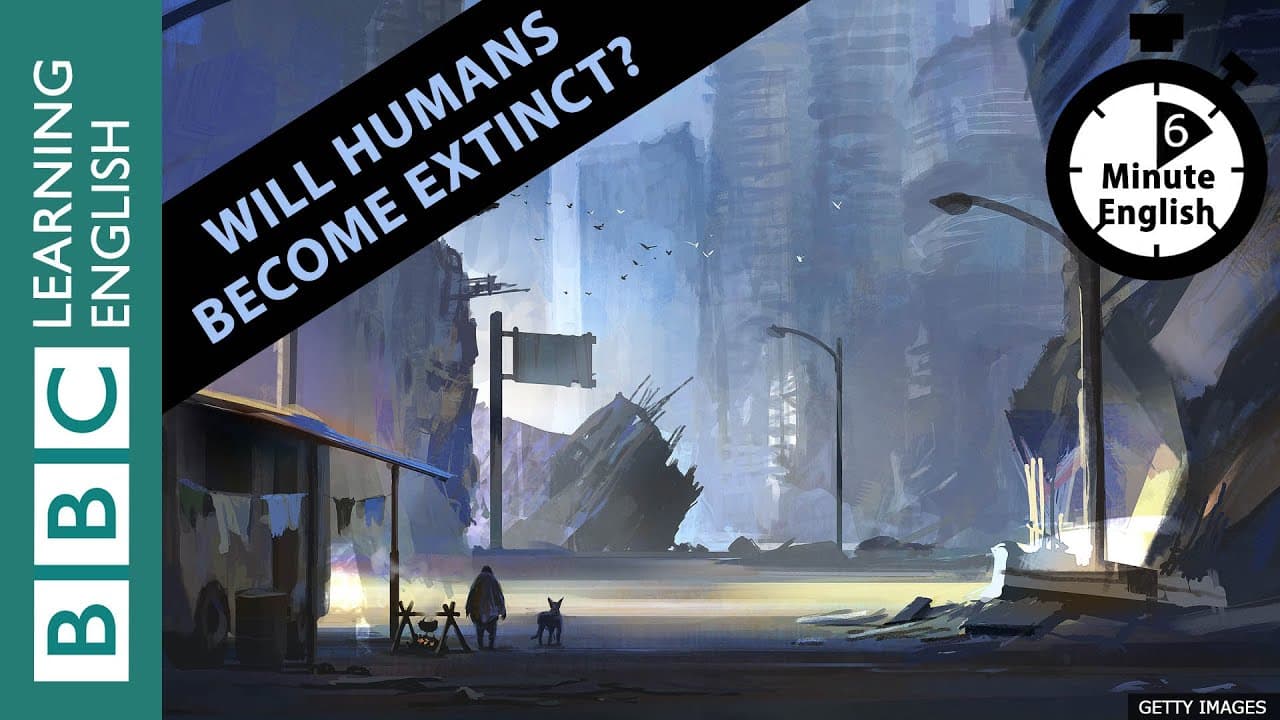
Will humans become extinct? 6 Minute English
TL;DR
Exploring existential threats to humanity's survival in the 21st century.
Transcript
Hello. This is 6 Minute English from BBC Learning English. I’m Neil. And I’m Sam. In this programme, we’ll be looking at some of the many dangers facing humanity, from climate change and global pandemics to asteroid impacts and nuclear war. We’ll be finding out whether human civilisation can survive these risks and looking at some of the related vo... Read More
Key Insights
- Humanity faces numerous existential threats, including climate change, nuclear war, global pandemics, and asteroid impacts, which could potentially lead to extinction or severe societal collapse.
- Historical records show that catastrophic events, such as the Black Death, have previously wiped out significant portions of the human population, indicating that such risks have been a constant part of human history.
- Existential risks could lead to the destruction of civilization as we know it, leaving survivors in a post-apocalyptic world, rather than completely wiping out the human species.
- Human-made threats, such as nuclear war and rogue artificial intelligence, pose significant risks, with past events like the Cuban Missile Crisis highlighting the potential for human error to lead to catastrophic outcomes.
- False alarms, such as the 1995 incident involving US missiles mistaken for nuclear warheads by Soviet radars, demonstrate how close humanity has come to accidental nuclear war.
- Apocalyptic terrorists and fundamentalist cults actively seeking to end human life on Earth represent additional threats that could contribute to a potential Doomsday scenario.
- Despite the dangers, scientific intelligence and technological advancements offer hope for finding solutions to these human-made problems in the 21st century.
- The concept of Doomsday, or the final day of life on Earth, serves as a reminder of the importance of addressing existential risks and working towards a more secure future for humanity.
Install to Summarize YouTube Videos and Get Transcripts
Explore YouTube Video Summarizer or Get YouTube Transcript Extractor
Questions & Answers
Q: What are some of the existential risks facing humanity?
Existential risks facing humanity include climate change, nuclear war, global pandemics, and asteroid impacts. These threats have the potential to either wipe out the human species entirely or cause significant societal collapse, leaving survivors to navigate a post-apocalyptic world. The discussion also highlights human-made threats such as rogue artificial intelligence and apocalyptic terrorism.
Q: How do historical events relate to current existential risks?
Historical events, such as the Black Death, which wiped out a third of the global population during the Middle Ages, demonstrate that catastrophic risks have been a constant part of human history. These events serve as a reminder of the potential for significant population loss and societal disruption, drawing parallels to modern existential risks like pandemics and climate change.
Q: What role does human error play in existential risks?
Human error can significantly contribute to existential risks, particularly in the context of nuclear war. The Cuban Missile Crisis exemplifies how miscommunication and false alarms, such as the 1995 incident where US missiles were mistaken for nuclear warheads, can lead to near-catastrophic outcomes. These incidents underscore the importance of clear communication and error prevention in mitigating existential threats.
Q: How do apocalyptic terrorists contribute to existential risks?
Apocalyptic terrorists, including rampage shooters and fundamentalist cults, actively seek to end human life on Earth, contributing to existential risks. Their actions, such as the Tokyo subway gas attack, demonstrate the potential for individuals or groups to intentionally bring about Doomsday scenarios, highlighting the need for vigilance and prevention measures to counteract these threats.
Q: What are the implications of false alarms in the context of nuclear war?
False alarms, such as the 1995 incident involving US missiles mistaken for nuclear warheads, illustrate the potential for accidental nuclear war due to miscommunication or technical errors. These incidents highlight the precarious nature of nuclear deterrence and the importance of robust systems to prevent unintended escalations that could lead to catastrophic consequences for humanity.
Q: How does scientific intelligence offer hope against existential threats?
Scientific intelligence and technological advancements provide hope for addressing existential threats by developing solutions to human-made problems. For example, advancements in climate science and renewable energy technologies offer pathways to mitigate climate change, while innovations in diplomacy and conflict resolution can reduce the risk of nuclear war, suggesting that human ingenuity may prevent Doomsday scenarios.
Q: What is the significance of the concept of Doomsday?
The concept of Doomsday, or the final day of life on Earth, serves as a warning of the potential consequences of unchecked existential risks. It emphasizes the importance of proactive measures to address these threats and safeguard humanity's future. By acknowledging the possibility of Doomsday, societies can prioritize resilience and preparedness to mitigate the impact of catastrophic events.
Q: Can humanity survive the 21st century despite existential risks?
While existential risks pose significant challenges, humanity's survival in the 21st century is not predetermined. By leveraging scientific intelligence, technological advancements, and proactive policies, societies can address these threats and enhance resilience. The potential for false alarms and human ingenuity suggests that the end of the world is not inevitable, offering hope for a secure future.
Summary & Key Takeaways
-
The discussion highlights various existential threats facing humanity, including climate change, nuclear war, pandemics, and asteroid impacts, questioning the likelihood of human survival in the 21st century.
-
Historical events like the Black Death illustrate that catastrophic risks have long been a part of human history, with modern threats further complicating the survival equation.
-
While existential risks could destroy civilization, scientific advancements offer potential solutions, suggesting that the end of the world might be a false alarm rather than an inevitable outcome.
Read in Other Languages (beta)
Share This Summary 📚
Summarize YouTube Videos and Get Video Transcripts with 1-Click
Try YouTube Summary with ChatGPT & Claude or YouTube Transcript Generator
Explore More Summaries from BBC Learning English 📚

Summarize YouTube Videos and Get Video Transcripts with 1-Click
Try YouTube Summary with ChatGPT & Claude or YouTube Transcript Generator