What is GOD - The Answer in 1 Sentence ft. @ashwinsanghi
TL;DR
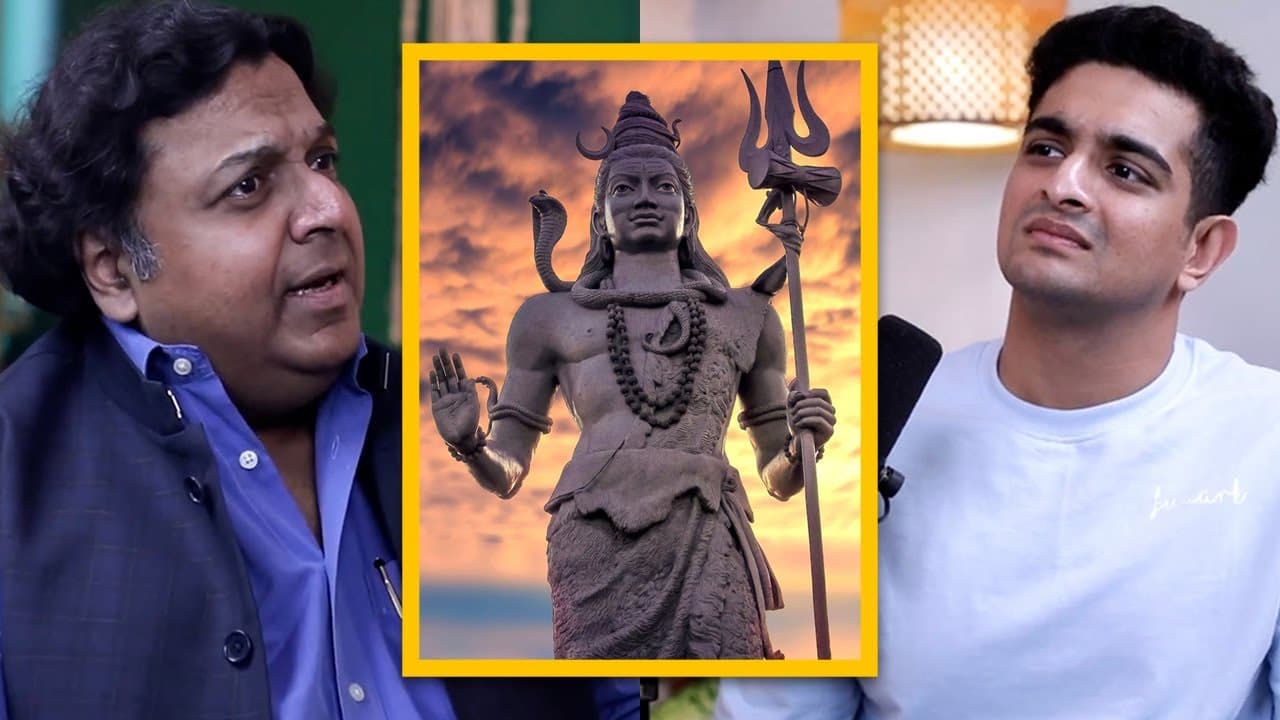
Dan Brown and Ashwin discuss the definition of God through a mathematical lens.
Transcript
welcome to trs clips india's fastest learning portal make sure you subscribe make sure you hit that bell icon so i have a simple but profound question for you sure which is that big bang thing you spoke about about three or four years ago uh there was uh an event known as the penguin annual lecture and the keynote speaker for that event was dan bro... Read More
Key Insights
- 😉 The phrase "g = infinity - k" succinctly captures the relationship between God, the universe, and knowledge.
- 🥺 Evolution of human understanding often leads to a shift in the perception of divinity, as illustrated by historical examples.
- ⛽ The discussion reinforces the idea that ignorance often fuels the attribution of the unexplained to divine forces.
- 〽️ Knowledge acquisition creates a dynamic tension between faith and understanding, altering our interpretations of God.
- ❓ Ashwin's engagement with Dan Brown highlights the relevance of philosophical inquiry in contemporary dialogues about spirituality.
- 🤕 The blending of mathematics with theology invites a fresh perspective on age-old questions regarding existence and divinity.
- ❓ Emphasizing humility in knowledge encourages a lifelong pursuit of learning while being mindful of our limitations.
Install to Summarize YouTube Videos and Get Transcripts
Explore YouTube Video Summarizer or Get YouTube Transcript Extractor
Questions & Answers
Q: What is the significance of the equation g = infinity - k in defining God?
The equation illustrates the relationship between the universe and human knowledge in defining God. "G" represents God, "infinity" symbolizes the totality of the universe, while "k" stands for the extent of human knowledge. This suggests that God encompasses all that exists minus what humans can understand. As our comprehension grows, our concept of God may become smaller, reflecting our evolving understanding of the universe.
Q: How does Ashwin relate historical views of divinity to modern knowledge?
Ashwin draws parallels between ancient beliefs and contemporary scientific understanding by citing the Egyptian sun god Ra. Initially, the sun's cyclical behavior was attributed to a divine being due to the lack of explanation. However, as knowledge advanced through figures like Aryabhat, Copernicus, and Galileo, the natural phenomena were demystified, reducing the perceived need for divine explanations.
Q: Why did Dan Brown find Ashwin's perspective intriguing during their discussion?
Dan Brown appreciated Ashwin's reduction of a complex concept like God to a simple mathematical equation. This perspective resonates with many contemporary discussions that reconcile spirituality with an increasingly empirical view of the universe. Ashwin’s analogy invites a re-examination of how knowledge influences belief, making it both a thought-provoking and modern interpretation of divinity.
Q: What is the overarching message conveyed in Ashwin's explanation?
The overarching message is that true understanding lies in recognizing the limitations of human knowledge. As Ashwin states, "true knowledge is knowing that you know nothing." This perspective encourages humility and ongoing inquiry, suggesting that the quest for knowledge inherently shapes and sometimes diminishes traditional notions of divinity.
Summary & Key Takeaways
-
Ashwin presents a mathematical equation to define God as "g = infinity - k," where "g" represents God, "infinity" denotes the universe, and "k" is human knowledge.
-
The discussion includes historical perspectives, illustrating how human understanding of natural phenomena once labeled as divine—like the sun god Ra—has evolved through scientific discoveries.
-
The central theme emphasizes that as human knowledge expands, the need to attribute phenomena to a divine presence diminishes, reflecting the dynamic interplay between faith and understanding.
Read in Other Languages (beta)
Share This Summary 📚
Summarize YouTube Videos and Get Video Transcripts with 1-Click
Try YouTube Summary with ChatGPT & Claude or YouTube Transcript Generator
Explore More Summaries from TRS Clips 📚




Summarize YouTube Videos and Get Video Transcripts with 1-Click
Try YouTube Summary with ChatGPT & Claude or YouTube Transcript Generator