VHDL code for 8x3 Encoder | Digital Systems Design | Lec-63
TL;DR
This video explains how to write VHDL code for an A23 encoder using different modeling styles.
Transcript
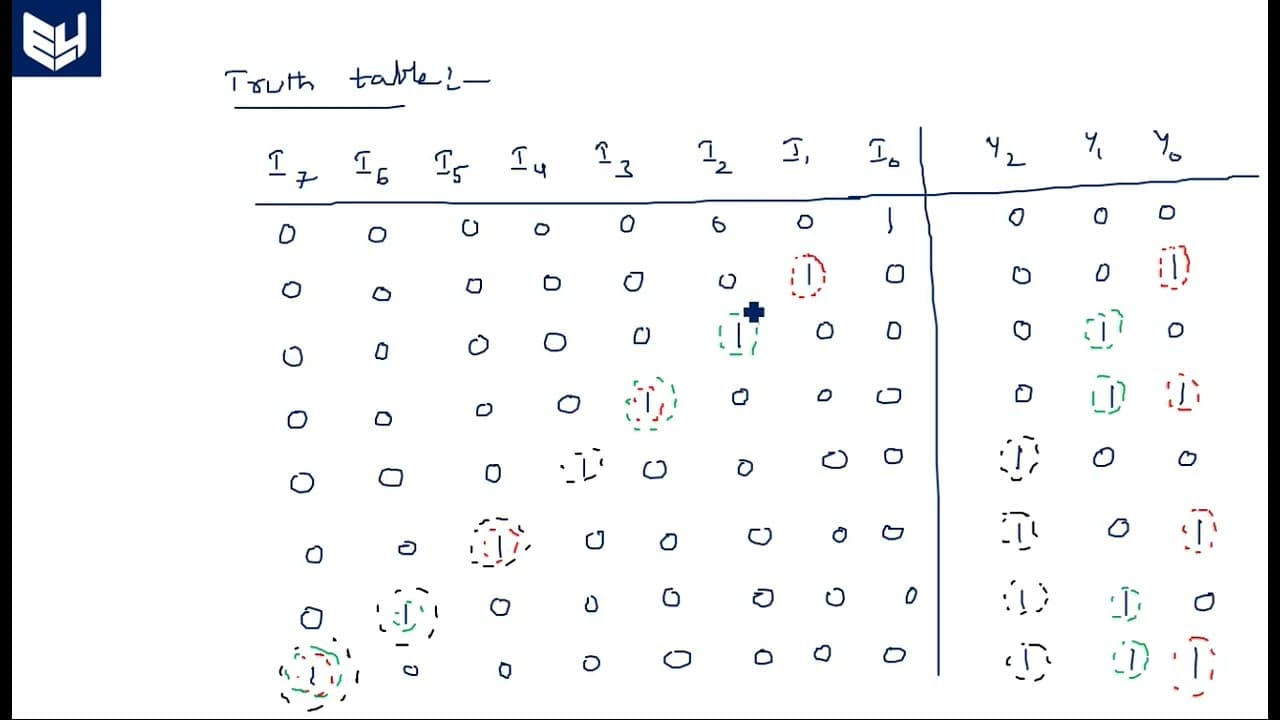
hi everyone in this video I'm going to tell you how to write a vhdl code for a23 encoder so this is what the a23 encoder introduction we have started and this this is the logic diagram we have seen all these in the previous video and this is the truth table and in which cases the outputs are ones that we have seen based on that the Boolean Expressi... Read More
Key Insights
- 👨💻 Writing VHDL code for an A23 encoder involves a clear understanding of logic diagrams and truth tables to guide the coding process.
- 😑 A data flow model using Boolean expressions simplifies the representation of relationships between inputs and outputs in a straightforward format.
- 👻 Behavioral modeling allows for complex systems to be represented more abstractly, accommodating timing and sequencing considerations in logic design.
- 🦻 The structural modeling approach aids in visualizing the physical relationships between various components, ensuring a comprehensive understanding of the system's architecture.
- 🚙 Understanding how to utilize libraries in VHDL, such as ieee.std_logic_1164, is crucial for defining data types and managing port definitions effectively.
- 👻 Each modeling style provides unique advantages, allowing developers to choose the most appropriate approach based on the specific requirements of their design.
- 👨💻 The structure of VHDL code emphasizes modularity, with an entity that serves as the primary interface and various architectural models to detail implementation.
Install to Summarize YouTube Videos and Get Transcripts
Explore YouTube Video Summarizer or Get YouTube Transcript Extractor
Questions & Answers
Q: What are the key differences between data flow and behavioral modeling in VHDL?
Data flow modeling focuses on defining the behavior of the system based on Boolean expressions or conditional statements, allowing for direct representation of relationships between inputs and outputs. In contrast, behavioral modeling uses processes and case statements to describe the sequence of operations, offering a higher-level abstraction that reflects how the circuit operates over time.
Q: How can you represent a truth table in VHDL code?
In VHDL, a truth table is usually represented by using case or conditional statements in behavioral modeling. Each input combination in the truth table corresponds to a specific state or output, which can be encoded within a process block that evaluates conditions based on the inputs.
Q: Why is the entity part common across different VHDL styles?
The entity part in VHDL establishes the interface for the module, defining inputs and outputs. Regardless of the architecture style (data flow, behavioral, or structural), the entity encapsulates the fundamental characteristics of the module, making it essential for consistency and clarity across various coding representations.
Q: What is the role of Boolean expressions in data flow modeling?
Boolean expressions in data flow modeling are used to directly express the relationships between inputs and outputs in a compact and concise manner. By utilizing these expressions, developers can succinctly derive output values based on the current input states, enhancing readability and simplifying the coding process.
Q: Can you explain what a structural model is in VHDL?
A structural model in VHDL describes a system by connecting various components or instances of entities. This approach represents the physical architecture of the design, highlighting how components like logic gates or multiplexers are interconnected, thus providing a clear depiction of the overall system’s structure.
Q: How does conditional statement usage differ in data flow models?
In data flow models, conditional statements can be utilized to assign output values based on specific input conditions. This can take the form of select statements or other control flow mechanisms that enable a flexible and efficient way to manage varying input scenarios, enhancing modularity and clarity in the code.
Summary & Key Takeaways
-
The video outlines the process of writing VHDL code for an A23 encoder, detailing the logic diagrams, truth tables, and Boolean expressions involved.
-
It explores three styles of VHDL coding: data flow using Boolean expressions, data flow with conditional statements, and behavioral modeling, emphasizing the similarities in the entity part of the code.
-
Structural modeling is also discussed, showcasing how to instantiate components like AND gates within the VHDL framework for encoder design.
Read in Other Languages (beta)
Share This Summary 📚
Summarize YouTube Videos and Get Video Transcripts with 1-Click
Try YouTube Summary with ChatGPT & Claude or YouTube Transcript Generator