how to find the average velocity and instantaneous velocity? Calculus 1 tutorial
TL;DR
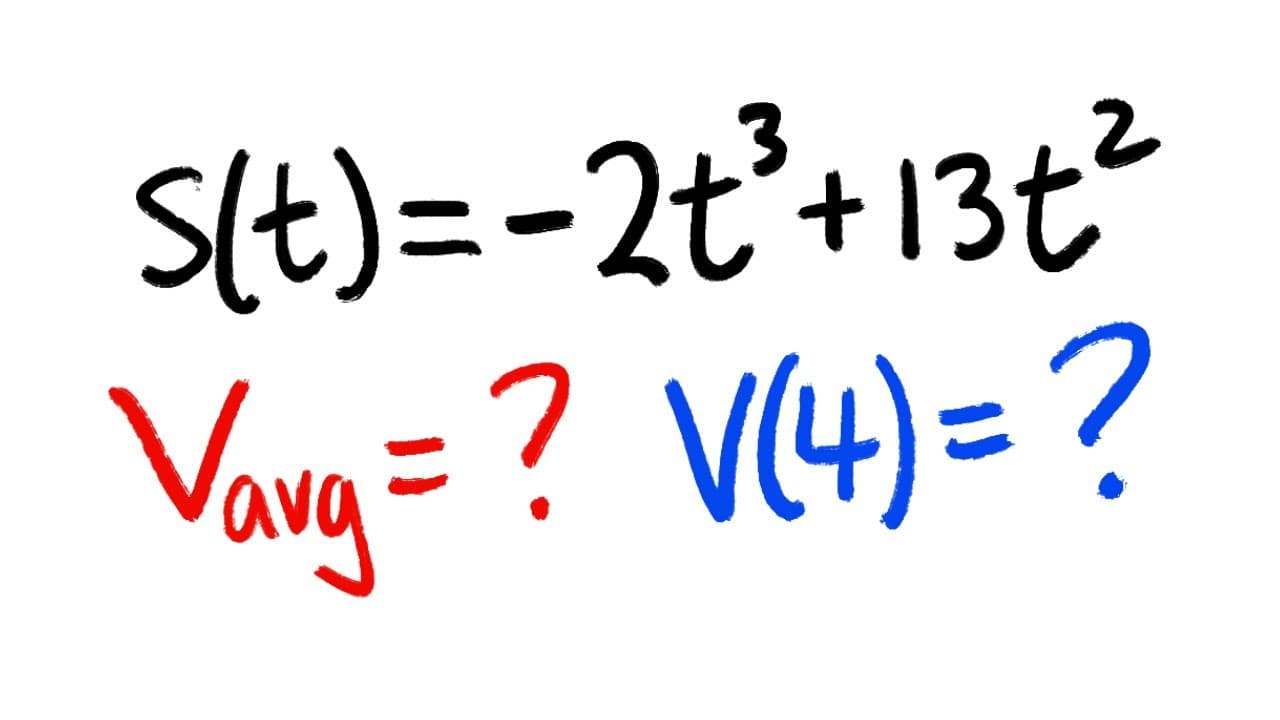
The content explains how to calculate average speed and instantaneous velocity using position and velocity functions.
Transcript
okay Andrew this is for you we are given a position function of the moving particle and we have two parts first we are going to find the average speed from 4 to 6 and this right here is the slope formula pretty much right so I will just write this down right here the average remember what you do is you look at the final position so I just put up th... Read More
Key Insights
- 🧘 Average speed is determined by subtracting initial position from final position and dividing by time taken.
- 🧘 Position at a specific time is obtained by substituting the time value into the position function.
- 🧘 Instantaneous velocity is found by taking the derivative of the position function.
- ✊ The velocity function is derived by bringing down the power as a coefficient and reducing the power by 1.
- ⌛ Instantaneous velocity at a specific time is calculated by substituting the time value into the velocity function.
- 🗨️ Negative velocity indicates motion towards the left.
- 🤒 Average speed is measured in meters per second.
Install to Summarize YouTube Videos and Get Transcripts
Explore YouTube Video Summarizer or Get YouTube Transcript Extractor
Questions & Answers
Q: How is average speed calculated using the position function?
Average speed is calculated by subtracting the initial position from the final position and dividing by the time taken. It can be represented as (S6 - S4) / (6 - 4).
Q: How is the position at a specific time calculated using the position function?
To calculate the position at a specific time, substitute the time value into the position function. For example, to find S(6), substitute 6 into the function.
Q: How is the instantaneous velocity calculated using the position function?
The instantaneous velocity is calculated by taking the derivative of the position function. This is done by bringing the power down as a coefficient and reducing the power by 1.
Q: How is the instantaneous velocity at a specific time calculated using the velocity function?
To calculate the instantaneous velocity at a specific time, substitute the time value into the velocity function. For example, to find V(4), substitute 4 into the function.
Summary & Key Takeaways
-
The content discusses finding the average speed by subtracting the initial position from the final position and dividing by the time taken.
-
The position function is provided and used to calculate the position at a specific time by substituting the time value.
-
To find the instantaneous velocity, the derivative of the position function is taken.
-
The velocity function is derived, and the instantaneous velocity at a specific time is calculated by substituting the time value.
Read in Other Languages (beta)
Share This Summary 📚
Summarize YouTube Videos and Get Video Transcripts with 1-Click
Try YouTube Summary with ChatGPT & Claude or YouTube Transcript Generator
Explore More Summaries from blackpenredpen 📚
Summarize YouTube Videos and Get Video Transcripts with 1-Click
Try YouTube Summary with ChatGPT & Claude or YouTube Transcript Generator