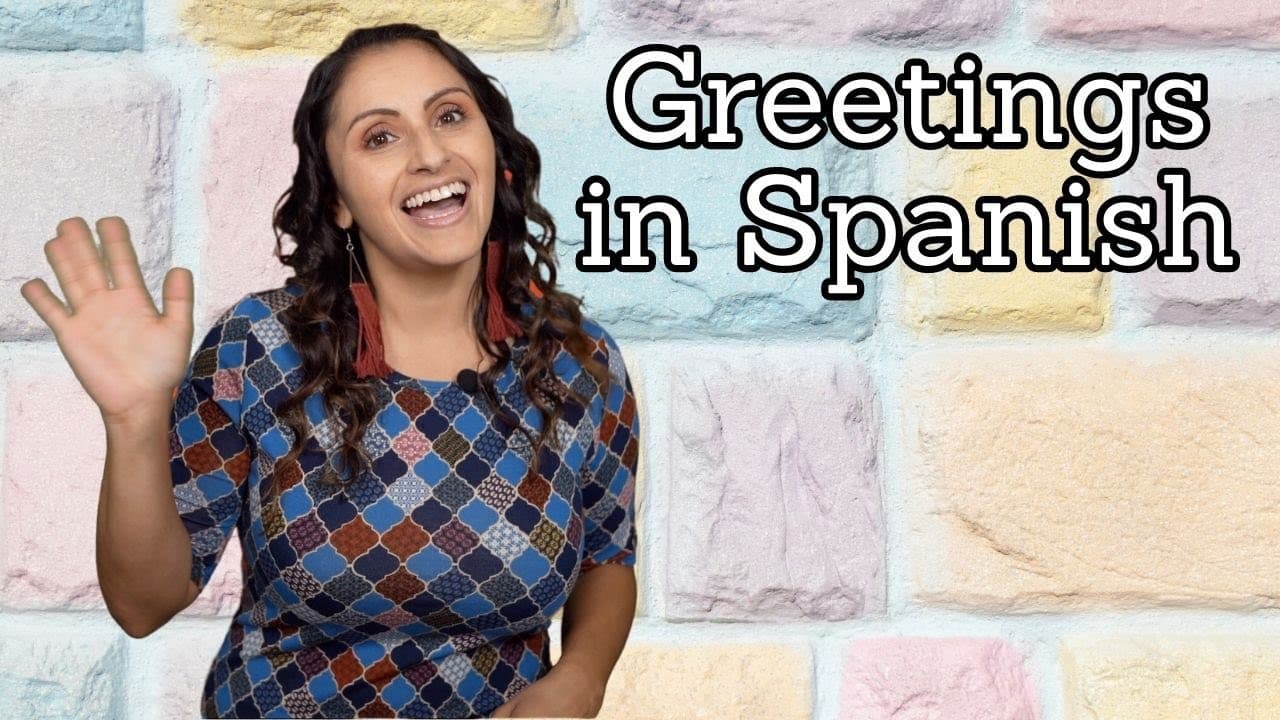
Greetings in Spanish ( Spanish Lesson 1)
TL;DR
Learn basic Spanish greetings and their proper usage.
Transcript
greetings in Spanish that's what we're learning right now so let's start with how do you feel about greeting somebody in Spanish do you feel pretty confident do you feel so so or do you feel that you need to learn a lot about that wherever you're at it's totally okay to be there our goal is that by the end of... Read More
Key Insights
- The lesson focuses on teaching basic Spanish greetings, such as 'hola', 'buenos días', 'buenas tardes', and 'buenas noches'.
- The Spanish letter 'H' is silent, as demonstrated with the word 'hola'.
- Greetings in Spanish can be both formal and informal, depending on the time of day and context.
- 'Buenas noches' serves a dual purpose, being used for both greeting and farewell.
- The lesson introduces the concept of gender in Spanish nouns, as seen in 'buenos días' and 'buenas tardes'.
- The lesson aims to boost confidence in greeting people in Spanish, regardless of the learner's current skill level.
- Future lessons will cover how to ask someone how they are doing, building on the foundation of greetings.
- The content encourages active participation through vocabulary sheets, quizzes, and practice exercises.
Install to Summarize YouTube Videos and Get Transcripts
Explore YouTube Video Summarizer or Get YouTube Transcript Extractor
Questions & Answers
Q: What are the basic greetings taught in the lesson?
The lesson teaches basic Spanish greetings including 'hola' (hello), 'buenos días' (good morning), 'buenas tardes' (good afternoon), and 'buenas noches' (good night). These greetings are essential for starting conversations in Spanish and vary in formality and context based on the time of day.
Q: How is the letter 'H' pronounced in Spanish?
In Spanish, the letter 'H' is silent. This is exemplified in the word 'hola', which means 'hello'. Learners are encouraged to practice pronouncing Spanish words without vocalizing the 'H', as this is a common rule in the language.
Q: What dual purpose does 'buenas noches' serve?
'Buenas noches' serves as both a greeting and a farewell in Spanish. It can be used to say 'good evening' when greeting someone and 'good night' when parting ways. This dual functionality makes it unique among the greetings covered in the lesson.
Q: Why is there a gender difference in 'buenos días' and 'buenas tardes'?
The difference in gender ('buenos días' vs. 'buenas tardes') highlights a grammatical aspect of Spanish where nouns have gender. 'Días' is masculine, hence 'buenos', while 'tardes' and 'noches' are feminine, hence 'buenas'. Understanding noun gender is crucial for mastering Spanish grammar.
Q: What is the goal of the lesson regarding learner confidence?
The lesson aims to increase learner confidence in using Spanish greetings. It encourages learners to assess their current comfort level and strive for improvement through practice and review. The goal is for learners to feel more assured in their ability to greet others in Spanish by the lesson's end.
Q: What future topics will be covered in the course?
Future lessons will cover how to ask someone how they are doing, building on the foundation of greetings. This will include phrases like '¿Cómo estás?' (how are you?) and '¿Qué tal?' (how's it going?). These topics will further enhance conversational skills in Spanish.
Q: How does the lesson encourage active participation?
The lesson encourages active participation through the use of vocabulary sheets, quizzes, and practice exercises. Learners are prompted to take notes and review them, allowing for better retention and understanding. Interactive elements are designed to engage learners and reinforce the material taught.
Q: What additional resources are available for learners?
Learners have access to a variety of resources provided by Teacher Catalina, including pronunciation tips, quizzes, and a community for language learners. These resources are available on her website and YouTube channel, offering comprehensive support for those looking to improve their Spanish language skills.
Summary & Key Takeaways
-
This lesson introduces basic Spanish greetings, emphasizing pronunciation and context. Learners are encouraged to practice saying 'hola', 'buenos días', 'buenas tardes', and 'buenas noches'. The lesson also lightly touches on the concept of gender in Spanish nouns, preparing learners for more advanced topics.
-
By the end of the lesson, learners should feel more confident in greeting others in Spanish. The lesson is structured to accommodate learners at various levels, encouraging growth and understanding through practice and review. Future lessons will build on this foundation, introducing more conversational elements.
-
The lesson is part of a free Spanish course available on YouTube, designed to be engaging and interactive. Learners are encouraged to subscribe and access additional resources provided by Teacher Catalina, including pronunciation tips, quizzes, and a community for language learners.
Read in Other Languages (beta)
Share This Summary 📚
Summarize YouTube Videos and Get Video Transcripts with 1-Click
Try YouTube Summary with ChatGPT & Claude or YouTube Transcript Generator