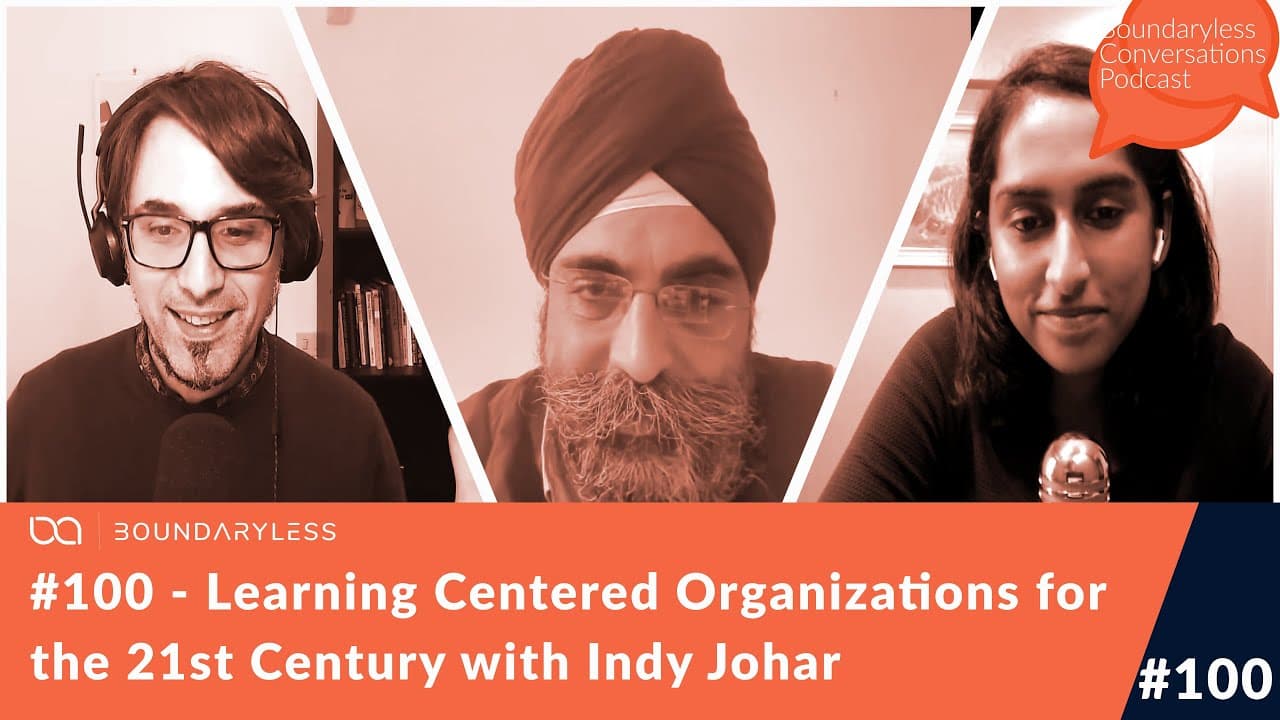
#100 - Learning Centered Organizations for the 21st Century with Indy Johar
TL;DR
Indy Johar discusses the shift to learning-centered organizations.
Transcript
We have weaponized labor and instrumentalized labor. The reactionary effect of a 21st century good employee is to act as to prevent the extraction capacities of an organism. You have to fight the machine, which is driving extraction. I'm going to defend my time. I'm going to defend my hours. I'm going to defend my c... Read More
Key Insights
- Indy Johar argues for a shift from traditional command-and-control organizational models to learning-oriented systems to better handle complexity.
- Risk management should be decentralized, with decision-making power localized to enhance responsiveness and effectiveness.
- Dark Matter Labs adopts a mission-driven approach, emphasizing partnerships over traditional consultancy to enable sustainable change.
- Organizations need to redefine value metrics, incorporating multi-dimensional success indicators rather than focusing solely on productivity.
- The concept of citizenship within organizations is crucial, where individuals contribute to decision-making processes and organizational learning.
- Legal structures need to evolve to support distributed risk and empower collective action, moving away from centralized control.
- A post-managerial economy requires redefining organizational roles to encourage craft and citizenship.
- The conversation challenges traditional labor theories, advocating for a more engaged and emotionally connected workforce.
Install to Summarize YouTube Videos and Get Transcripts
Explore YouTube Video Summarizer or Get YouTube Transcript Extractor
Questions & Answers
Q: What is the main argument Indy Johar makes about traditional organizational models?
Indy Johar argues that traditional command-and-control organizational models are inadequate for handling the complexities of the 21st century. He advocates for a shift towards learning-oriented systems that prioritize decentralized decision-making and adaptability, allowing organizations to better respond to complex challenges.
Q: How does Dark Matter Labs approach organizational change differently?
Dark Matter Labs adopts a mission-driven approach that emphasizes partnerships over traditional consultancy. This approach enables sustainable change by fostering collaboration and shared ownership of outcomes, rather than relying on prescriptive consulting models that may not effectively address complex, entangled problems.
Q: What changes does Indy Johar suggest for measuring organizational value?
Indy Johar suggests redefining organizational value metrics to incorporate multi-dimensional success indicators. This involves moving beyond traditional productivity measures to account for collective intelligence, systemic contributions, and the overall learning capacity of the organization, enabling a more holistic understanding of value creation.
Q: What is the role of citizenship in organizations according to Indy Johar?
Indy Johar emphasizes the importance of citizenship within organizations, where individuals are encouraged to contribute to decision-making processes and organizational learning. This approach fosters a sense of ownership and accountability, moving away from traditional employee roles towards a more engaged and participatory organizational culture.
Q: Why does Indy Johar believe legal structures need to evolve?
Indy Johar argues that legal structures need to evolve to support distributed risk and empower collective action. Current centralized control mechanisms are inadequate for handling complexity, and new frameworks are needed to facilitate decentralized decision-making and enhance the learning capacity of organizations.
Q: What is the significance of a post-managerial economy?
In a post-managerial economy, organizational roles are redefined to encourage craft and citizenship. This shift moves away from traditional managerial hierarchies towards a more decentralized and collaborative approach, where individuals are empowered to take initiative and contribute to the organization's learning and adaptability.
Q: How does Indy Johar challenge traditional labor theories?
Indy Johar challenges traditional labor theories by advocating for a more engaged and emotionally connected workforce. He argues that the detachment of employment is problematic and calls for a new theory of labor that emphasizes emotional involvement, leadership, and the ability to navigate complexity and uncertainty.
Q: What is the impact of complexity on organizational efficacy according to Indy Johar?
Indy Johar asserts that complexity demands a new approach to organizational efficacy, moving away from linear, control-oriented systems. Organizations must embrace learning and adaptability, with decentralized decision-making and localized risk management, to effectively navigate the uncertainties and interconnected challenges of a complex world.
Summary & Key Takeaways
-
Indy Johar discusses the inadequacies of traditional business models and advocates for learning-centered organizations that can handle complexity.
-
The podcast highlights the need for decentralized risk management and localized decision-making to enhance organizational responsiveness.
-
Indy emphasizes the importance of redefining value metrics and incorporating multi-dimensional success indicators in organizations.
Read in Other Languages (beta)
Share This Summary 📚
Summarize YouTube Videos and Get Video Transcripts with 1-Click
Try YouTube Summary with ChatGPT & Claude or YouTube Transcript Generator