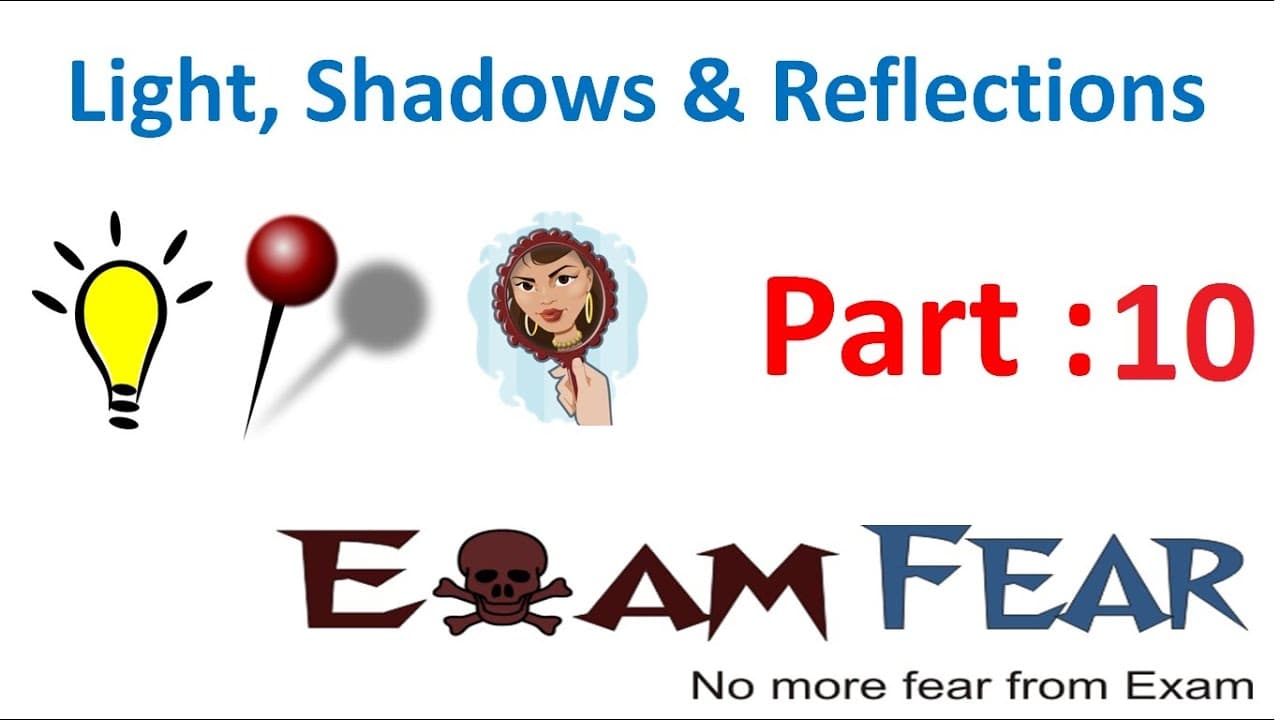
Physics Light Shadow & Reflection Part 10 (Questions) Class 6 VI
TL;DR
This video explains the concepts of opaque, transparent, and translucent objects, as well as luminous and non-luminous objects, through examples and demonstrations.
Transcript
hello friends this video on light shadows and reflection part 10 is brought to you by exam for calm no more fear from exam so with this we have reached towards the end of this lesson so let us quickly look at some of the questions question number one rearrange the boxes given below to make a sentence that helps us understand opaque objects see here... Read More
Key Insights
- 🔑 Rearranging words can help create meaningful sentences to understand opaque objects.
- 🙂 Opaque objects, such as rocks and wooden blocks, do not allow light to pass through them.
- ✈️ Transparent objects, like water and air, allow light to completely pass through.
- 🙂 Translucent objects, such as fog and smoke, allow light to pass through but result in an unclear or hazy display.
- 😅 Luminous objects, such as red-hot iron and fluorescent tubes, are able to produce their own light.
- 🙂 Non-luminous objects, like mirrors and wire mesh, do not produce their own light.
- 🙂 The Moon is considered a non-luminous object as it reflects the light it receives from the Sun.
Install to Summarize YouTube Videos and Get Transcripts
Explore YouTube Video Summarizer or Get YouTube Transcript Extractor
Questions & Answers
Q: How can opaque objects be defined?
Opaque objects do not allow light to pass through them. They are not transparent or translucent. Examples include rocks, wooden blocks, and aluminum sheets.
Q: What defines a transparent object?
Transparent objects allow light to completely pass through them. Examples include water, air, and most polythene sheets.
Q: Can you explain the concept of luminous objects?
Luminous objects are able to produce their own light. Examples include red-hot iron, fluorescent tubes, torch lights, and the Sun.
Q: Why can't we see our reflection in a mirror in a completely dark room?
Reflection requires light to bounce back. In the absence of light, no image formation occurs, and we cannot see our reflection in a mirror.
Summary & Key Takeaways
-
The video discusses rearranging words to form a sentence that helps understand opaque objects.
-
It explains the classification of objects as opaque, transparent, or translucent, and as luminous or non-luminous.
-
Various examples, such as rocks, water, fog, and flames, are provided to illustrate these concepts.
Read in Other Languages (beta)
Share This Summary 📚
Summarize YouTube Videos and Get Video Transcripts with 1-Click
Try YouTube Summary with ChatGPT & Claude or YouTube Transcript Generator
Explore More Summaries from LearnoHub - Class 11, 12 📚

Summarize YouTube Videos and Get Video Transcripts with 1-Click
Try YouTube Summary with ChatGPT & Claude or YouTube Transcript Generator