Gram-Schmidt Orthogonalization
TL;DR
Ana Rita Pires explains Gram-Schmidt orthogonalization and demonstrates how to find orthonormal vectors using this method, as well as how to perform the QR decomposition of a matrix.
Transcript
ANA RITA PIRES: In lecture, you've learned about Gram-Schmidt orthogonalization, and that's what today's problem is about. We have a matrix A, and its columns are a, b, and c. And I want you to find orthonormal vectors q_1, q_2, and q_3 from those three columns. Then I want you to write A as a-- it's QR decomposition where Q is an orthogonal matrix... Read More
Key Insights
- 😫 Gram-Schmidt orthogonalization is a method to find orthonormal vectors from a given set of vectors.
- 📐 The QR decomposition represents a matrix as the product of an orthogonal matrix (Q) and an upper triangular matrix (R).
- 💁 The orthonormal vectors found using Gram-Schmidt orthogonalization form the columns of the Q matrix in QR decomposition.
- 🤨 The R matrix in QR decomposition is obtained by permuting the rows of the original matrix to match the structure of the Q matrix.
Install to Summarize YouTube Videos and Get Transcripts
Explore YouTube Video Summarizer or Get YouTube Transcript Extractor
Questions & Answers
Q: What is the purpose of Gram-Schmidt orthogonalization?
Gram-Schmidt orthogonalization is a method used to find orthonormal vectors from a set of given vectors. It ensures that each vector is orthogonal to the previous ones and has a length of 1.
Q: How do you find the first orthonormal vector, q1?
To find q1, you start with the first vector in the set and normalize it by dividing it by its length. In this case, q1 is [1, 0, 0].
Q: How do you find the second orthonormal vector, q2?
To find q2, subtract the projection of the second vector onto q1 from the second vector itself. Normalize the resulting vector to obtain q2. In this case, q2 is [0, 0, 1].
Q: How do you find the third orthonormal vector, q3?
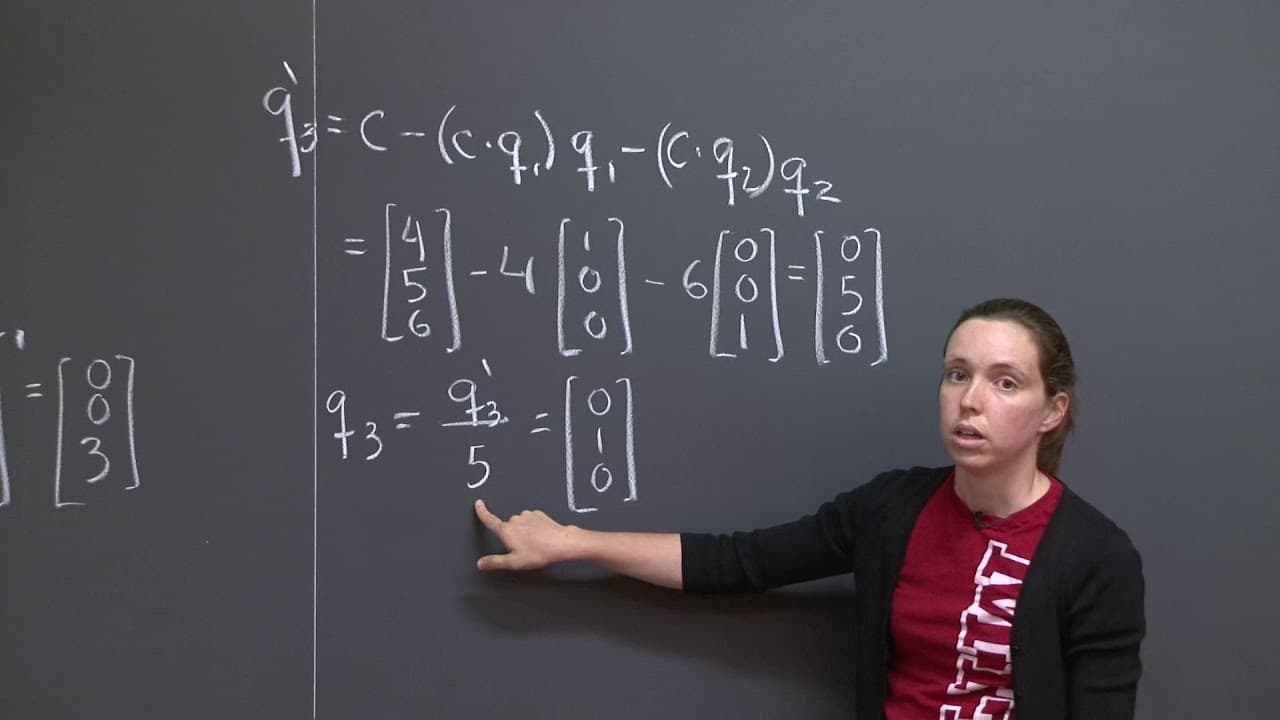
To find q3, subtract the projection of the third vector onto q1 and q2 from the third vector itself. Normalize the resulting vector to obtain q3. In this case, q3 is [0, 1, 0].
Q: What is the purpose of the QR decomposition?
The QR decomposition represents a matrix as the product of an orthogonal matrix, Q, and an upper triangular matrix, R. It is useful for solving linear systems of equations and performing matrix operations.
Q: How do you obtain the Q matrix in QR decomposition?
The Q matrix in QR decomposition consists of the orthonormal vectors found using Gram-Schmidt orthogonalization. Each vector becomes a column in the Q matrix.
Q: How do you obtain the R matrix in QR decomposition?
The R matrix in QR decomposition is obtained by permuting the rows of the original matrix A in such a way that the resulting matrix matches the structure of the Q matrix. The resulting matrix will have an upper triangular form.
Q: Why are the vectors q1, q2, and q3 in this example integers?
In most cases, when performing Gram-Schmidt orthogonalization, the resulting vectors would involve square roots due to normalization. However, in this specific example, the vectors happen to be integers, which is fortunate.
Summary & Key Takeaways
-
Ana Rita Pires teaches about Gram-Schmidt orthogonalization and its application in finding orthonormal vectors.
-
She demonstrates step-by-step how to find orthonormal vectors q1, q2, and q3 from the given matrix.
-
She explains how to write the matrix A in the form of QR decomposition, where Q is an orthogonal matrix and R is an upper triangular matrix.
Read in Other Languages (beta)
Share This Summary 📚
Summarize YouTube Videos and Get Video Transcripts with 1-Click
Try YouTube Summary with ChatGPT & Claude or YouTube Transcript Generator
Explore More Summaries from MIT OpenCourseWare 📚



Summarize YouTube Videos and Get Video Transcripts with 1-Click
Try YouTube Summary with ChatGPT & Claude or YouTube Transcript Generator