Scanning patterns | Acquisition patterns | Radar Systems | Lec-52
TL;DR
The video explains various scanning patterns used in radar acquisition systems for target identification.
Transcript
hi everyone in this video I am going to explain about different types of scanning patterns and acquisition so acquisition and scanning pattern before going to that equation what do you mean by acquisition in order to acquire a Target information we are using different types of scanning patterns equation is nothing but acquisition is nothing but acq... Read More
Key Insights
- 💁 Acquisition in radar is crucial for determining a target's presence and related information, which is foundational for tracking.
- ♻️ Scanning patterns are integral to effective radar function, with each pattern tailored for specific operational requirements and environments.
- 😁 The pencil beam pattern is highlighted for its ability to achieve long-distance detection, making it critical for precise acquisition.
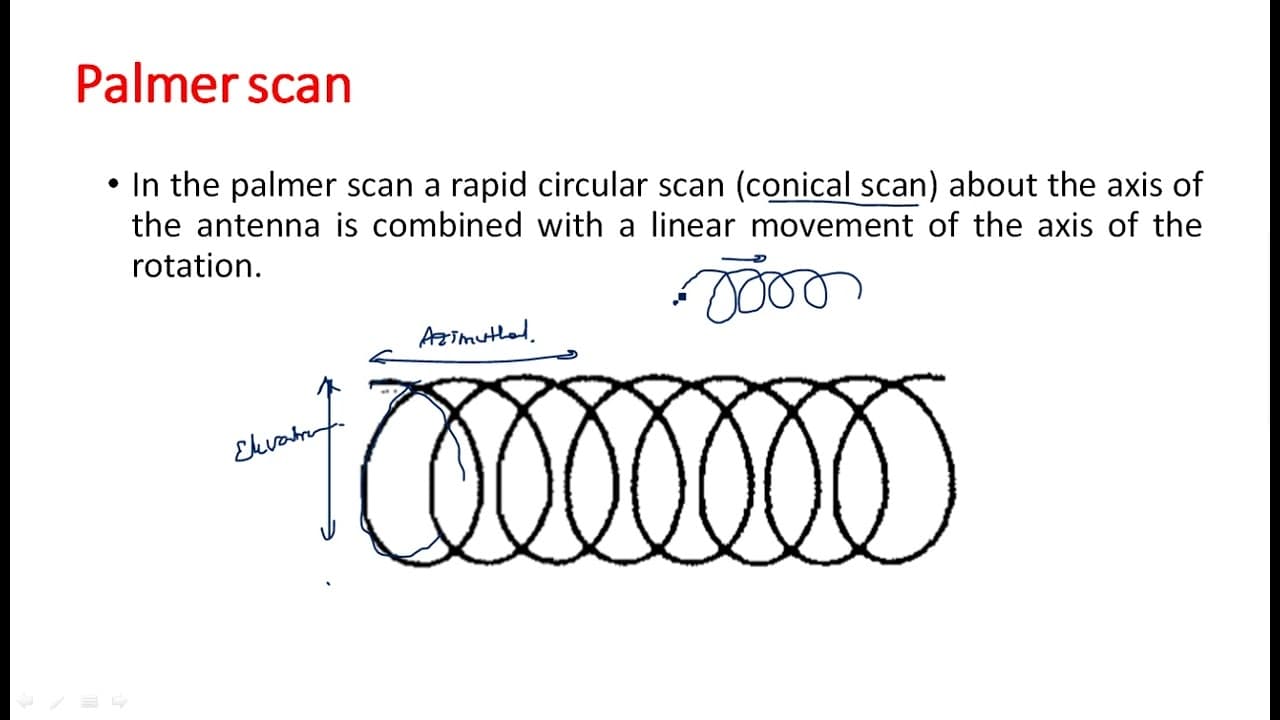
- 🦾 Helical and polymer scans are defined by their unique movement mechanics, impacting how effectively different sectors are monitored.
- 😵💫 Spiral scans are beneficial in fire control scenarios, allowing for gradual area coverage and enhanced target tracking.
- 🥋 Raster scans utilize a straightforward approach, ensuring uniform coverage of a designated area for efficient target identification.
- 🚥 Nodding scans offer a balance of vertical and horizontal scanning, optimizing performance across varied operational needs.
Install to Summarize YouTube Videos and Get Transcripts
Explore YouTube Video Summarizer or Get YouTube Transcript Extractor
Questions & Answers
Q: What does the term "acquisition" refer to in radar technology?
In radar technology, "acquisition" refers to the process of determining the presence of a target within a specified area. It involves using radar systems to gather information about whether a target is detected, its location, and potentially other relevant parameters that can aid in tracking or monitoring.
Q: Why is a narrow beam preferred over a wide beam in radar scanning?
A narrow beam is preferred in radar scanning because it can travel longer distances and maintain better resolution when identifying targets. Unlike a wide beam, which can spread signal strength and reduce detection accuracy, narrow beams allow for more precise targeting and effective range.
Q: Can you explain the difference between helical and polymer scans?
Helical scans involve the radar beam rotating in a circular path while moving vertically, effectively increasing its elevation with each rotation. In contrast, polymer scans involve the radar beam rotating horizontally while the antenna plate moves vertically. Each scan serves distinct purposes, optimizing target detection in different scenarios.
Q: How does the spiral scan work, and what are its applications?
The spiral scan begins at a central point and gradually expands outwards in a circular manner. This scanning pattern increases its area over time, effectively covering more ground. It is commonly used in fire control systems, where tracking moving targets is essential for accurate acquisition and engagement.
Q: What is a raster scan and how is it executed?
A raster scan methodically covers a search area like painting a wall, moving in a horizontal and vertical pattern. The radar beam sweeps across the area in uniform strokes, providing a detailed inspection while ensuring all potential targets are scanned efficiently without missing sections.
Q: Describe the nodding scan technique and its coverage capabilities.
Nodding scan involves oscillating the antenna beam rapidly in the vertical (elevation) direction while moving slowly in the horizontal direction. This technique allows for comprehensive coverage of elevation angles, effectively scanning up to 90 degrees vertically while maintaining full horizontal scan capabilities up to 360 degrees.
Summary & Key Takeaways
-
The content discusses acquisition in radar systems, emphasizing that it refers to obtaining target information, such as the presence or absence of a target within a specified area.
-
Different types of scanning patterns used for target identification are described, including pencil beams, helical scans, polymer scans, spiral scans, raster scans, and nodding scans, each serving unique purposes.
-
The video concludes by noting the importance of selecting the right scanning pattern for effective target acquisition and tracking in radar technology.
Read in Other Languages (beta)
Share This Summary 📚
Summarize YouTube Videos and Get Video Transcripts with 1-Click
Try YouTube Summary with ChatGPT & Claude or YouTube Transcript Generator