Flamingo: a Visual Language Model for Few-Shot Learning
TL;DR
Flamingo is a multimodal model that combines vision and language to perform few-shot learning tasks, achieving competitive performance with existing methods.
Transcript
greetings in this video my aim is to provide a digest of the flamingo visual language model this model was introduced in the paper flamingo a visual language model for few shot learning by jean-baptiste allerac and co-authors here's an outline for what will be covered in the video first we will describe the motivation for the work and various chall... Read More
Key Insights
- 😀 Multi-modal systems aim to learn quickly from short instructions, but current methods require thousands of training examples and significant tuning, hindering few-shot learning.
- 😄 Flamingo proposes a visual language model inspired by large language models like GPT-3, with the goal of achieving flexible, few-shot learning in multi-modal tasks.
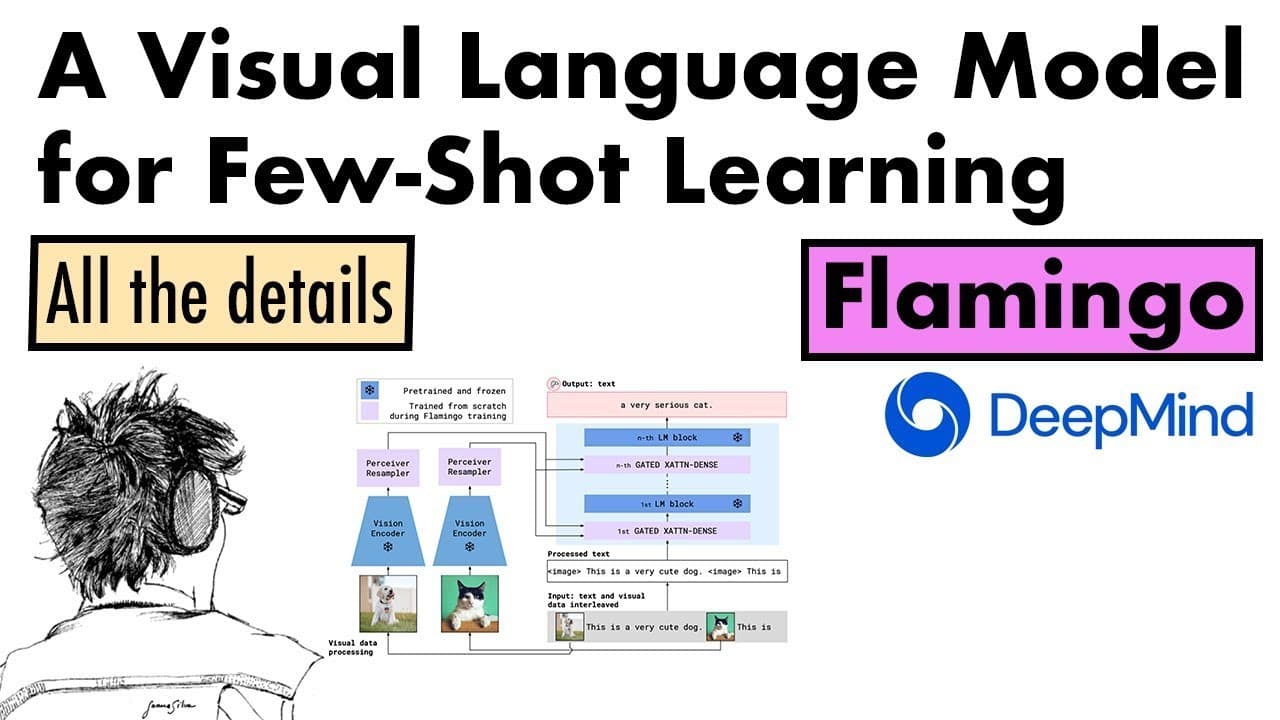
- 😎 Flamingo addresses challenges in multi-modal generative modeling by incorporating cross-attention layers with language-only self-attention layers and using a perceiver-based architecture for handling high-dimensional image and video inputs.
- 😍 Large-scale pre-training on internet-curated data is crucial for training multi-modal models, but data sets for multi-modal data are limited, leading Flamingo to combine web-scraped data with paired image-text and video-text data sets.
- 😊 Flamingo outperforms existing zero-shot and few-shot approaches on multimodal benchmarks, showing the effectiveness of its multi-modal generative modeling approach in a range of tasks.
- 🤩 Increasing the number of shots and scaling up the model size both improve Flamingo's performance, demonstrating the benefits of more training examples and larger models.
- 🙂 Flamingo performs well in zero-shot retrieval tasks, outperforming other methods like Florence, ALIGN, and CLIP on benchmark data sets like Flickr 30k and COCO.
- 😆 Fine-tuning the Flamingo model further improves performance on classification benchmarks, making it competitive with the state of the art that uses fine-tuning on larger data sets.
Install to Summarize YouTube Videos and Get Transcripts
Explore YouTube Video Summarizer or Get YouTube Transcript Extractor
Questions & Answers
Q: How does Flamingo address the challenges of training large language models for multimodal tasks?
Flamingo tackles the challenge of incorporating multimodal inputs by interleaving cross-attention layers with frozen language model layers, allowing for conditioning on visual tokens. It also addresses the challenge of working with high-dimensional visual inputs by using a perceiver resampler to transform them into fixed visual tokens. Finally, Flamingo leverages pre-trained language models and large-scale pre-training on internet data to save computation and improve few-shot learning performance.
Q: What are the advantages of using the perceiver resampler in Flamingo?
The perceiver resampler in Flamingo addresses the challenge of high-dimensional visual inputs by transforming them into a fixed number of visual tokens. This reduces the computational complexity and allows for a unified treatment of both images and videos. The perceiver resampler has been shown to work well in various domains and helps Flamingo achieve its goal of multimodal generative modeling.
Q: How does Flamingo compare to existing fine-tuned models in terms of few-shot learning performance?
Flamingo achieves competitive few-shot learning performance compared to existing fine-tuned models. It often outperforms previous zero-shot or few-shot approaches on multimodal benchmarks and also surpasses the best fine-tuned models on some tasks. Even with only 32 shots, Flamingo can achieve performance similar to models fine-tuned on thousands of labeled examples.
Q: What is the role of pre-training in Flamingo?
Pre-training plays a crucial role in Flamingo by leveraging large pre-trained language models to save computational resources. Flamingo incorporates a vision encoder trained with contrastive loss and a language model pre-trained on a massive text corpus from the internet. This pre-training allows Flamingo to learn the multimodal tasks more efficiently and perform well in few-shot learning scenarios.
Summary & Key Takeaways
-
Flamingo is a multimodal model that aims to leverage large pre-trained language models for few-shot learning tasks in vision and language domains.
-
The model incorporates a vision encoder trained with contrastive loss and a perceiver resampler to transform visual inputs into fixed visual tokens.
-
Gated cross-attention layers are inserted between frozen layers of a pre-trained language model to condition it on visual tokens, allowing for open-ended and close-ended multimodal tasks.
Read in Other Languages (beta)
Share This Summary 📚
Summarize YouTube Videos and Get Video Transcripts with 1-Click
Try YouTube Summary with ChatGPT & Claude or YouTube Transcript Generator
Explore More Summaries from Samuel Albanie 📚

Summarize YouTube Videos and Get Video Transcripts with 1-Click
Try YouTube Summary with ChatGPT & Claude or YouTube Transcript Generator