How to Improve Decision-Making with Annie Duke's Strategies
TL;DR
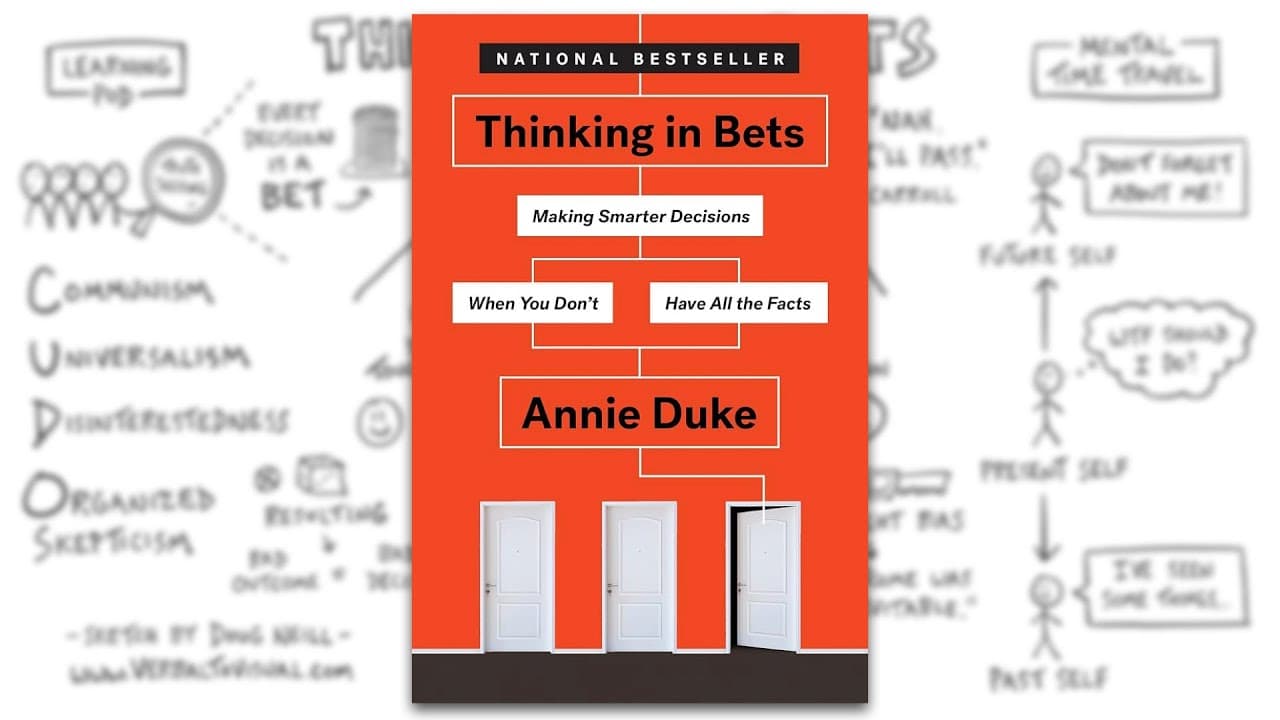
Annie Duke's Thinking in Bets teaches you to approach decisions as probabilistic bets rather than absolute choices. It highlights the importance of understanding potential outcomes, recognizing cognitive biases, and working collaboratively in learning pods to refine your judgment. Techniques like mental time travel and backcasting can enhance your decision-making by considering past experiences and future impacts.
Transcript
hello and welcome to verbal to visual I'm your host Doug Neil and today I'm going to be sharing some of my favorite ideas from this book right here thinking in bets by Annie Duke making smarter decisions when you don't have all the facts Duke is a former professional poker player she won over $4 million in tournaments and pr... Read More
Key Insights
- Annie Duke introduces the concept of an outcome tree, emphasizing that each decision leads to multiple possible futures, not just a single result.
- Duke discusses the common reasoning errors of resulting and hindsight bias, where people incorrectly link decisions directly to outcomes.
- Every decision is a bet with inherent uncertainty, and probabilistic thinking can help manage expectations and outcomes.
- Duke suggests forming learning pods, groups that objectively analyze decisions to improve future decision-making.
- Mental time travel involves considering both past experiences and future consequences when making decisions.
- Backcasting involves planning steps backward from a desired positive outcome, while premortems prepare for potential negative outcomes.
- Probabilistic thinking reduces emotional distress by acknowledging that outcomes are influenced by both skill and luck.
- Duke highlights the value of honest feedback and organized skepticism within a truth-seeking group to enhance decision-making.
Install to Summarize YouTube Videos and Get Transcripts
Explore YouTube Video Summarizer or Get YouTube Transcript Extractor
Questions & Answers
Q: What is the main metaphor used in Thinking in Bets?
The main metaphor used in Thinking in Bets is the outcome tree, which represents the various potential futures that can result from a single decision. This metaphor helps illustrate that decisions are not linear but rather probabilistic, with each choice leading to multiple possible outcomes.
Q: How does Annie Duke address reasoning errors in decision-making?
Annie Duke addresses reasoning errors such as resulting and hindsight bias by explaining how these errors cause people to incorrectly link decisions directly to their outcomes. Resulting involves judging decisions solely based on their outcomes, while hindsight bias makes outcomes seem inevitable. Duke suggests adopting probabilistic thinking to mitigate these errors.
Q: What is the purpose of learning pods according to Annie Duke?
Learning pods are groups that objectively analyze decisions to improve future decision-making. Annie Duke recommends forming these pods to provide honest feedback and organized skepticism, allowing members to evaluate decisions without bias and learn from each other's experiences to make better-informed choices.
Q: What role does mental time travel play in decision-making?
Mental time travel involves considering both past experiences and future consequences when making decisions. By engaging with past and future selves, individuals can gain insights from previous experiences and anticipate the impact of their decisions, leading to more thoughtful and informed choices.
Q: How does backcasting differ from premortems?
Backcasting involves planning steps backward from a desired positive outcome to identify necessary actions to achieve it. In contrast, premortems assume a negative outcome and analyze potential causes and responses to prevent or mitigate it. Both techniques enhance decision-making by considering different scenarios.
Q: What is the significance of probabilistic thinking in decision-making?
Probabilistic thinking acknowledges the uncertainty inherent in decisions, recognizing that outcomes are influenced by both skill and luck. This mindset reduces emotional distress by helping individuals accept that a bad outcome doesn't necessarily indicate a bad decision, and vice versa, promoting a more balanced view of decision-making.
Q: How can organized skepticism improve decision-making?
Organized skepticism involves allowing for dissent and critically evaluating decisions by exploring potential flaws and alternative perspectives. By assigning roles like devil's advocate, groups can challenge assumptions and biases, leading to more robust decision-making processes and better outcomes.
Q: What is the role of feedback in Annie Duke's decision-making framework?
Feedback plays a crucial role in Annie Duke's decision-making framework by providing an honest reflection of past decisions. Within learning pods, feedback helps identify biases and errors, fostering a culture of continuous improvement and enabling individuals to make more informed and objective decisions in the future.
Summary & Key Takeaways
-
Annie Duke's Thinking in Bets encourages probabilistic thinking in decision-making, using the metaphor of an outcome tree to visualize potential futures.
-
Duke identifies reasoning errors like resulting and hindsight bias, advocating for learning pods to collaboratively analyze decisions and improve judgment.
-
Through mental time travel, backcasting, and premortems, individuals can better assess decisions by considering past experiences and future impacts.
Read in Other Languages (beta)
Share This Summary 📚
Summarize YouTube Videos and Get Video Transcripts with 1-Click
Try YouTube Summary with ChatGPT & Claude or YouTube Transcript Generator
Explore More Summaries from Verbal to Visual 📚
Summarize YouTube Videos and Get Video Transcripts with 1-Click
Try YouTube Summary with ChatGPT & Claude or YouTube Transcript Generator