Huge Misconception: Protons, Electrons, Atoms, and Ions
TL;DR
Many people mistakenly believe that the number of protons in an atom always has to equal the number of electrons, but in reality, atoms can have different numbers of protons and electrons, resulting in charged ions.
Transcript
I want to talk about one of the biggest mistakes one of the biggest misconceptions in chemistry so many people think that the number of protons in an atom always has to equal the number of electrons okay let's say I'm making a video and I draw an atom like this okay it's got four protons and two electrons I put an atom like this in my video and bef... Read More
Key Insights
- 😐 The misconception stems from the assumption that atoms are always electrically neutral.
- 🫀 Ions are formed when atoms or groups of atoms have a different number of protons and electrons.
- 😑 Ions can have either a positive or negative charge, depending on the imbalance of protons and electrons.
- 😑 Polyatomic ions, which consist of multiple atoms, can also have different numbers of protons and electrons.
- 😑 Understanding the concept of ions is essential in comprehending chemical compounds and reactions.
- #️⃣ The number of protons determines the element's identity, while the number of electrons contributes to its chemical behavior.
- 🫀 The periodic table provides the atomic number, indicating the number of protons, but assuming the atom is neutral can be misleading.
Install to Summarize YouTube Videos and Get Transcripts
Explore YouTube Video Summarizer or Get YouTube Transcript Extractor
Questions & Answers
Q: Is it true that the number of protons and electrons must be the same in an atom?
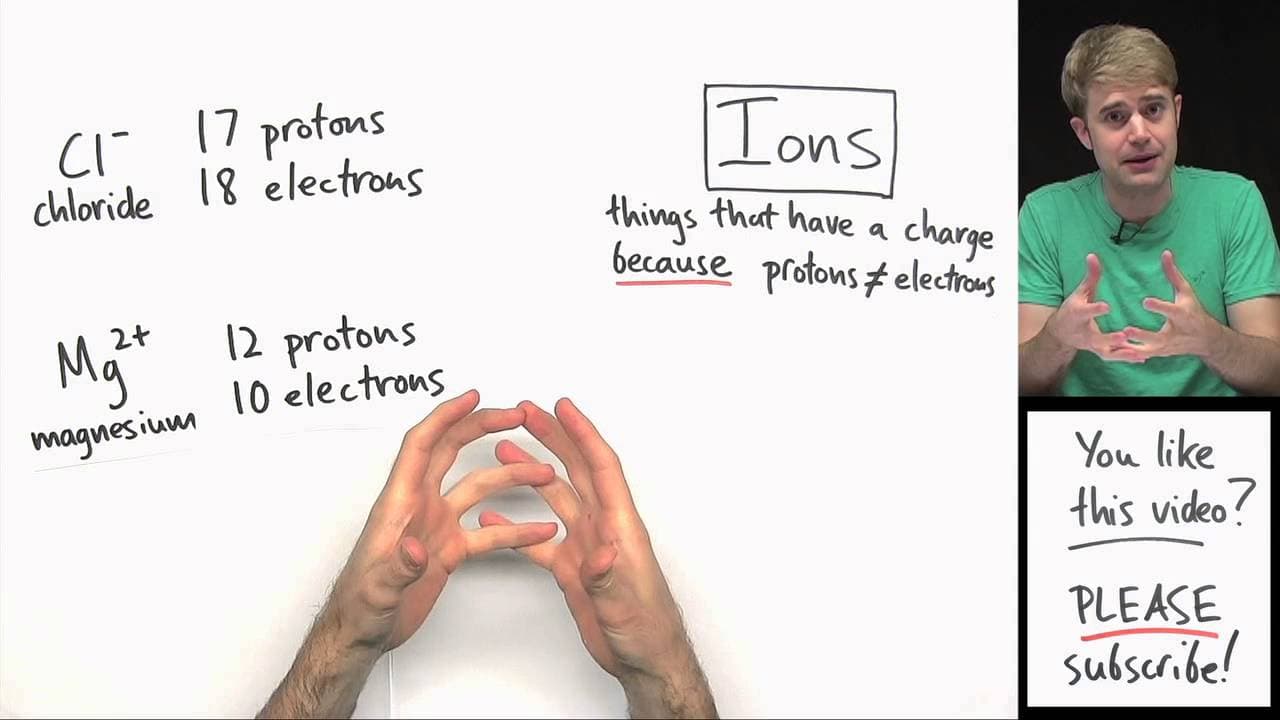
No, atoms can have different numbers of protons and electrons. This misconception arises from the assumption that atoms are electrically neutral, but they can actually have a charge and become ions.
Q: What are some examples of ions with different numbers of protons and electrons?
Examples include chloride (Cl-) with 17 protons and 18 electrons, magnesium (Mg2+) with 12 protons and 10 electrons, and ammonium (NH4+) with 11 protons and 10 electrons.
Q: Can groups of atoms also have different numbers of protons and electrons?
Yes, groups of atoms called polyatomic ions can have a different number of protons and electrons. For instance, phosphate (PO4^3-) has 47 protons and 50 electrons.
Q: Why do people commonly believe that atoms must have the same number of protons and electrons?
This misconception arises from the assumption that atoms are electrically neutral. When atoms are neutral, the number of protons and electrons is usually the same, but ions can exist with different charges.
Summary & Key Takeaways
-
It is commonly believed that the number of protons and electrons in an atom should be equal, but this is not always the case.
-
Atoms or groups of atoms with a different number of protons and electrons have an electrical charge and are called ions.
-
Ions can have positive or negative charges and can be found in various chemical compounds.
Read in Other Languages (beta)
Share This Summary 📚
Summarize YouTube Videos and Get Video Transcripts with 1-Click
Try YouTube Summary with ChatGPT & Claude or YouTube Transcript Generator
Explore More Summaries from Tyler DeWitt 📚

Summarize YouTube Videos and Get Video Transcripts with 1-Click
Try YouTube Summary with ChatGPT & Claude or YouTube Transcript Generator