10 Important Python Concepts In 20 Minutes
TL;DR
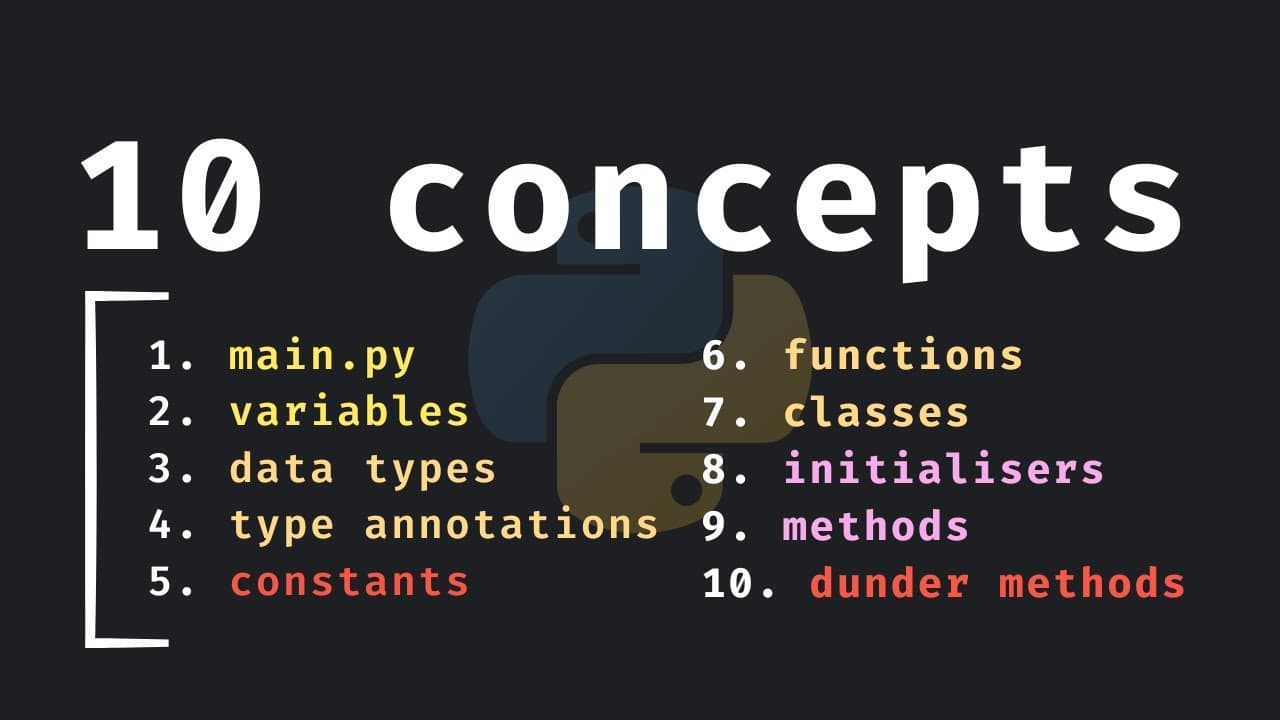
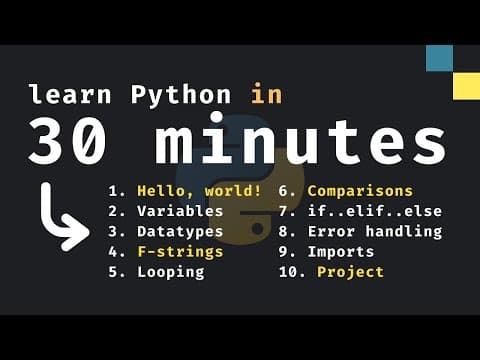
The video covers ten essential Python concepts for beginners.
Transcript
this video was brought to you by IND dentle IO learning python Made Simple how's it going everyone in today's video we're going to be covering 10 python Concepts that you should know about so starting with the first concept after you have downloaded python from python.org or wherever you downloaded it from you can create a f... Read More
Key Insights
- Python files are created with a .py extension, allowing scripts to be executed by the Python interpreter.
- Variables in Python are initialized using an equal sign, allowing for easy reference and modification throughout the program.
- Basic data types in Python include integers, floats, strings, Booleans, lists, tuples, sets, and dictionaries, each serving unique purposes.
- Type annotations in Python help developers by providing warnings for incorrect data types, enhancing code safety without affecting execution.
- Constants in Python can be simulated with type annotations and naming conventions, though they can still be changed at runtime.
- Functions in Python promote code reusability, allowing for parameter customization and return types, thus improving code efficiency and readability.
- Classes in Python act as blueprints for objects, encapsulating data and behavior, and simplifying the creation of multiple instances.
- Dunder methods in Python provide special functionality for classes, such as custom string representations and operator overloading.
Install to Summarize YouTube Videos and Get Transcripts
Explore YouTube Video Summarizer or Get YouTube Transcript Extractor
Questions & Answers
Q: What is the significance of the .py extension in Python?
The .py extension is crucial in Python as it designates a file as a Python script, enabling it to be executed by the Python interpreter. This extension informs the system that the contained code should be processed as Python, allowing for the execution of scripts and programs.
Q: How do variables work in Python?
Variables in Python are created by assigning a value to a name using an equal sign. This allows for easy reference and modification of data throughout the program. Once a variable is defined, it can be used multiple times without retyping the value, enhancing code efficiency and readability.
Q: What are the basic data types in Python?
Python's basic data types include integers, floats, strings, and Booleans. Integers represent whole numbers, floats represent decimal numbers, strings are sequences of characters, and Booleans represent true or false values. These data types form the foundation for more complex data structures like lists, tuples, sets, and dictionaries.
Q: What role do type annotations play in Python?
Type annotations in Python serve as a tool for developers to specify the expected data types of variables and function parameters. They provide warnings for incorrect data types, improving code safety and reducing errors. However, they do not affect the program's execution, acting more as a guide for developers.
Q: How are constants defined in Python?
While Python does not have built-in support for constants, developers can simulate them using type annotations and naming conventions. By using uppercase letters and the 'Final' type annotation, developers can indicate that a variable should not be changed, though this is not enforced by the language.
Q: How do functions enhance code in Python?
Functions in Python enhance code by promoting reusability and modularity. They allow developers to encapsulate code blocks, making them easier to call and reuse. Functions can accept parameters for customization and return results, improving code organization and reducing redundancy.
Q: What are classes and how do they work in Python?
Classes in Python serve as blueprints for creating objects, encapsulating data and behavior. They simplify the creation of multiple instances with shared characteristics. By defining attributes and methods, classes allow for organized and efficient code, supporting object-oriented programming principles.
Q: What are Dunder methods and their purpose in Python?
Dunder methods, or magic methods, in Python provide special functionality for classes. They enable custom behavior for built-in operations, such as string representation and operator overloading. By defining these methods, developers can control how objects interact with Python's syntax and operations, enhancing class functionality.
Summary & Key Takeaways
-
The video introduces ten fundamental Python concepts, starting with how to create and execute Python files using the .py extension.
-
It explains variables, basic data types, and type annotations, emphasizing their importance in writing clean and efficient code.
-
The video delves into functions, classes, and Dunder methods, illustrating how they enhance code reusability and functionality.
Read in Other Languages (beta)
Share This Summary 📚
Summarize YouTube Videos and Get Video Transcripts with 1-Click
Try YouTube Summary with ChatGPT & Claude or YouTube Transcript Generator
Explore More Summaries from Indently 📚

Summarize YouTube Videos and Get Video Transcripts with 1-Click
Try YouTube Summary with ChatGPT & Claude or YouTube Transcript Generator