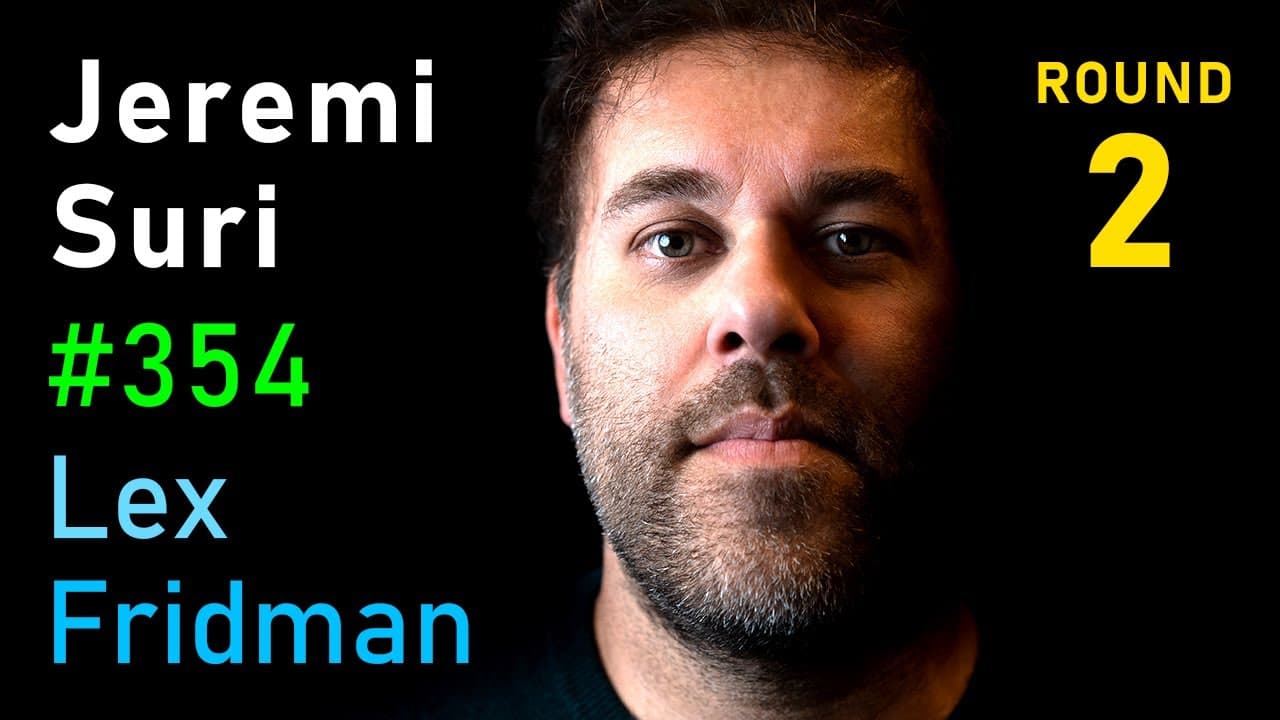
Jeremi Suri: Civil War, Slavery, Freedom, and Democracy | Lex Fridman Podcast #354
TL;DR
America's democratic institutions aim to provide freedom and innovation, yet they are plagued by flaws like exclusion and power imbalances that stunt societal growth. Historian Jeremi Suri emphasizes the need for critical reform rather than blind reverence to promote genuine progress and inclusion within these systems.
Transcript
the war continues after the battle's end this is something that's hard for Americans to understand our system is built with the presumption when War is Over when we signed a piece of paper everyone can go home that's not what happens the following is a conversation with Jeremy Surrey a historian a UT Austin this is the Lex Friedman podcast to suppo... Read More
Key Insights
- 📚 The flaws in American democratic institutions have hindered innovation and growth in society, including flaws of exclusion, power imbalances, and embedded myths. These flaws need to be reformed.
- 🗳️ True leadership involves critiquing institutions to encourage improvement and pushing for necessary reforms, rather than blindly supporting them.
- 🌍 Historically, revolutions that seek to destroy institutions often lead to the most powerful individuals gaining control and perpetuating oppression. Reforming institutions from within and gradually making changes is a more successful approach.
- 🗽 The American Civil War was fought over the expansion of slavery into new territories and the disproportionate power given to slaveholders in the country's institutions.
- ⚖️ Abraham Lincoln advocated for the values of freedom, democracy, and justice, and believed in preserving the Union while stopping the spread of slavery.
- 📰 Freedom of speech is a core tenet of American democracy, but there should be clear rules and guidelines for content moderation to prevent incitement to violence and protect against harmful content.
- 💻 Social media platforms should be transparent about their rules and consistently follow them to create a more productive space for diverse opinions, while still considering the complexities of content moderation at scale.
- 💡 The American Civil War showed the extreme violence humans are capable of, but also demonstrated resilience, empathy, and the potential for personal growth and societal change.
Install to Summarize YouTube Videos and Get Transcripts
Explore YouTube Video Summarizer or Get YouTube Transcript Extractor
Questions & Answers
Q: How did Abraham Lincoln contribute to the fight for equality during the Civil War?
Abraham Lincoln's main goal during the Civil War was to preserve the Union, but he also recognized the importance of ending slavery and ensuring freedom for all. He signed the Emancipation Proclamation, which declared that slaves in Confederate states were free, and he believed in building a society where all individuals had a stake and an opportunity for freedom and success.
Q: How did the Civil War impact the ideals of freedom and democracy in America?
The Civil War was a defining moment for America's ideals of freedom and democracy. It showed that the principles of freedom and equality should be extended to all individuals, regardless of race. The Emancipation Proclamation and the Union victory in the war paved the way for the eventual abolition of slavery and the recognition of the rights of all citizens.
Q: How did the flaws in America's democratic institutions hinder progress during the Civil War?
The flaws in America's democratic institutions, such as exclusion and power imbalances, hindered progress during the Civil War. The Southern states, dominated by slaveholders, held disproportionate power and attempted to expand slavery into new territories. This created a clash with the Northern states, which sought to limit the expansion of slavery and create opportunities for free labor. The flawed institutions allowed for the perpetuation of slavery and hindered the resolution of the conflict.
Q: How did the preservation of the Union contribute to the fight for democracy during the Civil War?
The preservation of the Union was a crucial aspect of the fight for democracy during the Civil War. The Union represented the ideals of freedom, democracy, and equality, and allowing the Confederacy to secede and establish a separate nation would have undermined these principles. By preserving the Union and ultimately abolishing slavery, the fight for democracy was advanced, although challenges and struggles continued in the years following the war.
Summary
In this conversation, historian Jeremy Suri discusses his new book, "Civil War by Other Means: America's Long and Unfinished Fight for Democracy." Suri highlights the flaws in American democratic institutions, particularly in terms of exclusion, power dynamics, and embedded myths. He argues for a critical evaluation of these institutions while also recognizing their virtues.
Questions & Answers
Q: What is the main argument of Jeremy Suri's book?
In his book, Suri argues that American democratic institutions have flaws that hinder innovation and growth in society. He emphasizes flaws of exclusion, giving power based on position rather than skill, and embedded myths that prevent societal progress. Suri calls for a critical evaluation and reform of these institutions.
Q: What are the flaws in American democratic institutions?
The flaws Suri highlights include exclusion of various groups, not just African Americans, and the power given to individuals based on position rather than merit. He also points out the presence of myths that prevent society from gaining the knowledge needed for improvement.
Q: What does Suri mean by the "false reverence for institutions"?
Suri explains that there is a belief that criticizing institutions is somehow wrong if one loves their country. However, he argues that true knowledge leadership involves encouraging institutions to improve rather than blindly supporting them.
Q: What is the counterpoint to Suri's argument?
The counterpoint is the extreme cynicism towards institutions, which can paralyze progress. While a healthy skepticism is essential, complete cynicism is not productive. Suri suggests finding a middle ground and working towards improving institutions from within.
Q: Should institutions be burned down and started anew, or should they be fixed from within?
Historically, there have been calls to burn down institutions and start from scratch, but this approach often leads to negative consequences. Suri's argument is that working through institutions and gradually making changes is a better approach. However, he warns against becoming too invested in institutions and encourages maintaining an outsider perspective for innovative ideas.
Q: How did the American Civil War start?
The Civil War was triggered by the flaws in American institutions, particularly the disproportionate power given to slaveholders. The Confederate states, relying on slavery and wanting to expand it, went to war with the Union, which sought to stop the spread of slavery in new territories.
Q: Who were the main parties involved in the war?
The Union, comprised of states north of Virginia, had a population of around 22 million. The Confederacy, made up of states south of the Mason-Dixon line, had a smaller population of around 9 million, along with 4 million slaves. The Union had a much larger army throughout the war.
Q: Was conscription present in the Civil War?
Initially, the Union relied on volunteers, but as the war progressed, they enacted conscription acts in 1862 and 1863, giving Lincoln the power to force men into the army. The Confederate states also conscripted soldiers. The Union army was significantly larger throughout the war.
Q: What role did the idea of all men being created equal play in the Civil War?
The idea of equality was complex during the time of the Civil War. Many Americans saw equality as dependent on others doing the work for them, which justified slavery. Abraham Lincoln sought to defend the core values of the country, including freedom, democracy, and justice, in his argument against slavery.
Q: How did Abraham Lincoln view slavery?
Lincoln saw slavery as a terrible institution. While he didn't initially advocate for abolition, he eventually supported it. His main goal was to stop the spread of slavery, rather than eradicate it entirely. He recognized the importance of freedom, democracy, and justice in building a better society.
Q: What can history teach us about human nature?
History shows the potential for humans to do harm and brutality to one another. Slavery and genocide are examples of this. However, history also demonstrates that with proper leadership and institutions, humans can resist these urges and channel their energies into productive and positive endeavors.
Takeaways
Suri's book and this conversation highlight the flaws in American democratic institutions and the need for reform. While the system has virtues, it is hindered by exclusion, power imbalances, and embedded myths. Suri argues for a critical evaluation of institutions and a focus on freedom, democracy, and justice. He emphasizes the importance of storytelling, leadership, and public discourse in bringing about positive change. Furthermore, history teaches us that humans have the capacity for both harm and good, and it is up to us to shape our institutions to encourage progress and civilized behavior.
Summary & Key Takeaways
-
America's democratic institutions have virtues that improve society, but also flaws that hinder progress.
-
Flaws include exclusion of various groups, power given based on position rather than merit, and embedded myths that prevent knowledge and improvement.
-
Historian Jeremy Surrey argues that it is important to criticize and reform institutions to encourage their improvement, rather than blindly revering them.
Read in Other Languages (beta)
Share This Summary 📚
Summarize YouTube Videos and Get Video Transcripts with 1-Click
Try YouTube Summary with ChatGPT & Claude or YouTube Transcript Generator
Explore More Summaries from Lex Fridman Podcast 📚



Summarize YouTube Videos and Get Video Transcripts with 1-Click
Try YouTube Summary with ChatGPT & Claude or YouTube Transcript Generator