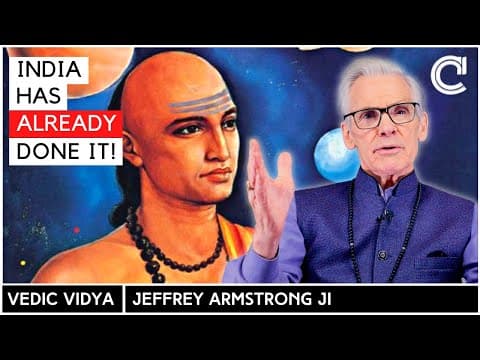
"Christianity & Islam rely on BLIND faith; Hinduism the opposite." Jeffrey Armstrong | Vedic Vidya

TL;DR
This video discusses the Dharma culture of India and compares it to the faith-based beliefs of the three Abrahamic religions, highlighting the importance of inquiry and understanding in the Vedic tradition.
Transcript
namaste welcome to Vedic Vidya my name is Jeffrey Armstrong kavanger Rishi Vedic Vidya is available exclusively on chitty media English Channel and Sunday nights at 7 pm ist our topic tonight is what is the Dharma culture of India compared to the face of the three abrahamic religions or why the three world religions of Judaism Christianity and Isla... Read More
Key Insights
- 🤝 It is important to respect and honor people of different religious beliefs and perspectives, as long as they are peaceful and friendly.
- 🔎 The misuse of religion in history, such as violence and oppression, does not truly represent the essence of religion itself, but rather reflects self-interest under the guise of faith.
- 🌍 The Sanskrit language, with its scientific and precise nature, supports inquiry and knowledge-seeking, which is essential for a Dharma culture, a culture rooted in knowing and conforming to the laws of nature.
- 🧩 The Dharma of each individual and thing is its particular essential nature, and understanding and conforming to this Dharma brings harmony and cooperation with the laws of nature.
- 🔄 Cause and effect scientifically speaking is referred to as karma in the Vedic worldview, and it is through this understanding of karma that the essence of something is revealed and analyzed. ⏳ Time plays a significant role in Dharma and Karma, as Dharma unfolds over time and Karma reflects the chains of cause and effect across lifetimes.
- ❓ The Vedic worldview differs from the three Abrahamic religions in that it embraces reincarnation and multiple lifetimes, as opposed to a one-off lifetime belief in the Abrahamic religions.
- 🤔 The Vedic worldview provides a larger, more expansive understanding of existence and the universe, allowing for exploration and learning over an unlimited amount of time, in contrast to the limited and often fear-based perspective of a one-time existence.
Install to Summarize YouTube Videos and Get Transcripts
Explore YouTube Video Summarizer or Get YouTube Transcript Extractor
Questions & Answers
Q: How does the Vedic approach to religion and spirituality differ from faith-based beliefs?
In the Vedic tradition, there is an emphasis on inquiry, questioning, and direct knowing, whereas faith-based beliefs rely more on blind faith and acceptance without questioning. Vedic culture encourages individuals to explore the laws of nature, karma, and their own Dharma through inquiry and understanding.
Q: What is the significance of Dharma in the Vedic culture?
Dharma represents the essential nature and purpose of everything in the universe. It defines how each entity functions and interacts with other elements. Understanding and conforming to Dharma allows individuals to live in harmony with nature and the laws of the universe.
Q: What is the role of karma in the Vedic tradition?
Karma refers to the scientific principle of cause and effect. In the Vedic culture, it is understood that every action has consequences and that individuals are responsible for their actions. Karma explains how the universe operates through chains of cause and effect, and it unfolds over time, often spanning multiple lifetimes.
Q: How does the Vedic worldview differ from the beliefs of the three Abrahamic religions?
The Vedic worldview recognizes the existence of multiple lifetimes, the exploration of knowledge through inquiry, and the idea of immortality. In contrast, the three Abrahamic religions focus on a single lifetime, blind faith, and the potential for eternal damnation or reward based on one's actions in that lifetime.
Summary & Key Takeaways
-
The video emphasizes the importance of respecting different perspectives and learning processes when it comes to religion and spirituality.
-
It introduces the concept of Dharma as the essential nature and purpose of everything in the universe, contrasting it with faith-based beliefs.
-
The video explores the Vedic approach of inquiry and direct knowing, as opposed to blind faith, and highlights the significance of understanding karma, Dharma, and the laws of nature.
Read in Other Languages (beta)
Share This Summary 📚
Summarize YouTube Videos and Get Video Transcripts with 1-Click
Try YouTube Summary with ChatGPT & Claude or YouTube Transcript Generator
Explore More Summaries from Citti Media 📚
Summarize YouTube Videos and Get Video Transcripts with 1-Click
Try YouTube Summary with ChatGPT & Claude or YouTube Transcript Generator