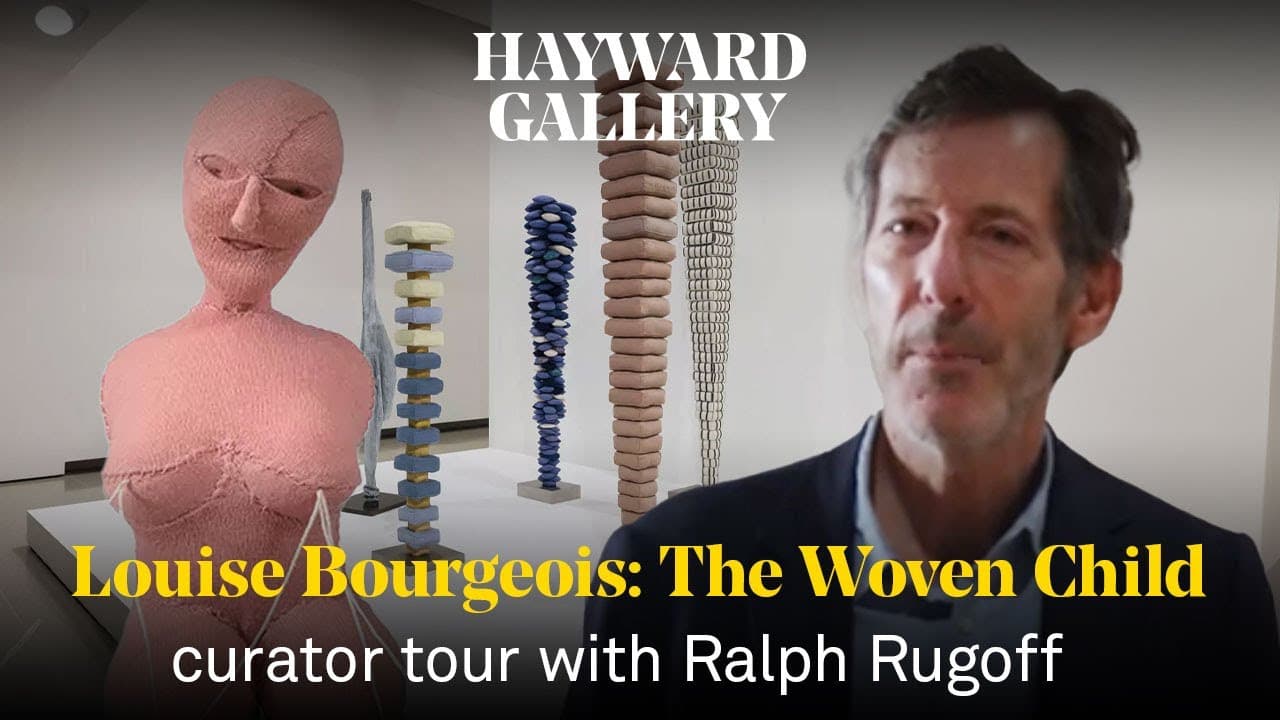
Louise Bourgeois: The Woven Child | curator tour with Ralph Rugoff
TL;DR
Louise Bourgeois used fabric to transform personal memories into sculptures that hold conflicting emotions and imaginative associations. Beginning this work in her early 80s, she drew on saved clothes, linens, handkerchiefs, tablecloths, and towels connected to people in her life. Her visible stitching frames the needle as a healing force while leaving each act of repair exposed, making it worth reading on to explore the works’ emotional layers.
Transcript
it wasn't until louise bourgeois was in her early 80s that she began working with fabric of different kinds and throughout her entire life she'd been a magnificent hoarder she'd never threw anything away she had the clothes her mother wore she had her clothes from throughout her life linens handkerchiefs tablecloths towels all this material she ass... Read More
Key Insights
- ❓ Louise Bourgeois transitioned from hoarding to creating textile sculptures in her later years, reflecting on memory and transformation.
- 🫥 The deliberate and visible stitching in Bourgeois' sculptures carries a raw and healing quality, emphasizing imperfections and honesty in her craft.
- 🧡 Bourgeois' sculptures like "Rejection" evoke a range of emotions, from pain to laughter, showcasing the complexity of human feelings.
- 🫵 Exploring Bourgeois' artwork can be intense and visceral, challenging viewers to confront their own emotional tensions and responses.
Install to Summarize YouTube Videos and Get Transcripts
Explore YouTube Video Summarizer or Get YouTube Transcript Extractor
Questions & Answers
Q: What is Louise Bourgeois: The Woven Child about?
The exhibition focuses on the fabric works Louise Bourgeois began making in her early 80s. These sculptures use saved textiles to explore memory, imaginative transformation, repair, and contradictory emotions.
Q: Why did Louise Bourgeois use old clothes and household fabrics in her art?
Bourgeois had kept clothes worn by herself and her mother, along with linens, handkerchiefs, tablecloths, and towels. She associated these materials with different people in her life, so they allowed her to look back through memory.
Q: When did Louise Bourgeois begin working with fabric?
She began working with different kinds of fabric in her early 80s. In 1998, she made her first sculpture of a head from fabric.
Q: How did Louise Bourgeois’s childhood connect to her later fabric sculptures?
As a child, Bourgeois grew up around the tapestry workshop that her mother supervised in the family business in France. Her late return to fabric recalled that background, although her own approach was very different.
Q: What did memory mean in Louise Bourgeois’s fabric works?
The works suggest that the past held in memory is transformed by imagination rather than preserved as reality. Bourgeois connected this process to playful transformations associated with fairy tales and myths, while recognizing that an altered memory can still affect the present.
Q: Why are the stitches so visible in Louise Bourgeois’s sculptures?
Bourgeois described the needle as a healing force associated with repair. At the same time, she deliberately left the needle’s traces visible, giving some fabric heads a Frankenstein-like appearance assembled from elements of different bodies.
Q: What emotions does Louise Bourgeois’s sculpture Rejection express?
Rejection can initially resemble a person in great pain, but another look may reveal someone laughing. Its open-ended form resists a single emotion and reflects Bourgeois’s interest in conflicting or contradictory feelings.
Q: What is it like to view Louise Bourgeois’s fabric sculptures?
The sculptures give form to emotional tensions that viewers may feel in their own bodies. Looking at them can be illuminating, embarrassing, tough, and intensely visceral, while their many associations and layers of resonance make exploration rewarding.
Summary & Key Takeaways
-
Louise Bourgeois started working with fabric in her 80s, reflecting on memory through collected materials associated with people in her life.
-
Her sculptures, like "Rejection," embody contradictory emotions, allowing viewers to experience a range of feelings and interpretations.
-
Bourgeois' deliberate sewing with visible traces of the needle imparts a strong and raw essence to her textile artworks.
Read in Other Languages (beta)
Share This Summary 📚
Summarize YouTube Videos and Get Video Transcripts with 1-Click
Try YouTube Summary with ChatGPT & Claude or YouTube Transcript Generator
Explore More Summaries from Southbank Centre 📚





Summarize YouTube Videos and Get Video Transcripts with 1-Click
Try YouTube Summary with ChatGPT & Claude or YouTube Transcript Generator