How to Use One Hot Encoding in TensorFlow.js
TL;DR
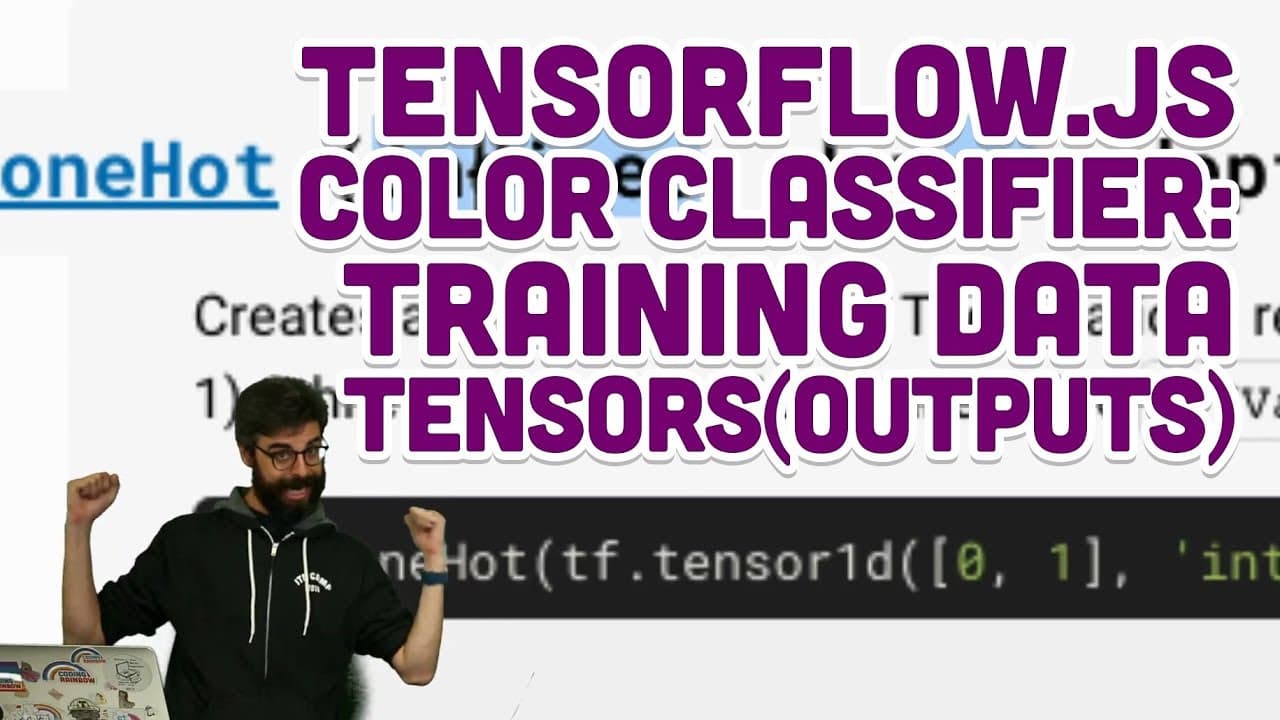
One hot encoding transforms categorical color labels into a binary vector representation required for neural network models. Each label is converted to an array where only one position is marked with a 1, indicating the active category, while others remain 0s. This method facilitates accurate training in machine learning by allowing the model to predict probabilities for each color category.
Transcript
okay we're still working with our data at some point we're gonna start training a model what have I done so far okay so just to recap for a second I've got this whole database of crowd-sourced colors with a label and now I've converted all that stuff to tensors so and I'm just looking at the inputs now the inputs that I want to use for my machine l... Read More
Key Insights
- 🎰 Crowd-sourced colors converted to tensors for machine learning.
- 😅 Introduction to one hot encoding for categorical label representations.
- 📽️ Utilizing TensorFlow.js for efficient data manipulation in neural network projects.
- 😫 Importance of dividing data into training and testing sets for model evaluation.
- 🎨 Architecture design and fitting steps crucial for completing the color classifier project.
- ❓ Memory management considerations and cleanup for efficient TensorFlow.js usage.
- 😵 Future introduction of softmax and cross-entropy concepts in the neural network model.
Install to Summarize YouTube Videos and Get Transcripts
Explore YouTube Video Summarizer or Get YouTube Transcript Extractor
Questions & Answers
Q: What is the significance of converting color labels to one hot encoding?
One hot encoding allows for representing categorical data numerically, crucial for training neural networks to predict color labels accurately.
Q: How does TensorFlow.js simplify the process of creating one hot vectors?
TensorFlow.js provides a convenient TF.oneHot function to efficiently convert categorical labels into one hot encoded vectors for machine learning tasks.
Q: Why is dividing data into training and testing sets essential in machine learning?
Splitting data into training and testing sets helps evaluate the model's performance on unseen data and prevents overfitting during the training process.
Q: What upcoming steps are necessary for completing the color classifier project?
The next steps involve architecting the neural network model, fitting it with the prepared data, and potentially addressing memory management considerations for optimization.
Summary & Key Takeaways
-
Converting crowd-sourced color data into tensors for machine learning.
-
Exploring the concept of one hot encoding for target outputs.
-
Utilizing TensorFlow.js for creating one hot vectors and preparing data for neural network training.
Read in Other Languages (beta)
Share This Summary 📚
Summarize YouTube Videos and Get Video Transcripts with 1-Click
Try YouTube Summary with ChatGPT & Claude or YouTube Transcript Generator
Explore More Summaries from The Coding Train 📚






Summarize YouTube Videos and Get Video Transcripts with 1-Click
Try YouTube Summary with ChatGPT & Claude or YouTube Transcript Generator