What Is Q-Learning and How Does It Work in Reinforcement Learning?
TL;DR
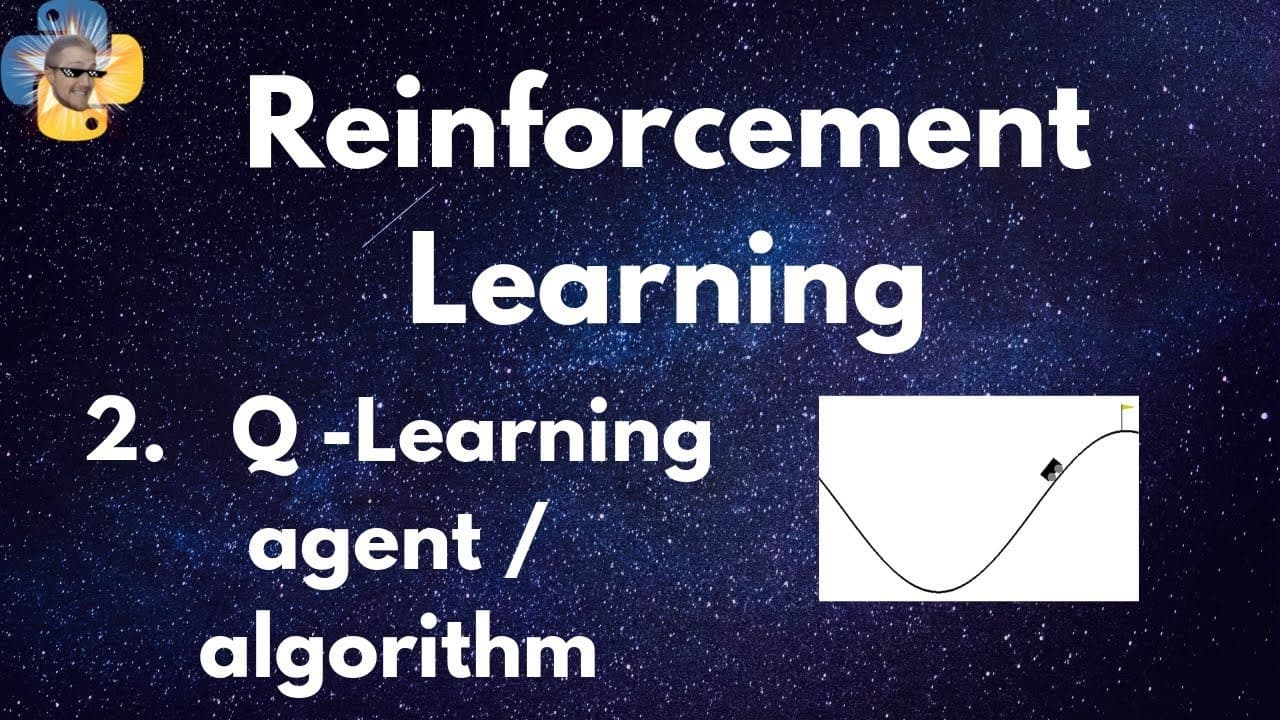
Q-learning is a reinforcement learning algorithm where an agent learns to maximize rewards by updating a Q-table based on the learning rate and discount factors. It converts continuous states into discrete states for easier processing and uses a defined formula to update Q-values based on current and future rewards. Epsilon is also introduced to balance exploration and exploitation during learning.
Transcript
what is going on everybody and welcome to part 2 of the reinforcement learning series as well as part 2 of doing cue learning in this video we are hopefully gonna finish this agent and we will have it traversing up a mountain in no time so where we left off we initialized our cute table but the cute table just has random values and now we're ready ... Read More
Key Insights
- ☠️ Learning rate and discount parameters determine the speed and prioritization of learning in Q-learning.
- 😆 Discrete state space allows for easier representation and update of Q-values.
- 🇶🇦 The Q-value formula combines current and future rewards to update the Q-table.
Install to Summarize YouTube Videos and Get Transcripts
Explore YouTube Video Summarizer or Get YouTube Transcript Extractor
Questions & Answers
Q: What is the purpose of the learning rate in Q-learning?
The learning rate determines how quickly the agent updates its Q-values based on new information. A higher learning rate means faster adaptation, while a lower learning rate means more gradual learning.
Q: How does the discount parameter affect Q-learning?
The discount parameter determines the importance of current rewards compared to future rewards. A higher discount rate values future rewards more, while a lower discount rate prioritizes immediate rewards.
Q: What is the purpose of the discrete state space in Q-learning?
The discrete state space allows the agent to represent continuous states in a discrete format, making it easier to estimate and update Q-values for each state-action pair.
Q: How does the exploration parameter, epsilon, influence the agent's actions?
Epsilon controls the trade-off between exploration and exploitation. A higher epsilon value makes the agent more likely to take random actions and explore the environment, while a lower value makes it more likely to exploit the existing knowledge.
Summary & Key Takeaways
-
The video starts by introducing the learning rate and discount parameters, which control how much the agent values future actions and rewards.
-
The discrete state space is introduced, and a helper function is created to convert continuous states to discrete states.
-
The Q-value formula is explained, which updates the Q-table based on current and future rewards.
-
The exploration parameter, epsilon, is implemented to balance exploration and exploitation in the agent's actions.
Read in Other Languages (beta)
Share This Summary 📚
Summarize YouTube Videos and Get Video Transcripts with 1-Click
Try YouTube Summary with ChatGPT & Claude or YouTube Transcript Generator
Explore More Summaries from sentdex 📚
Summarize YouTube Videos and Get Video Transcripts with 1-Click
Try YouTube Summary with ChatGPT & Claude or YouTube Transcript Generator